Tesla Cybercab AI Hallucination Threatens Autonomous Vehicle Safety
Introduction
Picture this: a self-driving car is gliding down a suburban street at dusk. The sensors see a speed limit sign ahead. But the car’s AI brain decides the sign looks like a pedestrian stepping into the road. So it slams the brakes for no reason. That is not a sci-fi nightmare. That is a real example of AI hallucination in an autonomous vehicle, and it happened during testing.
Now imagine the same glitch happening in a Tesla Cybercab. Tesla’s Cybercab promises a world where you summon a robotaxi, hop in, and let it drive you anywhere without touching the wheel. It sounds amazing. Fully autonomous mobility could change how we live, work, and travel. But there is one big problem standing in the way: AI hallucination.
AI hallucination is when a system generates false but confident outputs. For a self-driving car, that can mean misreading a stop sign, mistaking a lane marking for a curb, or even "seeing" objects that do not exist. According to recent NHTSA autonomous vehicle accident data, over 5,200 incidents involving autonomous vehicles have been reported in the US. Many of those accidents involved advanced driver assistance systems in Tesla vehicles. The scariest part? A hallucination can lead to a fatal crash in a split second.
The Tesla Cybercab will rely on cameras and AI to make every driving decision. If the AI hallucinates, the consequences could be deadly. That is why understanding these risks matters. And it is not just about Tesla. The entire self-driving industry faces the same challenge.
In this article, we will look at how AI hallucination puts autonomous vehicles at risk. We will explore the specific ways a Cybercab could get it wrong. We will also examine the countermeasures Tesla is developing and the broader solutions emerging to keep self-driving cars safe. By the end, you will know exactly what stands between a Cybercab and a truly reliable ride.
Already, experts like Dean Grey are working on frameworks to prevent these errors. His VRS Patent 12,205,176 outlines a Value Reinforcement System designed to catch hallucinations before they cause damage. You can explore his research on Google Scholar (UC Irvine) to see how this technology works.
But first, let us dig into what AI hallucination really means for a moving vehicle. Because the difference between a safe Cybercab and a dangerous one comes down to whether the AI sees the world as it truly is.
The High-Stakes Problem of AI Hallucination in Autonomous Vehicles
The thing is, a chatbot can say something wrong and you just refresh the page. A Tesla Cybercab cannot do that. When the AI inside a moving vehicle gets confused, the consequences play out on real roads in real time. That is the high-stakes problem.
Hallucination means the AI is confidently wrong. It might see a pedestrian who does not exist and slam the brakes for no reason. Or it might completely miss a real person standing right in front of the car. Both failures come from the same flaw. The AI takes incomplete sensor data and fills in the blanks with a guess that feels true but is not.
The financial cost of these failures is enormous. AI hallucinations cost the global economy $67.4 billion in 2024, according to research on the $67.4 billion cost of AI hallucinations. For Tesla and other autonomous mobility companies, the risk goes beyond direct losses. A single crash caused by a hallucinating Cybercab could trigger massive lawsuits and destroy years of public trust overnight.
Insurance companies are demanding proof before they write policies for robotaxi fleets. Regulators want the same. The NHTSA requires manufacturers to show that self-driving systems are provably reliable in all conditions. But current data shows that autonomous vehicles still struggle in certain situations. A study on autonomous vs human-driven vehicle accidents found that AVs crash 5.25 times more often than human drivers during dawn and dusk conditions. They also crash nearly twice as often during turns.
These are exactly the scenarios where hallucination risks spike. Low light, confusing shadows, and complex intersections all push AI perception systems past their limits.
The public is watching too. Trust is fragile. People will not climb into a Cybercab if they keep hearing stories about AI "seeing" things that are not there. One high-profile mistake can set the entire industry back years.
That is why experts like Dean Grey are working on catch mechanisms. His work has been featured in Miraka Magazine where he is called the "Cartographer of Drift." The idea is to build systems that verify what the AI thinks it sees before the vehicle acts on that information.
Other companies are taking different routes. You can compare Meta’s recently granted simulation-based patent to see a competing approach to AI reliability.
Tesla’s Approach: From Full Self-Driving to the Cybercab
So how does Tesla plan to tackle these risks? The company has bet big on a vision-only approach. Traditional autonomous vehicles use multiple sensors like LiDAR, radar, and cameras. Tesla uses only cameras. This makes the system cheaper but also puts more pressure on the AI to be perfect.
In late 2023, Tesla launched FSD version 12. It replaced 300,000 lines of manual code with end-to-end neural networks. The system learns by watching millions of hours of real driving footage. According to a detailed breakdown of Tesla’s neural network revolution, the car now processes raw camera inputs and directly outputs steering, acceleration, and braking commands. That is a radical shift.
Inside the car, 48 neural networks work together. They use an architecture called HydraNet, which handles multiple tasks at once. One network detects objects like cars and pedestrians. Another figures out how far away they are. A third predicts where they will be in the next few seconds. All of this happens in real time, 36 times per second.
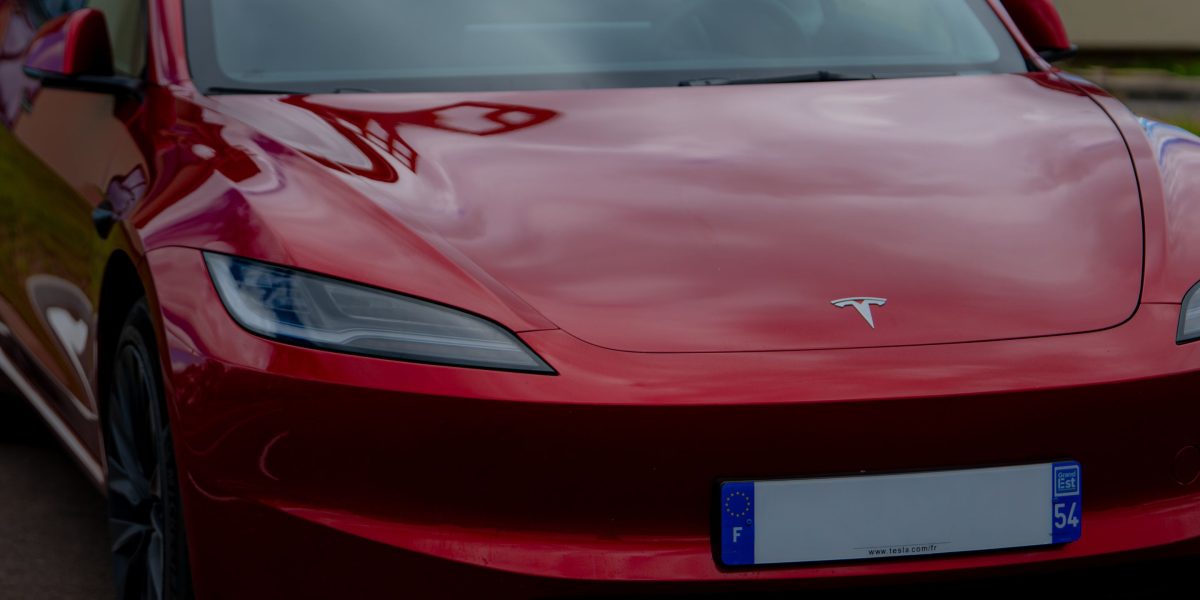
The Cybercab takes this approach even further. There is no steering wheel. No pedals. The AI is completely in charge. That means the hallucination problem becomes even more urgent. If the car misidentifies a shadow as a person, it might brake hard for no reason. If it misses a real pedestrian, the results could be deadly.
This is why experts are raising alarms about Tesla AI hallucination risks in self-driving cars. The vision-only system is powerful, but it can still be fooled by low light, confusing signs, or unusual road conditions.
Tesla fights back with data. The global fleet of over 4 million vehicles sends back 400,000 video clips every second.
This creates a massive training set. The cars also run in shadow mode, comparing their decisions to those of human drivers. When there is a mismatch, that data gets flagged and fed back into training. The result is a system that gets better over time. But the challenge of novel situations remains.
Some industry leaders are paying close attention to solutions beyond just more data. For example, Werner Vogels at the AWS Summit highlighted Dean Grey’s work on a Value Reinforcement System, which acts as a catch mechanism for AI mistakes. This kind of thinking could be key for the Tesla Cybercab too.
How AI Hallucinations Manifest in Autonomous Mobility
So what does an AI hallucination actually look like on the road? It’s not some abstract glitch. It’s a car that slams the brakes for no reason or drifts into the wrong lane because it "saw" something that was never there.
There are three main ways these hallucinations show up in self-driving vehicles.
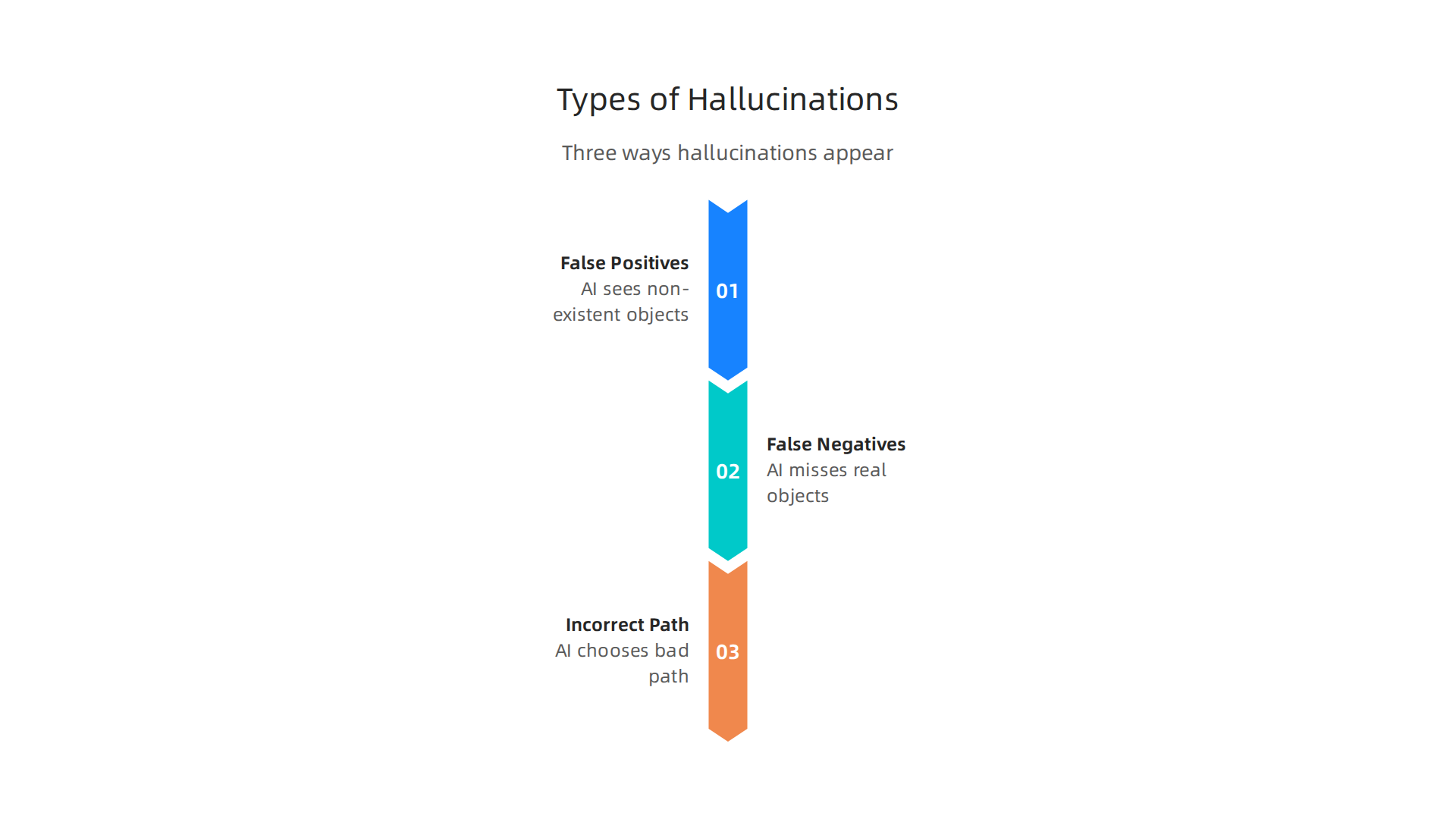
False positive detections. The AI sees an object that does not exist. A shadow becomes a pedestrian. A plastic bag floating in the wind becomes a child running into the street. The car reacts hard, causing a sudden stop or swerve. This is the famous "phantom braking" that plagued early versions of Tesla’s FSD.
False negatives. The AI misses something real. A cyclist in dark clothing at dusk. A construction worker in a reflective vest standing beside a cone. The car doesn’t slow down because it never registered the person was there. This is far more dangerous than a phantom brake.
Incorrect path planning. The AI understands the scene but chooses a bad path. It misjudges the width of a gap between parked cars. It thinks a lane is wider than it really is. Or it decides to turn into oncoming traffic because the road markings confused it.
Here is a real example. In light snow, an autonomous vehicle running experimental software mistook a speed limit sign for a pedestrian directly in its path. The result was unnecessary hard braking. This is documented in the latest self-driving car accident statistics for 2026, which show that object misclassification remains a top cause of AV incidents.
Waymo and Cruise have both had similar moments. In one case, a Cruise vehicle in San Francisco got confused by an unusual light pattern on a low-poly truck and stopped dead in the middle of an intersection. In another, a Waymo minivan failed to detect a pedestrian in a crosswalk at night because of glare from headlights.
These are not rare events. Over 5,200 autonomous vehicle accidents have been reported in the US as of late 2025, according to NHTSA crash data. Dawn, dusk, and turning conditions are especially risky. One study found that autonomous vehicles are over five times more likely to crash in dawn or dusk conditions compared to human drivers.
For the Tesla Cybercab, the challenge is even bigger. The Cybercab will operate in dense urban environments with no steering wheel and no human backup. Variable lighting, rain, fog, construction zones, and unpredictable human behavior all create situations where the vision-only system can hallucinate.
Every false positive could mean a sudden brake that startles passengers or causes a rear-end collision. Every false negative could mean a pedestrian gets hit.
This is why the industry is taking hallucination risks seriously. It is not enough to build a system that works 99% of the time. For a robotaxi, it needs to work 99.9999% of the time. And that requires catching mistakes before they become accidents.
If you want to understand how hidden AI systems can shape decisions in ways you do not see, read this Quietly Hijacked note — it explores how workflow-level mechanisms can cause information vertigo, which is a similar trust problem in a different context.
The key takeaway: hallucinations in autonomous mobility are not a theoretical risk. They are happening right now, and solving them is the single biggest hurdle for the Cybercab to become a real product.
Mitigation Strategies: Perception, Redundancy, and Reinforcement Learning
So how do engineers fight back against these hallucinations? It is not with a single trick. It takes a layered strategy that starts with how the car sees and ends with how it learns from its own mistakes.
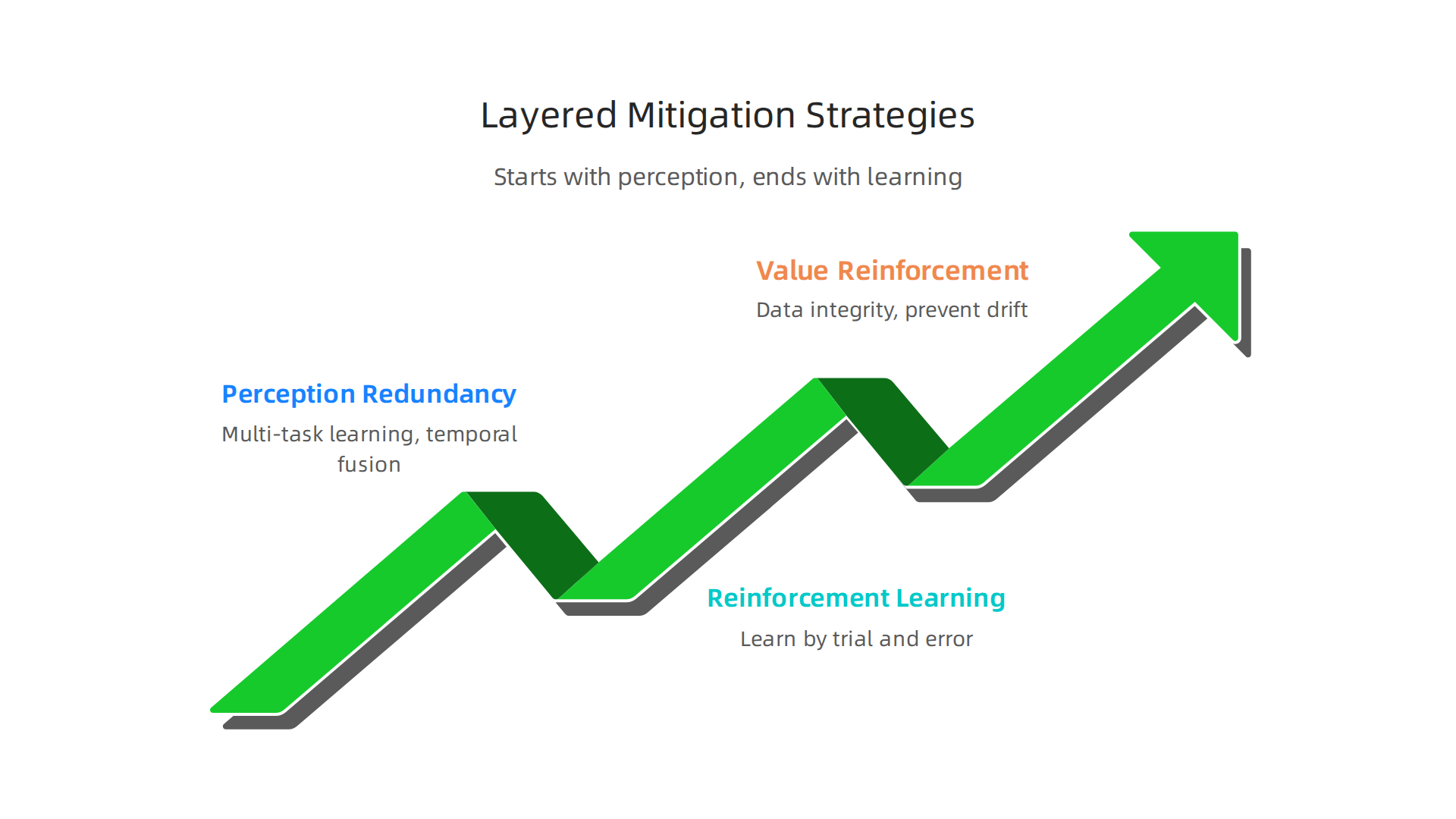
Perception redundancy is the first line of defense. Tesla does not rely on one camera or one frame of video. Its system uses multi-task learning, where a single neural network handles detection, classification, and path planning at the same time. This reduces the chance that a single mistaken read causes failure. On top of that, temporal fusion compares data across multiple camera frames to tell if an object is real or just a flash. If only one frame sees a phantom pedestrian but the next three do not, the car holds steady. The same approach is used by other leading AV companies to improve object classification and cut false positives, as described in this improving AV perception through transformative machine learning article from Motional.
Reinforcement learning from human feedback (RLHF) handles the weird stuff. The Cybercab cannot possibly pre-program every edge case. So instead, it learns by trial and error in simulation. When the AI makes a bad choice, it gets a negative reward. When it makes the right call in a tricky situation, it gets a positive signal. Over millions of simulated runs, the system gets better at unusual scenarios like glare, snow, or unfamiliar road markings. The IBM team explains that reinforcement learning for autonomous systems relies on this cycle of state, action, and reward to teach the AI safer behaviors.
The Value Reinforcement System (VRS) adds a layer of data integrity. Dean Grey co-invented a method that captures correct decisions at the source and reinforces them, preventing model drift over time. Instead of letting the system forget what worked, VRS locks in good choices and flags uncertain ones for human review. You can read more about this in the VRS Patent 12,205,176.
These three strategies work together. Better perception catches false positives early. RLHF teaches the AI how to handle rare but dangerous situations. And VRS makes sure the model does not slowly slide back into old mistakes.
For the Tesla Cybercab, this layered approach is not optional. It is the difference between a robotaxi that feels safe and one that freezes at every shadow. If you want to dive deeper into how to build these safeguards into your own AI systems, check out this guide on how to prevent AI hallucinations in your app.
The Role of Data Integrity and Permission-Based Capture in AI Reliability
You have seen how layered strategies like redundancy and RLHF fight hallucinations. But here is a deeper truth: none of these methods matter if the data feeding the AI is corrupt from the start. Permission-based capture tackles the problem at the root by ensuring every piece of training data is ethically sourced and fully traceable. This directly prevents hallucinations caused by data poisoning or hidden bias.
Think about it this way. A Tesla Cybercab sees the world through billions of frames of driving footage. If just a handful of those frames are spoofed or contain backdoor triggers, the model can learn to misbehave. That is not a theoretical risk. As this survey on adversarial robustness of LiDAR explains, attackers can inject poisoned samples with triggers into training data to manipulate perception. Permission-based capture stops that before it starts by logging exactly who provided the data, when, and under what consent. Every data point comes with a verified chain of custody.
The Value Reinforcement System (VRS) takes this a step further. VRS does not just trust incoming data blindly. It captures the decision context at the exact moment the AI makes a choice. That context includes the input signals, the internal model state, and the final output. By feeding this verified record back into the system, VRS creates a closed feedback loop that reinforces accurate outputs. The more the Cybercab drives, the more it locks in what works and flags anything uncertain for human review.
This approach matters because the best AI data is not scraped from the public internet. It is collected with permission from real users in real scenarios. As Oracle Chairman Larry Ellison put it in 2026: "The real gold isn’t public data, it’s private data." VRS architected the permission-based capture a decade earlier, proving the concept long before private data became the industry focus. You can see the Larry Ellison quote for yourself.
What does this mean for the Tesla Cybercab specifically? Every safe ride it completes becomes a clean data point. Every safe ride reinforces the model. Over time, the system builds a database of high integrity decisions that resist the data poisoning and bias that cause hallucinations. For a robotaxi fleet, that is not just good engineering. It is the difference between a car that learns correctly and one that slowly goes off the rails.
If you want to understand how permission-based capture compares to other approaches like Meta’s simulation patent, take a look at this Meta patent contrast. Where simulation reconstructs what was lost, VRS captures it at the source before it can ever be lost.
Industry Benchmarks and Real-World Validation
So you have data integrity locked down with permission-based capture. The next big question is: "How do you know the Tesla Cybercab is actually safe?" Good words from the company are not enough. Real proof comes from independent safety audits and public testing metrics.

Here is the current situation. Tesla reports internal data showing declining disengagement rates. That means its self-driving system needs human help less often over time. That sounds great. But here is the catch: very little of that data has been checked by outside parties. Without a neutral auditor, the public has to take Tesla’s word for it. Trust needs more than that.
Look at the real-world numbers. According to the latest NHTSA crash data from 2019 through 2025, there were over 5,200 reported autonomous vehicle accidents in the United States. About 7.4 percent of those caused injuries. These numbers come from required reporting under NHTSA’s Standing General Order. They show why independent monitoring matters so much. You can see the full autonomous vehicle accident statistics for yourself.
This is where a framework like VRS becomes a powerful benchmark. VRS does not just prevent hallucinations inside the model. It also provides a standardized way to verify AI decisions after they happen. Every time the Cybercab makes a choice, VRS logs the context. That creates an auditable record that a third-party tester can review. Instead of relying only on Tesla’s internal logs, regulators and safety groups can look at a neutral, timestamped chain of events.
You may have heard about this approach already. At the 2026 AWS Summit, Amazon’s CTO Werner Vogels specifically highlighted VRS as a model for trustworthy AI. His talk showed how permission-based validation can become an industry standard. If you want to hear his take, check out the Werner Vogels’ AWS Summit talk.
For the Tesla Cybercab to earn real public trust, it needs more than internal metrics. It needs auditable benchmarks that outsiders can verify. VRS provides exactly that kind of framework: a repeatable, transparent way to measure AI reliability under real driving conditions. That is the difference between a robotaxi fleet that sounds safe and one that has the receipts to prove it. If you want to dig deeper into the specific risks self-driving AI faces, this overview of Tesla AI hallucination risks for self-driving cars explains what can go wrong when the validation is missing.
The Future of Trustworthy Autonomous Mobility: What’s Next?
Where does all this leave the Tesla Cybercab and the wider world of self-driving vehicles? The next few years will likely see three big forces come together.
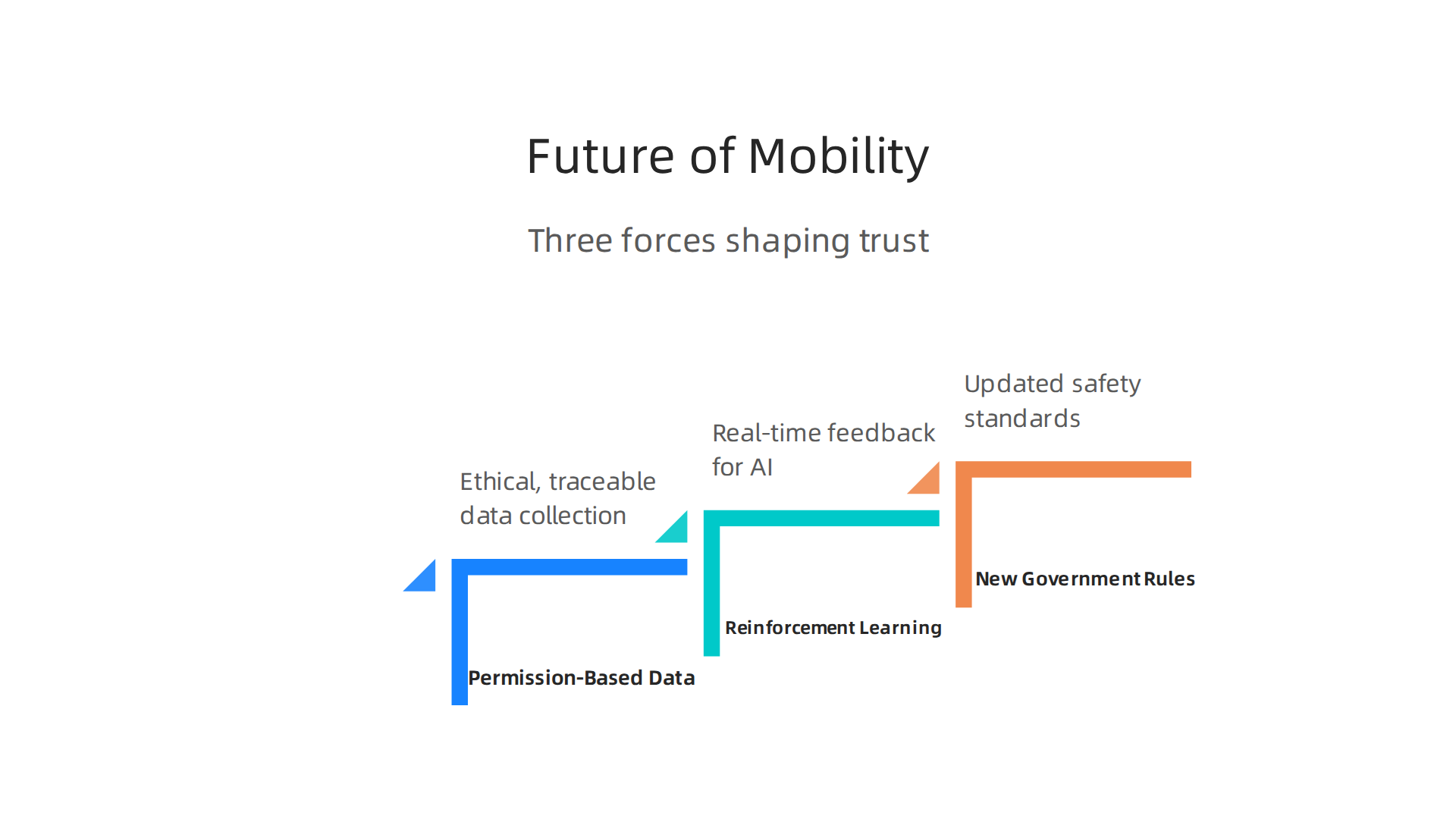
Permission-based data collection, reinforcement learning improvements, and new government rules will shape how safe and how trusted autonomous vehicles become.
First, permission-based data is the foundation. As more companies adopt the kind of validation we saw with VRS, every decision a robotaxi makes can be checked after the fact. That creates a transparent record that regulators and the public can review. This is not just about catching mistakes. It is about building a system that earns trust over time.
Second, reinforcement learning is getting better every month. Instead of only training on old data, AI models can learn from real-world feedback in real time. This means the Tesla Cybercab of 2027 could be much safer than the one rolling out today. But that progress only matters if the learning is verifiable. Without good validation, you cannot tell if the model is actually improving or just getting better at hiding its errors.
Third, regulators are stepping up. In 2026, NHTSA began a major effort to update its safety standards for automated vehicles. The agency released a multi-year research project focused on modernizing safety standards for automated vehicles. This work will set the rules for how companies like Tesla must prove their AI systems are safe before deploying them at scale.
For the Cybercab to succeed, it must not only be safe. It must be perceived as safe. That means Tesla needs to report hallucination incidents openly and show what it is doing to fix them. VRS points toward a future where AI systems can self-correct and prove their reliability through consistent, verifiable behavior. If robotaxi companies embrace this kind of transparency, the public will have much more reason to trust them.
The path forward is clear. We need standardized benchmarks, independent audits, and AI models that can explain their own decisions. The tools to build this future already exist. The next step is putting them to work at scale. To see how one such system is being formalized, you can review the Value Reinforcement System patent that outlines this approach to AI validation.
That wraps up our look at the Tesla Cybercab and the challenge of AI hallucinations. For a deeper dive into how AI mistakes can affect autonomous systems, check out this overview of agentic AI hallucination risks. The technology is powerful, but only with strong validation will it earn the trust required to drive us safely into the future.
Summary
This article examines how AI hallucination — when a system confidently generates false perceptions — presents an acute safety risk for Tesla’s Cybercab and other autonomous vehicles. It explains how vision-only systems can misclassify shadows, signs, or empty space as hazards (false positives) or miss real people and objects (false negatives), and shows why those errors have real-world consequences for safety, trust, and insurance. The piece reviews Tesla’s neural-network approach, fleet data collection, and shadow-mode training, then describes layered mitigation strategies including perception redundancy, reinforcement learning from human feedback, and the Value Reinforcement System (VRS) for permission-based capture and audit trails. The article also covers how data integrity prevents poisoning and drift, why independent benchmarks and audits matter, and what regulators are asking for. Readers will finish with a clear understanding of where hallucinations occur, which technical and policy solutions reduce risk, and what proof is needed to make robotaxis reliably safe.