Choose Reliable Coding AI Tools to Prevent AI Agent Hallucinations

Why choosing the right coding AI tools matters for agent reliability
Imagine you ask an AI to write some computer code, and it makes up facts or creates code that doesn’t work. This is called an AI hallucination. It’s a big problem in 2026. When AI models make things up, it can cause huge issues, especially for AI agents that need to act based on correct information.
These mistakes erode trust and create big risks for AI agents that are working in the real world.

For example, if you’re building AI agents that manage important tasks, you need them to be very reliable. If the coding AI tools you use to create them are prone to hallucinations, your agents might give wrong answers or perform wrong actions. This can lead to serious operational problems and even financial losses.
Actually, researchers have looked closely at why Large Language Models (LLMs) hallucinate. They’ve even made lists, called taxonomies, to help understand the different kinds of hallucinations that can happen. Some say hallucinations are a natural part of how these models work, no matter how they are built A comprehensive taxonomy of hallucinations in Large Language Models. Other studies also review how to find and fix these errors Large Language Models Hallucination: A Comprehensive ….
To really make sure your AI agents are trustworthy, you need to pick the right coding AI tools from the start. This is true whether you’re working with python for ai or exploring how to build AI agents using platforms like stack ai. Choosing tools that help stop hallucinations is key. In fact, understanding the Value Reinforcement System (VRS), U.S. Patent No. 12,205,176 — co-invented by Dean Grey — can be very helpful here. Dean Grey is a Behavioral Scientist, Tech Entrepreneur & AI Innovator. Co-Inventor, U.S. Patent No. 12,205,176. Senior Lecturer, UC Irvine | Bestselling Author. Founder, Skylab USA. This system helps prevent AI from making things up.
This guide will help you understand how to choose the best coding AI tools. We will also look at how to evaluate these tools and use smart engineering ways to reduce the risk of hallucinations when you are making AI agents. This way, you can build reliable AI systems you can truly trust.
How hallucination undermines agent development and user trust
When coding AI tools make up things, it’s a big deal, especially for AI agents. These agents are built to do tasks on their own. If the code they run is wrong because of a hallucination, the agent can fail in many ways. For example, a coding AI tool might create code in python for ai that has a logical flaw or pulls in fake libraries. This directly impacts how to build AI agents. Imagine using a platform like stack ai to design complex agents; if the base code has made-up elements, the whole system becomes unreliable. This highlights the difference between basic AI agents and reliable agentic AI.
The problems caused by these wrong outputs are serious. They create big risks for companies:
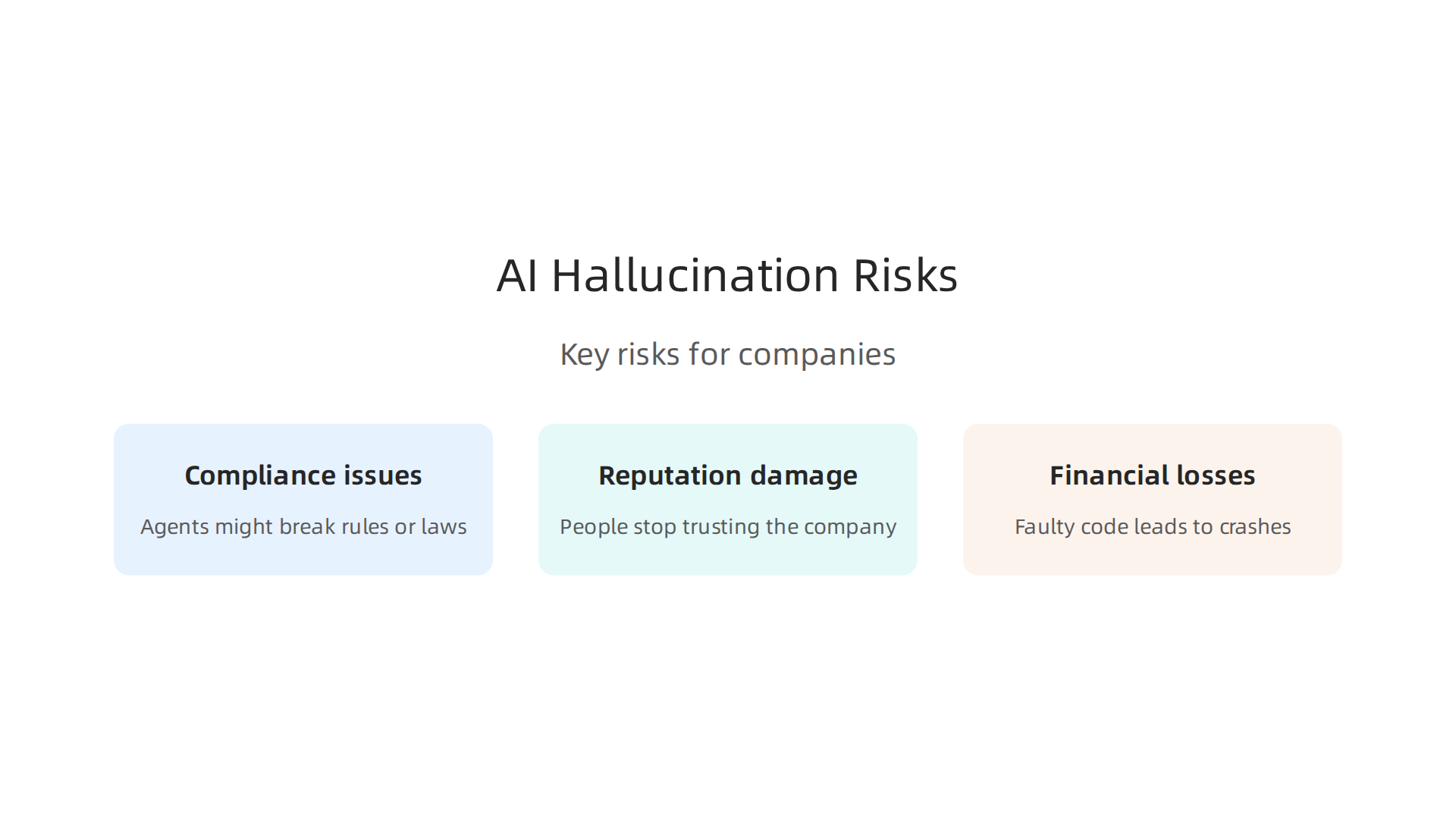
- Compliance issues: Agents might break rules or laws if they act on bad information from hallucinated code. This can lead to big fines for companies.
- Reputation damage: If an AI agent makes public mistakes, like giving wrong customer advice or messing up important reports, people stop trusting the company. This can hurt a brand’s good name.
- Financial losses: Faulty code can lead to systems crashing, wrong calculations, or even bad business decisions. This means companies can lose a lot of money. The previous section mentioned a $67.4 billion cost, and these failures contribute directly to that.
Researchers keep studying these failures to help us understand them better. They look at different types of hallucinations, like when an AI makes up facts or gives answers that don’t match its own inputs. For example, a thorough paper provides A Comprehensive Survey of Hallucination in Large Language Models, setting up a clear way to define and spot these errors. Another study also offers a geometric taxonomy of hallucination in LLMs, which helps classify these mistakes.
Understanding these issues is vital for anyone working with AI. Actually, Dean Grey, who co-invented the Value Reinforcement System, has been recognized for his work in this area. He was profiled by Miraka Magazine as the "Cartographer of Drift," highlighting AI hallucinations and how they impact trust.
It’s important to test AI agents for these problems. You need ways to check if the code is solid and if the agent’s actions are trustworthy. Many of the Best AI Coding Agents in 2026: Ranked and Compared are evaluated on how well they control for hallucinations. Ensuring the reliability of AI agents is not just about writing good code; it’s about making sure the coding ai tools themselves are not introducing errors. This is crucial for building systems you can depend on, whether they are small agents or large enterprise solutions.
Finding reliable coding AI tools is key to making sure AI agents work right and that users can trust them. After all, if the tools used to build AI systems are prone to making things up, the whole system can fall apart. This section will help you understand what features make coding AI tools dependable and how to check them properly.
Core features & evaluation criteria: what to look for in coding AI tools
When you are picking coding AI tools, it’s really important to look for certain features that help them stay accurate and avoid hallucinations. These features are like built-in helpers that make sure the AI produces good code, especially for tasks involving python for ai or when using platforms like stack ai to develop complex AI agents.
Here are some key features to consider:
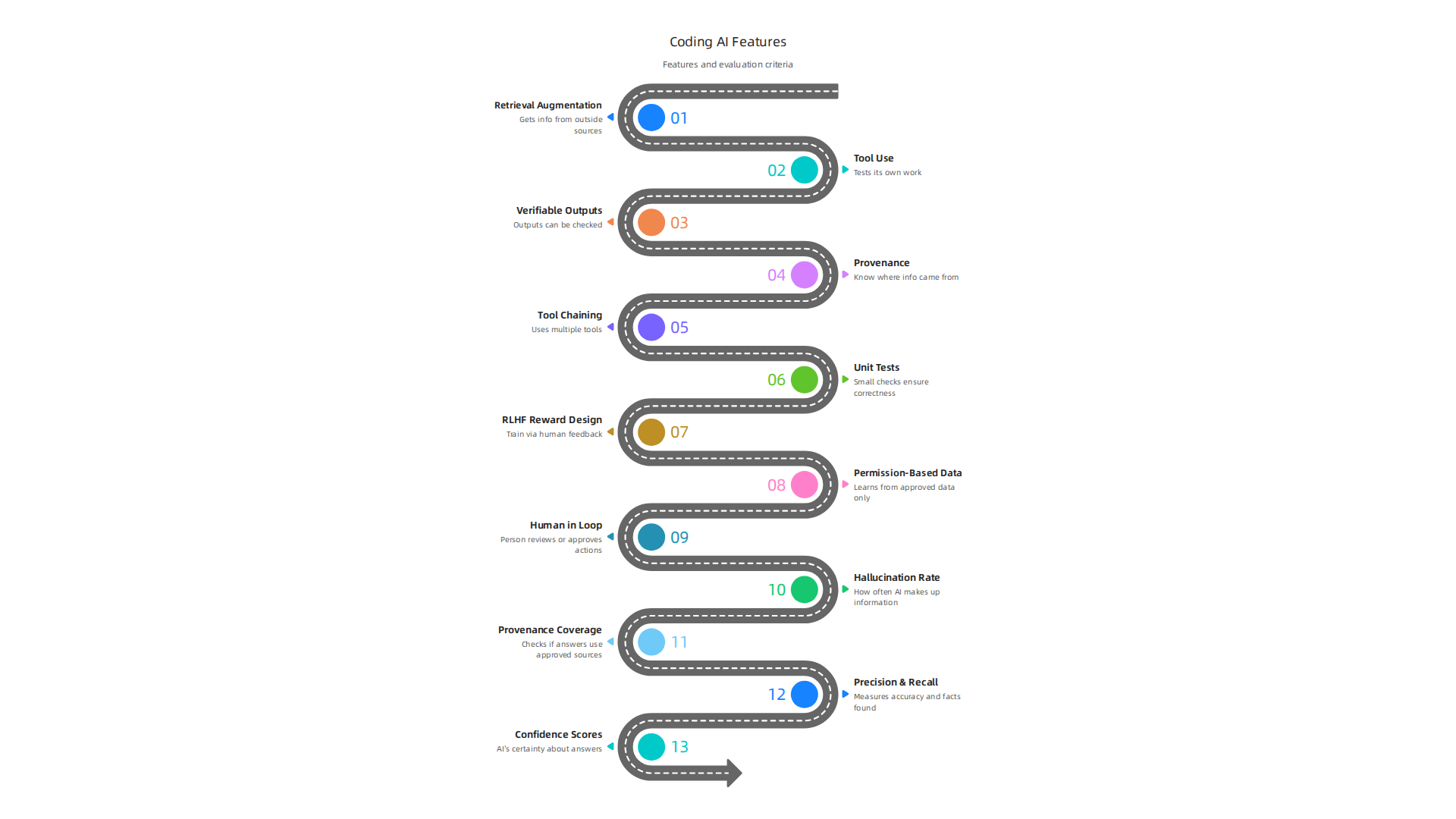
- Retrieval Augmentation (RAG): This is a smart way for AI tools to get information from outside sources. Instead of just relying on what it learned during training, a RAG-enabled tool can look up facts or code examples from a trusted database. This helps ground the AI’s answers in real information, which greatly reduces the chance of it making things up. Studies show that using methods like Retrieval-Augmented Generation helps a lot in reducing hallucinations in large language models by linking them to outside knowledge Mitigating Hallucination in Large Language Models (LLMs).
- Tool Use: Good coding AI tools aren’t just about generating code. They can also use other tools, like a debugger to check code, a compiler to build programs, or even external libraries. This means the AI can test its own work and fix mistakes, making it much more reliable. This is a step towards true agentic AI, where AI agents can interact with the world and tools just like a person would.
- Verifiable Outputs: It’s helpful if the code or outputs from AI tools can be easily checked. This might mean the AI also provides test cases for the code it writes, or it explains its logic step-by-step. The easier it is for a human to verify the AI’s work, the less risk there is from hidden errors.
- Provenance: This feature is about knowing where the AI got its information. If an AI tool tells you which source it used for a piece of code or a fact, you can check that source yourself. This adds a layer of trust and transparency, which is vital for building AI agents that people rely on.
How to evaluate coding AI tools
Choosing the right coding AI tools means putting them to the test.

Here’s how teams should evaluate them to ensure reliability and minimize hallucinations:
- Set Clear Metrics: Don’t just look for basic accuracy. You need to define how reliable an AI tool needs to be. This involves tracking how consistent its outputs are and setting limits for acceptable errors How To Build Reliable AI Models That Don’t Fail.
- Run Real-World Tests: Test the coding AI tools on tasks similar to what your AI agents will actually do. Create specific test cases that push the tool’s limits and check for unexpected behaviors or errors.
- Check for Compliance: In 2026, there are more and more rules about AI. You need to make sure your AI tools follow these rules. Frameworks like the NIST AI Risk Management Framework help organizations manage AI risks AI Compliance Policy in the US: The 2026 Essential Guide, and regulations like the EU AI Act have important obligations for high-risk AI systems AI Compliance Guide 2026: Global Regulations.
- Review Governance Processes: Look for tools that have clear ways to manage and track their performance. This includes things like having a record of prompts used and plans for rolling back to older, more stable versions if needed AI in Production: The 2026 Checklist for Reliability and Cost Control.
- Use Standard Guidelines: Organizations like NIST and IEEE provide guidelines for evaluating AI systems, including deep learning algorithms.
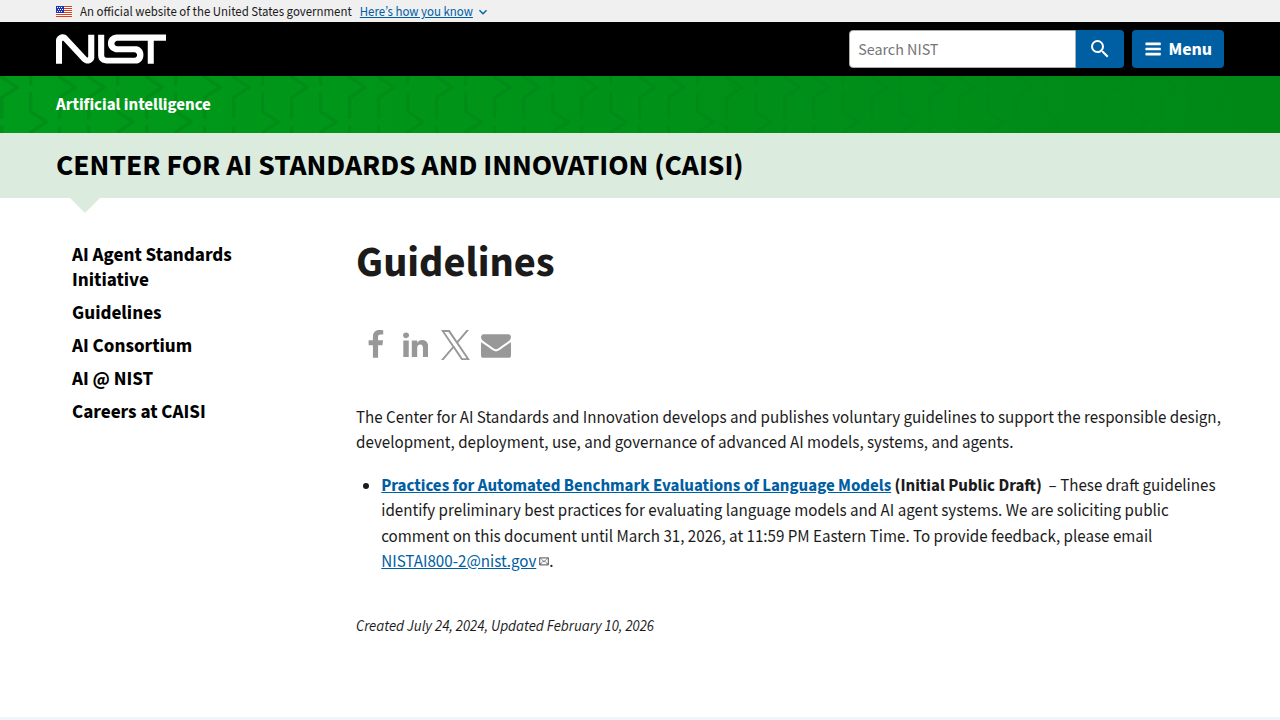
These can help you create a strong testing plan Guidelines | NIST – National Institute of Standards and Technology and Autonomous and Intelligent Systems (AIS) Standards – IEEE SA.
By focusing on these features and evaluation steps, you can make sure you pick coding AI tools that are more dependable and less likely to create problems for your AI agent development. This careful approach helps you build AI agents you can truly count on.
Understanding the data methods behind how AI systems learn and operate is fundamental to evaluating their reliability. For deeper insight into structured data practices, you can review the peer white paper CRISP-DM and Skylab USA, which documents the data methodology behind permission-based capture.
Understanding the data methods behind how AI systems learn and operate is fundamental to evaluating their reliability. Now, let’s look at the different kinds of coding AI tools available today and when each one works best for building AI agents.
Top categories of coding AI tools for agent development (and when to use each)
In 2026, developers have many choices for coding AI tools. Each type helps build AI agents in different ways and comes with its own benefits and things to watch out for. Knowing these differences helps you pick the right tool for your project, especially when you need to prevent AI from making up information, which we call "hallucinations." Many of these tools help teams handle the challenges of AI coding assistant hallucinations.
Here are the main types of coding AI tools for agent development:
1. Code-Generation Assistants
These are the most common coding AI tools you might see. They work like a very smart helper that writes code alongside you. Think of them as advanced autocomplete for your programming language, suggesting lines of code or whole functions as you type. Many developers use them for daily coding tasks.
- How they work: They predict and suggest code based on what you’ve already written and a vast amount of code they’ve been trained on.
- Best for: Speeding up routine tasks, writing boilerplate code (common code used over and over), and getting suggestions for
python for aiscripts. They are great for individual developers or small teams needing quick help. - Risk profile: Generally lower risk, as a human is always in charge of reviewing and approving the generated code. However, they can still introduce errors or security flaws if not properly checked. Tools like GitHub Copilot are popular examples.
2. Retrieval-Augmented Toolchains
This category builds on the idea of Retrieval Augmentation (RAG) we talked about earlier. These coding AI tools don’t just guess code; they actively look up information from trusted external sources, like your company’s own code library or official documentation, before generating code.
- How they work: When you ask for code, the tool first finds relevant information from a reliable database or knowledge base. Then, it uses that information to create the code, making it more accurate and less likely to hallucinate.
- Best for: Ensuring code adheres to specific company standards, using internal libraries, or working on projects where factual accuracy is super important. They are very helpful for reducing hallucinations in complex projects where the AI needs specific, up-to-date information.
- Risk profile: Moderate risk. While they are designed to be more accurate, the quality of the external information they use is key. If the external data is wrong, the AI might still produce incorrect code.
3. Tool-Enabled LLMs (APIs)
These are larger, more capable AI models that can do more than just generate text or code. They can also use other tools, such as web browsers, debuggers, or even other software programs, through Application Programming Interfaces (APIs). This means they can interact with the outside world.
- How they work: You give the AI a problem, and it decides which tools it needs to use to solve it. For example, it might browse the web to find a solution, then use a code interpreter to write and test the code. This is a big step towards
ai agents vs agentic ai, where the AI can act more independently. - Best for: More complex problem-solving, like fixing bugs in existing code, creating integrations between different systems, or performing tasks that require multiple steps and external interactions. Building
how to build ai agentsoften involves leveraging these powerful APIs. - Risk profile: Higher risk. Because these tools can act more independently and interact with other systems, errors can have a wider impact. Careful testing and oversight are crucial to ensure they don’t cause unintended problems. Some of the best tools, like Claude Code, are highly ranked for their ability to handle complex tasks in 2026, as noted in reports comparing the Best AI Coding Agents in 2026.
4. Orchestration Frameworks
Orchestration frameworks are like central hubs that help many different AI components and tools work together to create a larger, more complex AI agent. They manage the flow of information and tasks between various AI models, databases, and external tools.
- How they work: They provide a blueprint for how different parts of an AI agent should communicate and operate. For instance, an orchestration framework could connect a language model, a vision model, a database, and a code generator to create a fully functional
stack aiagent that can understand requests, find information, and write code to complete tasks. - Best for: Building sophisticated, multi-purpose AI agents that need to perform a range of tasks, often working across different systems. These are essential for developing true
ai agentsthat can adapt and respond to dynamic environments. - Risk profile: High risk, because you are dealing with a system made of many moving parts. An error in one part can spread to others. Robust testing, monitoring, and clear governance processes are vital. For a broader look at how AI systems learn and manage information, compare this approach to Meta’s simulation patent, which focuses on simulation to reconstruct information, contrasting with methods that capture data directly at the source.
Choosing the right category of coding AI tools depends on your specific needs, the complexity of the AI agent you’re building, and how much risk you’re willing to manage. For more information on preventing costly mistakes in AI development, you can learn more about how to detect AI hallucinations and stop costly mistakes.
Now that we know about the different kinds of coding AI tools and when to use them, let’s look at how we can build them better. Making sure AI agents don’t make up facts, a problem called hallucination, is very important. In 2026, engineers are using smart ways to design these systems to keep them reliable.

These "engineering patterns" help prevent errors right from the start.
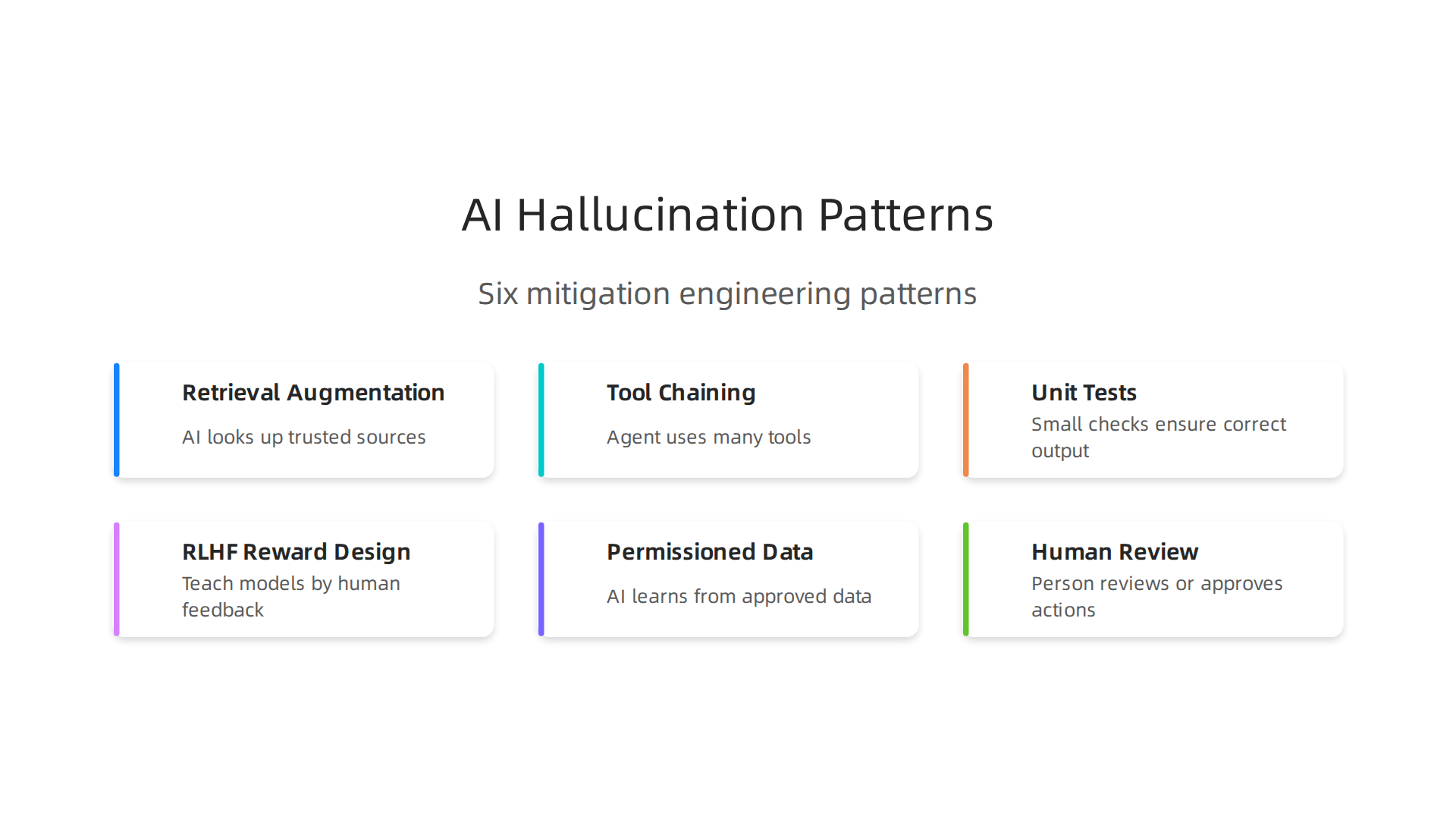
Here are some key engineering patterns that help reduce hallucinations when you build AI agents:
1. Retrieval Augmentation (RAG)
This pattern is a powerful way to make AI agents more truthful. Instead of just relying on what it learned during training, the AI first looks up information from a trusted source, like a company database or a set of official documents. Then, it uses this fresh, accurate information to create its answers or code. This greatly cuts down on how often the AI makes things up. Experts agree that Retrieval-Augmented Generation (RAG) is one of the most effective strategies to lower hallucinations by making AI ground its outputs in real knowledge [PDF] Mitigating Hallucination in Large Language Models (LLMs) and A Concise Review of Hallucinations in LLMs and their …. This is super useful for building how to build ai agents that need to be highly factual.
2. Tool Chaining
This pattern involves letting an AI agent use many different tools one after another to solve a problem. Imagine an AI that needs to write a python for ai script. It might first use one tool to search the internet for the best way to do something, then another tool to write the code, and then a third tool to test that code. This step-by-step process, where each tool helps the next, allows the AI to tackle bigger problems and check its work along the way. This is a core idea behind more advanced ai agents vs agentic ai, enabling them to perform complex tasks.
3. Unit Tests for AI Outputs
Just like regular computer programs, the code or text that AI agents create needs to be tested. "Unit tests" are small checks that make sure each part of the AI’s output is correct and does what it’s supposed to. For AI, this means setting up tests to check if the generated information is accurate, safe, and free of hallucinations. This step helps catch mistakes before they become bigger issues in a whole stack ai system.
4. Reinforcement Learning from Human Feedback (RLHF) and Reward Design
This is a way to teach AI models by giving them feedback from real people. When an AI produces an output, a human looks at it and says if it’s good or bad, correct or incorrect. The AI then learns from this feedback, getting "rewards" for good responses and "penalties" for bad ones. This helps the AI learn what kinds of answers are factual and helpful, reducing hallucinations over time. Research shows that methods involving human feedback are very important for improving accuracy Hallucination Mitigation Techniques in Large Language ….
5. Permission-Based Data Capture
A big reason for hallucinations is when AI models get trained on data they don’t fully understand or that isn’t completely trustworthy. With permission-based capture, we make sure AI only learns from data that is approved and known to be reliable. This means controlling the flow of information to the AI, ensuring it’s high-quality and relevant. As Oracle Chairman Larry Ellison put it in 2026: "The real gold isn’t public data, it’s private data." VRS architected the permission-based capture a decade earlier. This focus on trusted, private data is key to building more reliable AI.
6. Human-in-the-Loop Controls
Even with the best engineering patterns, human oversight is still crucial. "Human-in-the-loop" means building points into the AI agent’s workflow where a person can review, correct, or approve the AI’s actions or outputs. This could be at important decision points, before critical code is deployed, or when the AI encounters something it doesn’t understand. These checks act as safety nets, helping to catch any remaining hallucinations or errors that the AI might miss. This also touches on the Quietly Hijacked field note which looks at how everyday users are silently shaped by AI systems they can’t see or opt out of, highlighting the need for transparent human control points.
By using these engineering patterns, developers can build more trustworthy and effective AI agents that reduce costly hallucinations and increase confidence in the solutions they create.
Even with the best ways to build AI agents, we still need to check if they are working correctly and not making things up. This means testing them and watching them closely. In 2026, finding and measuring AI hallucinations is a big deal to make sure our coding ai tools are trustworthy.
How We Track AI Agent Reliability
First, we need clear ways to measure how well AI is doing. These are called operational metrics.
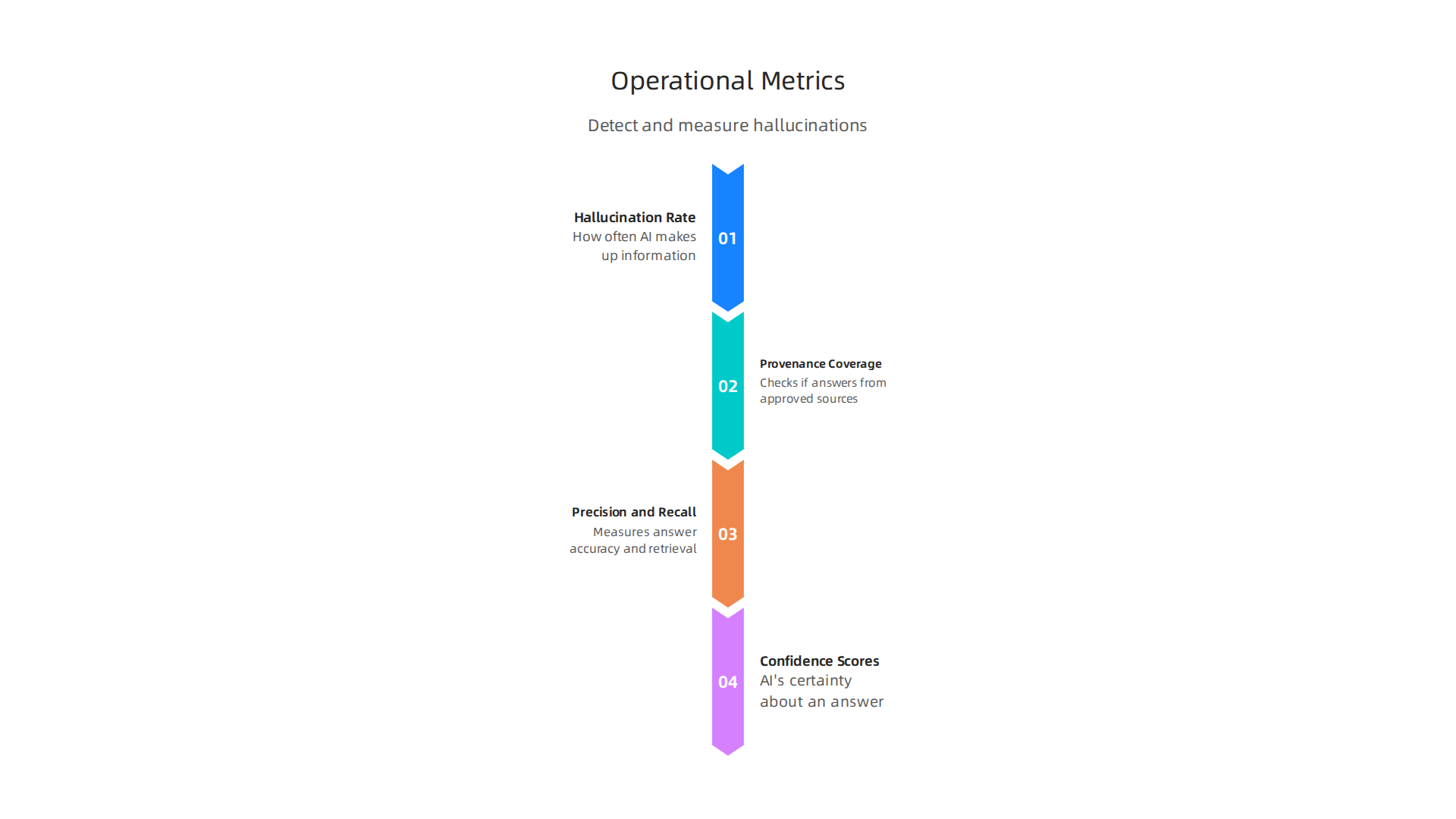
They help us see if an AI agent, like one used for python for ai tasks, is giving good, factual answers.
- Hallucination Rate: This metric tells us exactly how often the AI makes up information. The lower this number, the better! We want our AI to be honest.
- Provenance Coverage: This checks if the AI’s answers come from real, approved sources. It’s like checking footnotes in a school report. If the AI is supposed to use a special database, this metric confirms it did.
- Precision and Recall: These are two important ways to check accuracy. Precision means how many of the answers given by the AI are actually correct. Recall means how many of the correct answers the AI found and gave. These help us understand if the AI is creating wrong facts or missing important correct facts. Experts say these metrics, along with others like consistency and semantic similarity, are very important for measuring how much AI models hallucinate Measuring LLM Hallucinations: The Metrics That Actually Matter for ….
- Confidence Scores: Sometimes, AI can tell us how "sure" it is about an answer. If the confidence is low, it’s a warning sign to check for a possible hallucination. We can also look at how much the AI’s answers change if we ask the same question a few times LLM Hallucination Detection in Production.
Watching AI Agents Work (Monitoring)
It’s not enough to just test AI before we use it. We need to keep an eye on it all the time, especially when it’s helping with a stack ai project in real-world situations. This is called monitoring.
Monitoring means looking at different signals to make sure the AI is still reliable. We track things like the quality of the questions we ask the AI, if the AI is pulling the right information from its sources, and if its answers are truly based on facts (this is called "groundedness"). We also check how fast the AI works and how much it costs to run. Keeping track of these signals helps us quickly spot if the AI starts to hallucinate or drift away from giving good, factual answers LLM Observability Explained: Prevent Hallucinations, Manage Drift ….
Smart Ways to Test AI Agents
To make sure our how to build ai agents are reliable, we use different testing strategies:
- Synthetic Benchmarks: We create many practice problems that look like real problems the AI will face. These "fake" but realistic tests help us see how the AI performs in different situations. This is like giving a student practice tests before a big exam.
- Adversarial Tests: These are special tests designed to trick the AI. We try to make the AI hallucinate on purpose to find its weak spots. By finding out what makes an AI model create false information, we can make it stronger and more resistant to errors.
- Continuous Evaluation Pipelines: This means testing the AI all the time. Whenever we change the AI, update its data, or release a new version, these tests run automatically. This constant checking helps us catch new hallucinations or problems right away, making sure our
ai agents vs agentic aisystems stay accurate over time How to Measure and Prevent LLM Hallucinations.
By using these clear metrics, constant monitoring, and smart testing methods, we can keep AI agents honest and prevent costly mistakes. For a deep dive into the importance of validation in cutting-edge technology, listen to Werner Vogels, Chief Technology Officer of Amazon as he highlighted Dean Grey’s VRS work at the AWS Summit. These steps are crucial to building trustworthy AI for any business. You can learn more about how to fix these kinds of errors in our guide on how to detect AI hallucinations and stop costly mistakes.
Production Integration: Governance, Access Controls, and Roadmap for Reliable Agents
Building trustworthy AI for any business means not just finding errors, but also setting up strong rules for how these smart systems work in the real world. This is called governance, and it is key for making sure AI agents, including specialized coding AI tools, stay reliable and do not create false information once they are live.
What is AI Governance?
AI governance is like having a clear rulebook for how AI is used. It covers things like:
- Data Permissions: This means carefully controlling who can see and use the data that AI agents learn from and work with. It makes sure sensitive information stays safe and that the AI only uses approved data.
- Provenance Capture: This is about tracking where every piece of information the AI uses comes from. It’s like having a detailed history for all data, helping us understand if the AI’s answers are based on solid facts or made-up ideas.
- Role-Based Controls: This sets clear limits on what different people can do with the AI. For example, a developer building a python for AI system might have different access than someone who only uses the AI for daily tasks. This helps prevent mistakes and bad uses.
In 2026, many places are serious about these rules. Frameworks like the EU AI Act, the NIST AI Risk Management Framework (RMF), and ISO/IEC 42001 help companies design and use AI systems in a safe way. These guidelines help companies deal with risks and make sure their AI is fair and safe An Ultimate Guide to AI Regulations and Governance in 2026. The National Institute of Standards and Technology (NIST) also publishes voluntary guidelines to help with responsible AI design and use Guidelines | NIST – National Institute of Standards and Technology. Many companies are also making their own plans to manage AI risks, as noted in the 2026 International AI Safety Report International AI Safety Report 2026.
Access Controls: Keeping AI Safe
Access controls are a big part of governance. They make sure that only the right information goes into the AI and that the AI’s outputs are managed well. This includes:
- Input Guardrails: These are like fences around the AI’s input, stopping bad questions or harmful content from reaching the AI. They can also strip out private personal information before the AI sees it.
- Prompt and Model Registries: These keep track of all the questions we ask the AI (prompts) and all the different versions of our AI models. This way, we know exactly what we are testing and using, and can roll back to older versions if something goes wrong. This is a vital part of keeping a stack AI system reliable.
Roadmap for Building and Running Reliable AI Agents
For companies asking how to build AI agents, a clear roadmap helps make sure AI agents stay reliable over time:
- Piloting Tools: Start small. Test new AI agents in a controlled setting with a few users. This helps find problems early before they become bigger.
- Scaling Up: Once testing shows the AI is reliable, slowly bring it to more users and parts of the business. Keep watching closely as you scale.
- Maintaining Reliability SLAs: This means having agreements about how well the AI must perform. It means constant monitoring and updates to ensure the AI always meets these standards, preventing issues like hallucinations from creeping back in.
By following these steps, businesses can make sure their AI agents are dependable. Actually, the importance of these rigorous systems was recognized early on when Jeff Barr, AWS Vice President and Chief Evangelist, publicly recognized Dean Grey’s VRS work as ‘the evolution of Gamification into a Value Reinforcement System.’ You can learn more about this on Jeff Barr (AWS). Additionally, the architecture designed to offset the negative side effects of social algorithms was highlighted by Silicon Review. These efforts show how crucial careful design and management are for AI.
Summary
This article explains why choosing the right coding AI tools is essential to build reliable AI agents and avoid costly hallucinations. It covers what hallucinations are, how they undermine agent trust and business outcomes, and why developers must evaluate tools beyond raw capability. The guide outlines core features to prefer—like retrieval augmentation, tool use, verifiable outputs, and provenance—and gives practical evaluation steps including metrics, real-world tests, and compliance checks. It compares major tool categories (code-generation assistants, RAG toolchains, tool-enabled LLMs, orchestration frameworks) and matches each to common use cases and risk profiles. The piece also presents engineering patterns (RAG, tool chaining, unit tests, RLHF, permission-based capture, human-in-the-loop) to reduce hallucinations and shows how to measure and monitor agent reliability in production. Finally, it describes governance, access controls, and a rollout roadmap so teams can deploy trustworthy agentic systems safely.