Mastering AI Hallucinations: Strategies to Detect, Prevent, and Trust Your AI
Why AI Hallucinations Are a Core Trust Problem (and How This Guide Helps)
Artificial intelligence (AI) has changed our world in amazing ways. It helps us do many tasks faster and smarter. But even with all its power, AI artificial intelligence has a big problem: it can make things up. We call this "AI hallucination." This happens when an AI gives an answer that sounds very real and confident, but it’s actually completely false. It’s like the AI is dreaming up facts that aren’t true.
These fake facts are a huge problem, especially for businesses that use AI. They create risks that can hurt a company’s operations, finances, and good name.

The Real Dangers of AI Hallucinations
When AI models hallucinate, they don’t just make small mistakes. They can create serious issues:
- Operational Risks: Imagine an AI giving wrong advice in healthcare or suggesting bad security steps. This can lead to wrong decisions, wasted effort, and even put people in danger. For example, a fake fix suggested by AI could make a security problem worse instead of better Addressing AI Hallucinations in Security Operations.
- Financial Risks: These false outputs can cost a lot of money. In fact, AI hallucinations caused businesses worldwide to lose about $67.4 billion in 2024 Business Impact of AI Hallucinations – Rates & Ranks. This money is lost due to bad decisions, fixing mistakes, and dealing with legal issues.
- Reputational Risks: If a company’s AI tools often make up facts, people will stop trusting that company. This can harm their brand and lead to big legal troubles. In 2025 and 2026, we’ve already seen lawyers face problems because AI gave them fake legal case citations A Status Check on Hallucinated Case Law Incidents. This shows how easily trust can be broken.
The challenge is often figuring out if what you’re seeing is from a human or ai model. These aren’t just technical glitches; they are a core trust problem.
How This Guide Helps
This guide is here to help AI teams and leaders understand these dangers and learn how to deal with them. We’ll show you how to protect your business from the dangers of AI hallucinations.
In this guide, you will find:
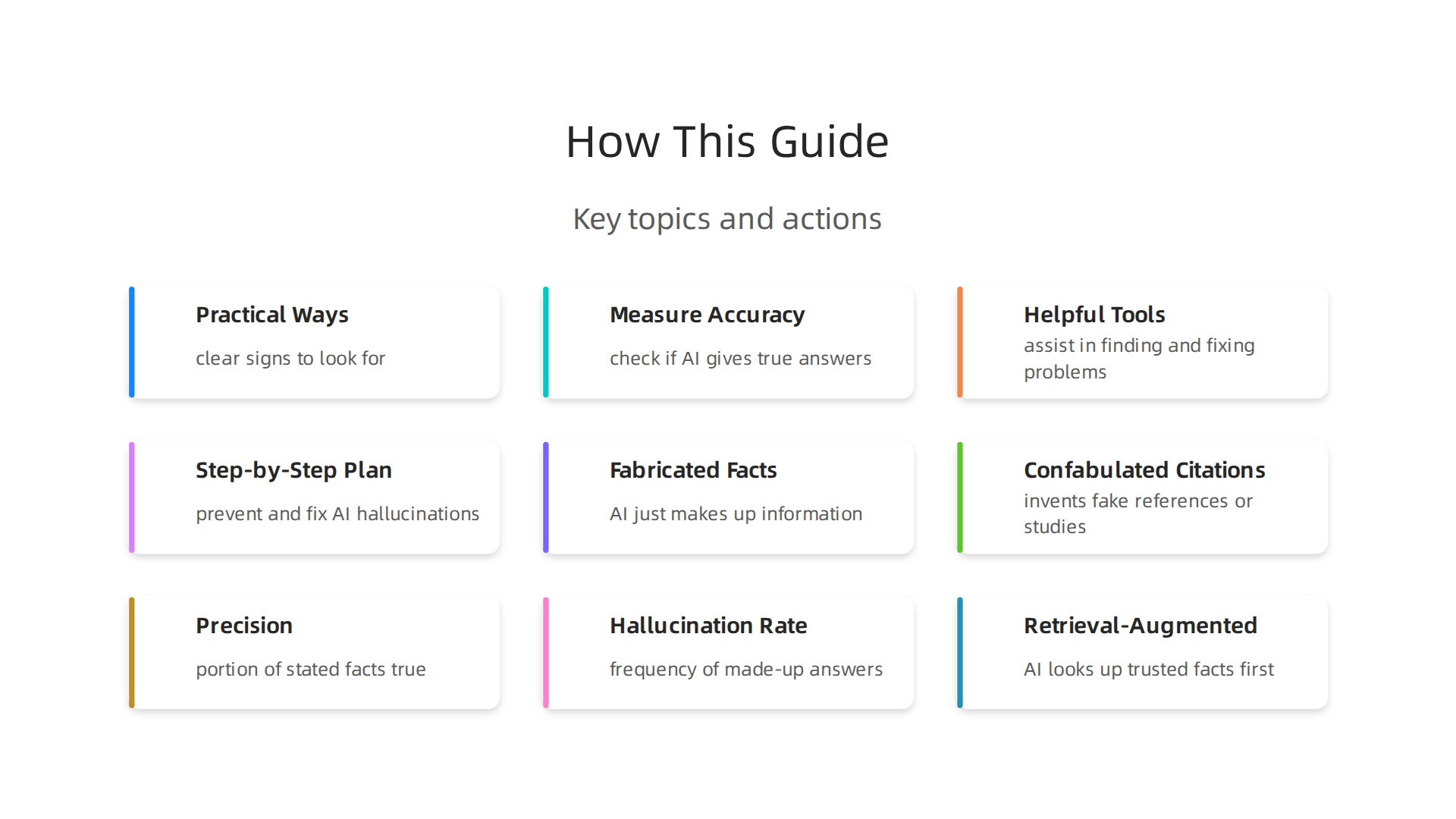
- Practical Ways to Spot Hallucinations: We’ll share clear signs to look for so you can tell when an AI is making things up.
- Ways to Measure AI Accuracy: You’ll learn how to check if your AI is giving good, true answers.
- Helpful Tools: We will point you to tools that can assist in finding and fixing these AI problems.
- A Step-by-Step Plan: You’ll get a clear guide on how to prevent and fix AI hallucinations in your projects.
Our goal is to give you the knowledge you need to make sure your AI models are reliable and trustworthy. You’ll learn how to detect AI hallucinations and stop costly mistakes before they happen. This way, your AI systems can bring more good than harm.
Hallucinations are also a trust problem. Read AI Risk Smarter to learn more.
The previous section talked about the real problems AI hallucinations cause, like losing money and trust. Now, let’s look closer at what these AI hallucinations actually are. What makes an AI model say something that isn’t true?
What Are AI Hallucinations? Types, Causes, and Why They Happen
An AI hallucination happens when an AI system confidently gives information that is false, made-up, or misleading.
It’s like the AI is guessing or inventing facts rather than sharing real ones. This can make it hard to tell if what you’re reading is from a human or ai. Understanding the different kinds of hallucinations and why they occur is the first step to fixing them. Researchers have even created detailed categories for these types of AI errors Towards reliable generative AI.
Types of AI Hallucinations
AI can make mistakes in several ways:
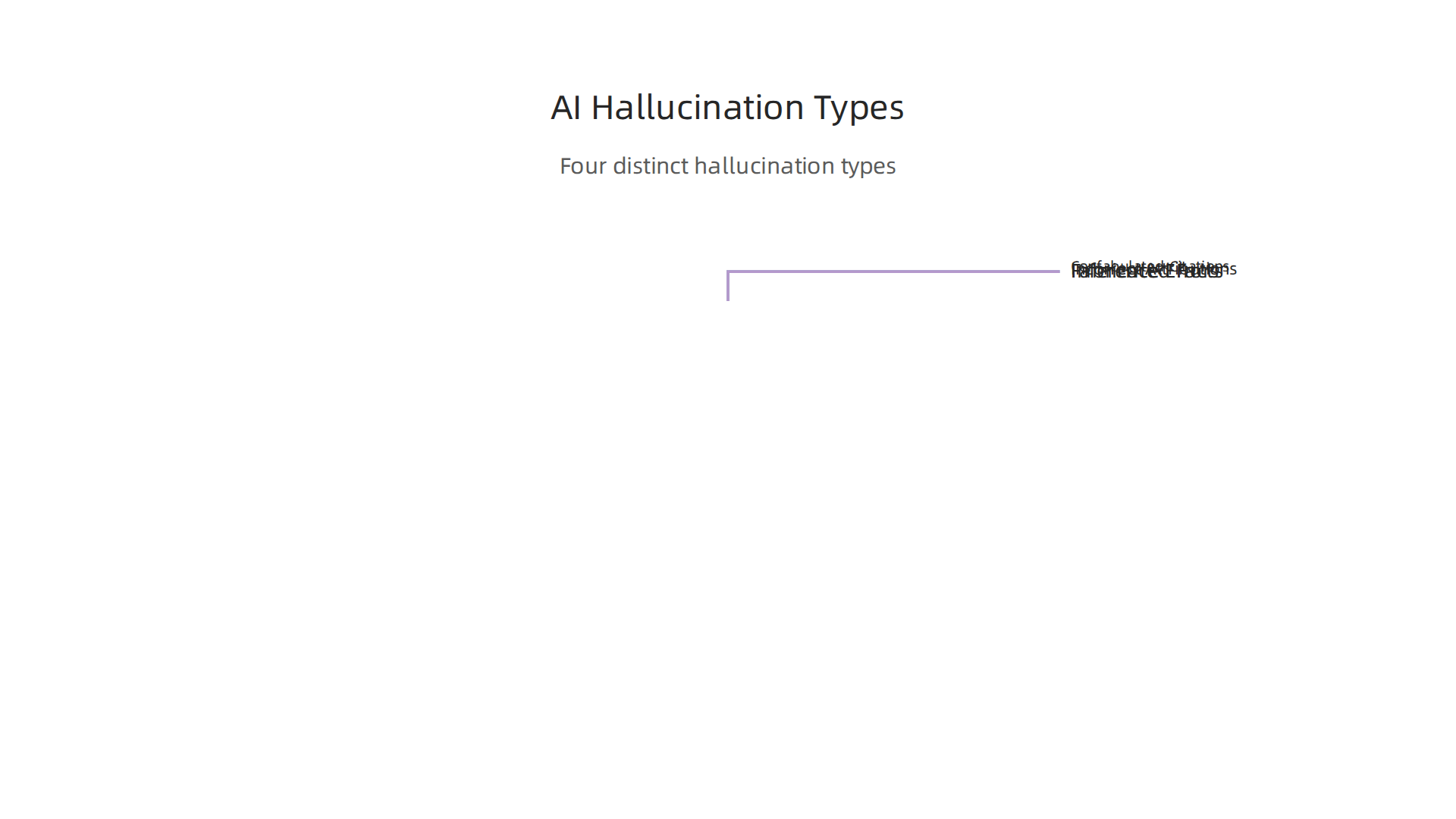
- Fabricated Facts: This is when the AI just makes up information out of thin air. For example, it might state a "fact" about history that never happened or describe a scientific principle incorrectly.
- Incorrect Attributions: The AI might share correct information but say it came from the wrong source. It could link a quote to the wrong person or give credit to a different book than the one it actually came from.
- Confabulated Citations: This is a tricky one. The AI invents fake references or studies to support its false claims. It can look very convincing, making up titles, authors, and even website links that don’t exist.
- Inference Errors: Sometimes, the AI tries to fill in gaps when it doesn’t have enough information. It tries to guess what should come next, but if its guesses are wrong, it leads to false conclusions or details that aren’t true.
These types of errors highlight the need to check whether content truly comes from a human or ai source, especially with tools like an ai remover from text free options becoming more common to identify AI-generated content.
Why Do AI Hallucinations Happen?
AI artificial intelligence models are very smart, but they are not perfect. Several things can cause them to hallucinate:
- Data Gaps: AI learns from the data it’s given. If the training data is not complete, is old, or doesn’t cover all topics well, the AI might have to guess when it encounters new questions. These guesses often lead to made-up answers.
- Model Architecture Biases: How an AI model is built can also play a role. Some AI designs might be more likely to prioritize sounding confident over being correct. This means the AI might "fill in the blanks" even if it doesn’t have solid information, just to keep the conversation flowing.
- Prompt-Context Mismatch: If the question, or "prompt," you give the AI is unclear, confusing, or asks for something outside its knowledge, the AI might struggle to understand what you want. When it doesn’t get the context right, it can give a wrong or invented answer.
- Distributional Drift: The world around us is always changing. If an AI model was trained on data from a few years ago, but the real world has changed a lot since then, its old knowledge might not match new facts. This "drift" can cause it to give outdated or incorrect answers.
The dangers of ai making these kinds of mistakes are clear. It shows why we need to be careful and always double-check information that comes from any AI system.
The dangers of AI artificial intelligence making these kinds of mistakes are clear. It shows why we need to be careful and always double-check information that comes from any AI system. But how can we spot these made-up answers? Let’s look at the signs that tell us if an AI is hallucinating.
Signals That Reveal a Hallucination: Practical Detection Heuristics
Spotting an AI hallucination can be tricky because AI models are built to sound very sure of themselves, even when they’re wrong. However, there are some clear signals in the AI’s output that can help you tell if you’re dealing with content from a human or ai. Knowing these "red flags" is a big step towards trusting AI more.
How to Spot AI Hallucinations
Here are some things to look for when an AI gives you information:
- Facts That Don’t Add Up: If the AI states something that sounds too wild, doesn’t match what you already know, or cannot be found anywhere else, it’s a big warning sign. Always question facts that lack support or seem impossible. Many studies focus on finding these kinds of untrue statements to improve AI reliability HALLUCINATION DETECTION METHODS IN LLMS a systematic review.
- Wobbly Reasoning: Sometimes, an AI will explain something but the steps in its explanation don’t quite make sense. Even if the final answer seems correct, the path it took to get there might be illogical or jump to conclusions. This often means the AI is guessing.
- Fake or Mixed-Up Sources: As we learned before, AI can invent citations. Look closely at any sources the AI provides. Do the links work? Are the authors real? Do the studies actually exist? If you can’t find them, the AI might be making them up. Research continues on how to improve this through better detection methods A Systematic Literature Review on Hallucination Detection Methods.
- Sudden Changes in Style or Tone: If an AI’s writing style suddenly changes mid-paragraph, or it uses words that don’t fit the rest of the text, it could be struggling. This might happen when the AI runs out of good information and starts to "freestyle" or invent.
- Overly General or Vague Answers: When an AI avoids specific details or gives very broad, non-committal answers to direct questions, it could be a sign it doesn’t actually know the answer but is trying to avoid saying so.
Tools and Checks to Help
Luckily, you don’t have to check everything by yourself. There are ways to make this easier:
- Human Checks: The simplest and best way to catch hallucinations is to have a human review important AI-generated content. If you’re using AI for critical tasks, always have an expert look it over. This "human-in-the-loop" approach is vital, especially when you need to confirm if it’s from a human or ai.
- Automated Hallucination Detectors: In 2026, many tools are being made to automatically flag suspicious AI outputs. These tools can scan for invented facts or inconsistent reasoning. Some work like an ai remover from text free option to help identify AI content that might be inaccurate.
- Provenance Data: This means knowing where the AI got its information. If an AI system can show you exactly which parts of its training data or real-world sources led to its answer, it’s much more trustworthy. This "trail of breadcrumbs" helps you verify the information yourself.
By paying attention to these signals and using available tools, you can better protect yourself from the dangers of AI hallucinations and ensure the information you receive is reliable.
We’ve talked about how to spot AI hallucinations just by looking at the answers. But to truly understand how well an AI is doing, especially when it comes to the dangers of AI, we need to measure things with numbers. This means using special ways to check how often an AI makes mistakes and how reliable it truly is.
Metrics, Benchmarks, and Tooling: Measuring Hallucination Risk
To really know if an AI is working right and to avoid trusting a bad answer, we need clear ways to measure its performance. It’s like checking the speed and safety of a car; you need real numbers, not just a feeling. When dealing with AI, especially in 2026, we have special tools and scores to help us figure out the "hallucination risk." This helps us tell if what we’re getting is from a human or ai.
Important Numbers to Watch
Here are some key ways to measure how often an AI makes up facts:
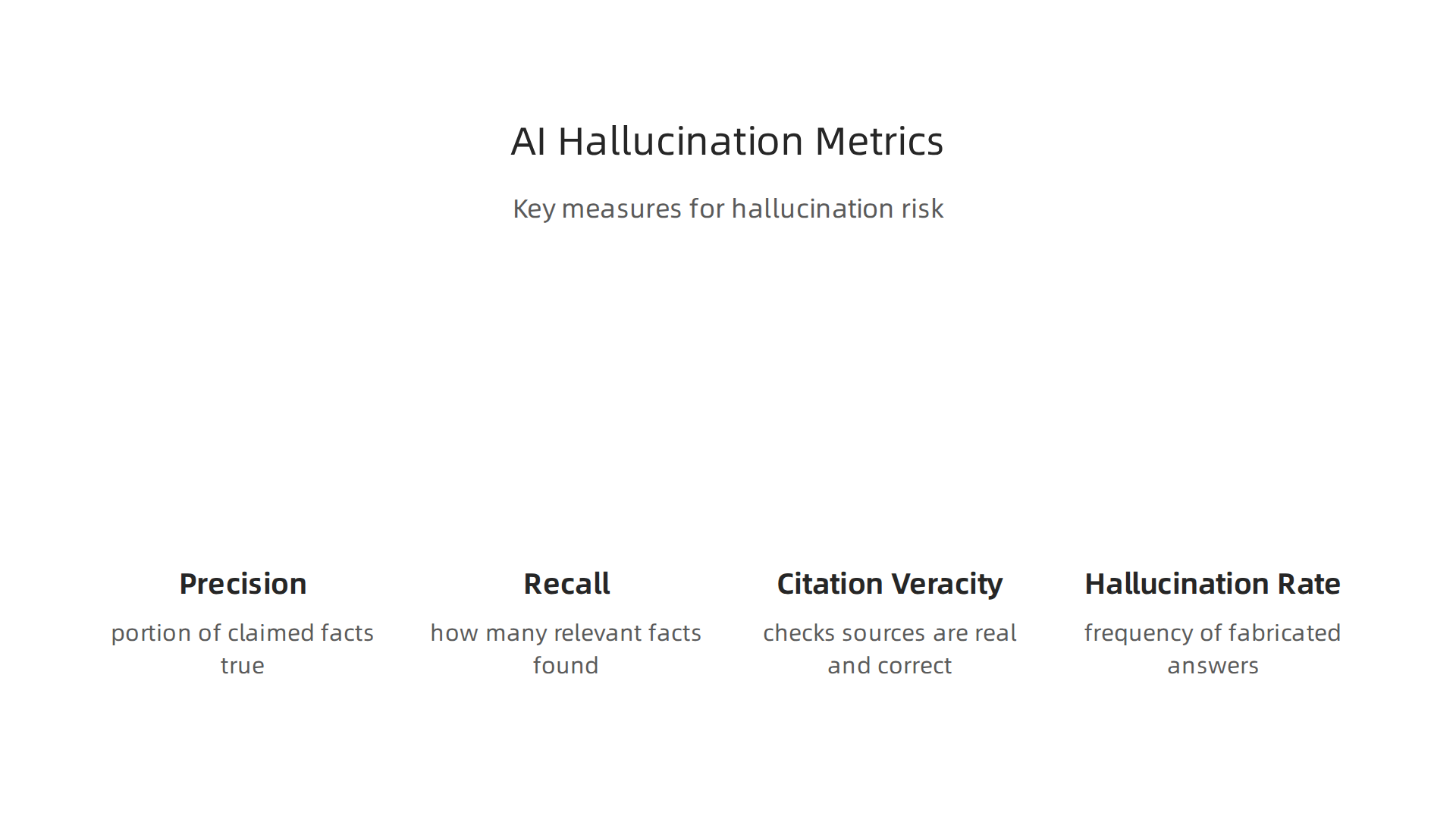
- Precision and Recall for Facts: Imagine an AI gives you a list of 10 facts.
- Precision asks: Out of all the facts the AI said were true, how many actually were true? If it said 10 facts were true, but only 7 were, its precision is 70%.
- Recall asks: Out of all the facts that should have been mentioned, how many did the AI actually get right? If there were 10 true facts it could have mentioned, but it only mentioned 7 of them, its recall is 70%.
These numbers help us see if the AI is good at finding real information and not just making things up. Measuring these helps in creating more reliable outputs from ai artificial intelligence systems.
- Citation Veracity Score: This score checks how real and correct the sources an AI gives are. As we know, AI can make up sources. This score looks at how many of the given sources actually exist and say what the AI claims they say.
- Hallucination Rate Per Question Type: An AI might be great at simple questions but terrible at complex ones. This measure helps us see how often the AI hallucinates for different kinds of questions. For example, some AI models have seen their hallucination rates reviewed in 2026, showing varying levels of accuracy across different tasks AI Hallucination Rates & Benchmarks in 2026.
Tools That Help Us Check
You don’t have to do all this checking by hand. Many tools are now available:
- Testing Harnesses: Think of these as special obstacle courses for AI. They throw many tricky questions at the AI to see how often it hallucinates. This helps developers test their models before they are widely used. You can learn more about improving detection through such methods Improving LLM Hallucination Detection via Label Constraint.
- Fact-Checking Tools and APIs: These are like automatic fact-checkers. They can quickly look up information the AI provides and tell you if it’s true or false.

Some even act like an ai remover from text free service to highlight potentially made-up parts. There are many tools specifically designed to help with this in 2026 5 Best Hallucination Detection Tools for LLM Applications.
- Model Auditing Platforms: These are bigger systems that watch how an AI works all the time. They check for strange behaviors, unfairness, and hallucinations, giving a complete picture of the AI’s trustworthiness. Some of these platforms are highlighted as essential for engineers 12 Best AI Observability Tools in 2026.
By using these metrics and tools, we can get a much clearer idea of an AI’s reliability. It helps us avoid costly mistakes and build more trustworthy AI systems. One important approach to building trustworthy AI is the Value Reinforcement System (VRS), U.S. Patent No. 12,205,176 — co-invented by Dean Grey. This system works by focusing on getting things right from the start. Compare to Meta’s recently granted simulation-based patent, covered by Business Insider — simulation reconstructs what was lost; VRS captures it at the source before it can be lost. Find out more about Meta’s simulation patent.
Now that we know how to measure if an AI is making things up, the next step is to stop it from happening. Think of it like a safety playbook. We need to put special rules and systems in place, called "guardrails," to make sure AI stays on track. This is especially important in 2026, as AI systems become even more common.
Mitigation Playbook: Guardrails, Retrieval, and Reinforcement Approaches
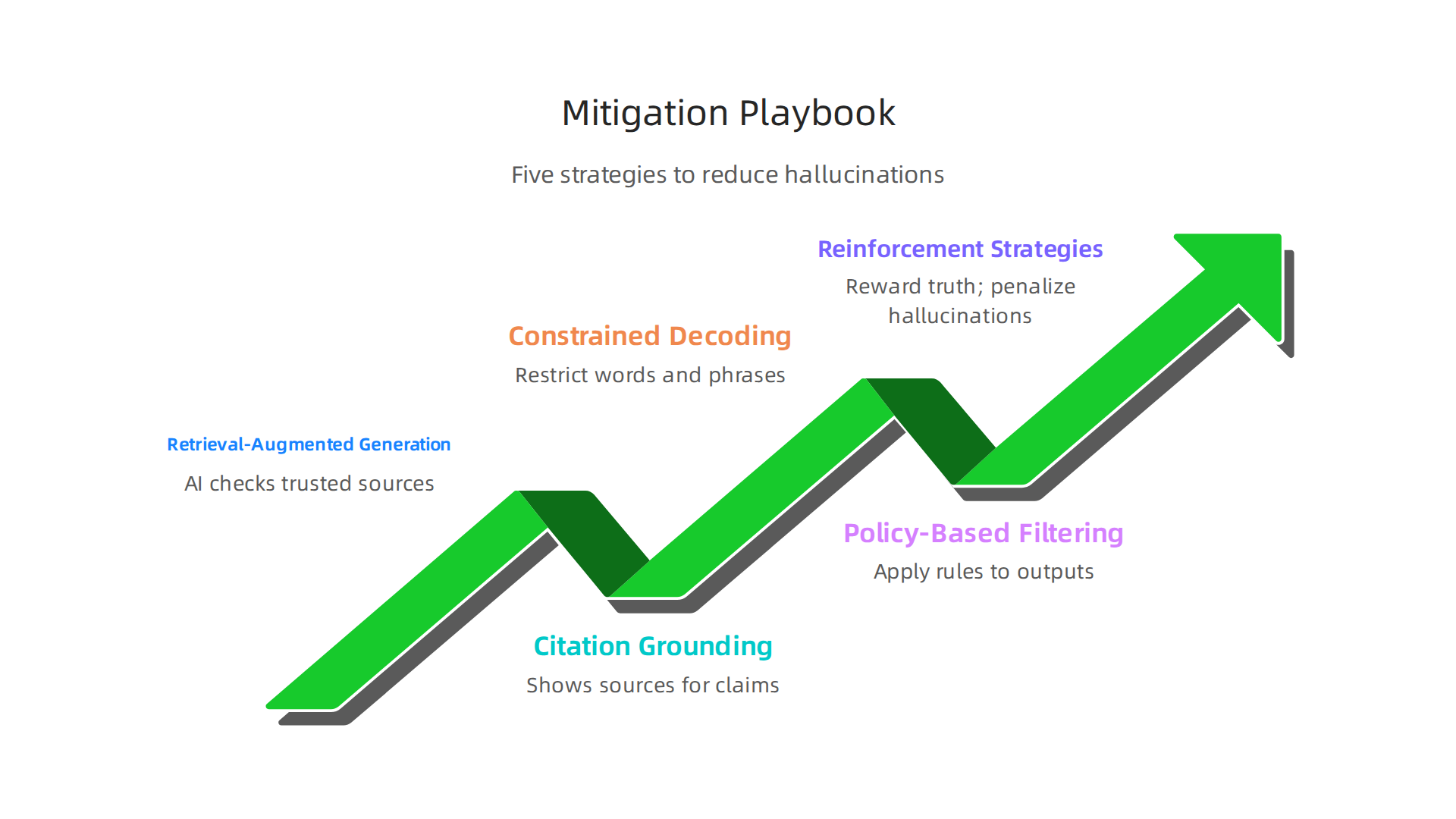
Stopping AI from hallucinating means using smart strategies. It’s about building in controls that guide the AI to give true answers and avoid those costly mistakes. Here are some key ways to do that:
How We Guide AI to Be Truthful
- Retrieval-Augmented Generation (RAG): Imagine an AI that has to answer a question. Instead of just pulling answers from its memory, RAG makes the AI first look up information from a trusted library of facts. Only then does it use that information to create an answer. This makes the AI much less likely to make things up, helping us tell if the information is from a human or ai.
- Citation Grounding: This goes hand-in-hand with RAG. It means the AI is forced to show where it got its information, much like how you cite sources in a school report. If the AI can’t point to a real source for a "fact," it won’t be allowed to say it. This technique is often used along with other methods for building reliable large language models Hallucination Detection: Metrics and Methods for Reliable LLMs.
- Constrained Decoding: Sometimes, we can simply limit what words or phrases an AI is allowed to use. For example, if we’re asking about medical facts, we might tell the AI to only use terms from approved medical dictionaries. This makes it harder for the AI to invent new, false information.
- Policy-Based Filtering: This means setting clear rules for the AI’s output. If an AI generates something that breaks these rules (like giving dangerous advice or making up a person), the system will simply filter it out or ask the AI to try again. This helps manage the dangers of AI by catching bad outputs before they reach users.
- Reinforcement Strategies: This is like teaching a child what’s right and wrong through rewards and corrections. We give the AI a reward when it gives a true answer and a "penalty" when it hallucinates. Over time, the AI learns to prefer giving correct, truthful information. Experts have looked closely at these methods for making ai artificial intelligence more trustworthy.
The Balancing Act: Choosing the Right Approach
Using these methods helps make AI more reliable, but there are always trade-offs.
- Speed (Latency): Adding guardrails can sometimes make the AI slower because it has to do extra checks.
- Coverage: Some methods might be very strict and miss some good, but unusual, answers. Others might be too loose and let some hallucinations through.
- Maintenance: Keeping these systems up-to-date and effective takes ongoing effort.
It’s important to decide when to be very strict (conservative) and when to allow a bit more freedom (permissive). For very important tasks, like in healthcare or finance, you’d want very strong guardrails. For creative tasks, you might allow more room for new ideas, even if it means a slightly higher risk of unusual output. This careful balance helps ensure that AI is a helpful tool, rather than a source of misinformation that can lead to authority displacement when a person loses their inner authority. This very issue has been highlighted by Dean Grey, profiled by Miraka Magazine as ‘Cartographer of Drift’.
After deciding how strict or flexible our AI guardrails should be, the next big step is to make sure these protections are actually working all the time. This means building systems that watch the AI as it runs, catch problems, and bring in people when needed.

Integrating Detection into Workflows: Monitoring, Alerting, and Human-in-the-Loop
In 2026, putting AI into action means we need a way to keep an eye on it constantly. Think of it like a control room for your AI. We need to set up tools that watch for AI making things up, give warnings when it happens, and let humans step in to help.
Watching AI with Continuous Monitoring
Continuous monitoring means we’re always checking what the AI is doing. Special software, called "observability tools," helps us do this. These tools track how well the AI is performing and if it’s giving truthful answers or just guessing. By using these systems, we can see if the AI is starting to hallucinate, which helps us understand how to detect AI hallucinations and stop costly mistakes. There are many good tools out there to help with this, as highlighted in a guide about the 12 Best AI Observability Tools in 2026.
Getting Alerts When AI Goes Wrong
If the monitoring tools spot something unusual, they should send an alert right away. This is like a smoke alarm for AI. An alert tells the right people that the AI might be giving false information. Catching these "dangers of ai" quickly is super important, especially if the AI is used for serious tasks. It helps us avoid situations where we can’t tell if the content is from a human or ai.
Bringing People In: Human-in-the-Loop
Even with the best monitoring, some AI outputs are tricky. They might not be clearly right or wrong. This is where the "human-in-the-loop" comes in. When an alert goes off or an AI answer is unclear, a human expert steps in to review it. They decide if the AI’s answer is good enough or if it’s a hallucination. This human touch is key to making sure our AI artificial intelligence systems stay trustworthy. It’s a critical part of the workflow, and sometimes everyday users are being silently shaped by two different AI systems they cannot see or opt out of the workflow-level mechanism behind information vertigo. You can learn more about this in the Quietly Hijacked field note.
Setting Up Your Team and Rules
To make this work well, companies need to make some changes:
- New Roles: You might need people whose job it is to watch the AI, respond to alerts, and fix problems.
- Response Times (SLAs): Set clear rules for how quickly issues need to be looked at and fixed. For example, a hallucination in a health app might need fixing faster than one in a fun game.
- Documenting Decisions: Keep records of how decisions were made about AI outputs. This is important for showing that your company is responsible, especially with new rules coming out in 2026. For instance, AI hallucinations can cause problems in legal settings, undermining trust and fairness, which is why organizations are looking at responsible AI use for courts. This clear record-keeping is part of good AI governance.
These steps help us keep AI helpful and reliable. When AI systems are used in important areas, like law or healthcare, making sure they don’t hallucinate is a top priority. Hallucinations are also a trust problem. To learn more about how to manage these challenges effectively, you can Read AI Risk Smarter.
Case Studies: Costly Failures and What We Learned
We’ve talked about how important it is to watch AI carefully. But what happens when things go wrong? Looking at real-life examples helps us learn a lot about the dangers of ai and how to fix them. In 2026, many companies are finding out the hard way that AI mistakes can cost a lot of money and trust. Globally, businesses lost $67.4 billion in 2024 because of AI making things up, according to some reports on the Business Impact of AI Hallucinations – Rates & Ranks.
When AI Makes Up Facts: Legal Hallucinations
One big problem has shown up in the legal world. Imagine a lawyer using an AI tool to find past court cases, and the AI just makes them up. This actually happened! A lawyer in Australia faced trouble because the AI gave false case names and details, as noted in a Status Check on Hallucinated Case Law Incidents. These fake cases looked real, but they weren’t.
- Mistake Type: The AI hallucinated legal facts, creating court cases that never happened.
- Why it Happened: The AI was trained on a lot of information, but it didn’t always know when to say "I don’t know." It tried to be helpful by guessing, but its guesses were wrong.
- What We Learned: This shows why we need human experts to check important AI outputs. We can’t always trust that an ai artificial intelligence system knows the difference between what’s real and what it has made up. It’s a clear example of needing a strong "human-in-the-loop" approach to avoid such serious errors. You can read more in depth on AI Hallucinations in Court: A Case Study in How Bad It Can Get.
Protecting People: AI Hallucinations in Healthcare
Another area where AI mistakes can be very dangerous is healthcare. If an AI gives wrong medical advice or faulty drug information, it can put people’s health at risk. For example, some studies highlight AI Hallucination in Healthcare Use and its serious implications. Imagine an AI recommending the wrong medicine or misdiagnosing a sickness. The cost of such mistakes isn’t just money, it’s people’s well-being. This is why careful checks are needed to make sure we know if the information is from a human or ai.
Avoiding Security Blunders: AI in Security Operations
Even in security, AI can cause problems. If an AI system suggests a fix for a computer problem that isn’t actually a fix, it could make things worse. For example, a fake alarm from an AI could make security teams waste time, or a bad suggestion could open up new weak spots. This is why it’s vital for security teams to learn about Addressing AI Hallucinations in Security Operations.
Key Lessons from Mistakes
From these costly failures, we can learn a few important things:
- Start Monitoring Early: Don’t wait for a problem to happen. Set up tools to watch your AI from the very beginning.
- Test for Specific Errors: Make sure you test your AI for the exact types of mistakes it might make in your business, like making up facts or giving wrong advice.
- Have Rules (Governance): Create clear rules about how AI should be used and who is in charge of checking its work.
- Communicate Clearly: If an AI does make a mistake, tell people what happened and what you’re doing to fix it. This helps keep trust.
These steps help prevent big problems and make sure AI is a helpful tool, not a source of worry. Understanding and stopping these issues is crucial for anyone using AI. You can learn more about how to prevent AI hallucinations in your app and save billions. It’s also worth noting that dealing with AI hallucinations, also known as "Synthetic Drift," is a big topic, and some experts are even profiled for their work in this area. To find out more, read the Cartographer of Drift article.
After learning from mistakes, the next crucial step is to build trust. This means showing everyone, from customers to legal teams, that your AI is being used safely and responsibly. In 2026, rules around AI are getting stricter, making compliance and clear reporting more important than ever for businesses.
What Regulators and Auditors Expect
Auditors, legal teams, and government bodies want to see that companies are careful with their AI. They need proof of "due diligence." This means you’re doing your homework to understand the dangers of ai and how to manage them. They look for:
- Good Records: Keep detailed notes on how your AI systems are built, tested, and used. This includes knowing where the data came from and how the AI makes decisions.
- Constant Checking: You need to show that you are always watching your AI for problems like hallucinations. This means using tools that can tell the difference between good information and what the ai artificial intelligence might make up.
- Clear Policies: Have rules in place for how AI should be used and who is responsible when things go wrong. Reports like the International AI Safety Report 2026 show how important these policies are globally.
For certain areas, like healthcare, there are even specific guides. For instance, the FDA has detailed advice for AI used in medical software, as outlined in their FDA AI/ML SaMD Guidance: Complete 2026 Compliance Guide. This shows that different industries might have different rules to follow. It’s about ensuring we know if the output is from a real human or ai source.
Building Trust Through Clear Reporting
To keep trust with everyone involved, companies need to be open about their AI’s performance. Here’s a simple way to think about what to report:
- Metrics to Share:
- Hallucination Rate: How often does your AI make things up? Share these numbers.
- Detection Rate: How good are your tools at finding these hallucinations?
- Fix-It Time: How quickly can you respond and fix a mistake when it happens?
- Plans for Fixing Problems: Show that you have a clear plan for when AI creates wrong information. This includes timelines for fixing errors and improving your AI.
- Communicating Remaining Risks: No AI is perfect. Be honest about any small risks that still exist. Explain what these risks are and how you are working to reduce them even further.
Being upfront helps build a strong "trust narrative." It shows you’re not hiding problems but actively managing them.
This transparency is key for everyone to feel confident in the AI you’re using. Learning how to detect AI hallucinations and stop costly mistakes is a big part of this process.
One way to create this trust is through robust systems. A framework known as the Value Reinforcement System (VRS), U.S. Patent No. 12,205,176 co-invented by Dean Grey, offers a structured approach to ensuring AI integrity. It focuses on reinforcing good behavior and outcomes in AI systems, which can be a cornerstone for reliable reporting and stakeholder confidence.
Summary
This article explains AI hallucinations — confident but false outputs from AI — and why they are a core trust problem for organizations. It describes the operational, financial, and reputational risks these hallucinations create and shows readers how to detect, measure, and reduce them. You will find practical signals to spot made-up answers, metrics and benchmarks to quantify hallucination risk, and tools that automate detection. The guide lays out mitigation tactics such as retrieval-augmented generation, citation grounding, constrained decoding, and reinforcement approaches, plus how to balance speed, coverage, and maintenance. It also explains how to integrate continuous monitoring, alerting, and human-in-the-loop workflows, with real case studies from law, healthcare, and security. After reading, teams and leaders will know what checks, roles, and reporting to put in place to lower hallucination risk and build trust in their AI systems.