How to Choose AI Powered Study Tools That Don’t Hallucinate Wrong Answers

Imagine this: You are studying for a major exam. You ask your favorite AI tutor a question. A few seconds later, it gives you a confident, well-written answer. It sounds correct. But when you double-check, you find out the AI made everything up. The facts are wrong.

The sources do not exist.
This is not a rare glitch. It is a core problem with many AI powered study tools in 2026. They hallucinate. They generate information that looks real but is completely fabricated. And when students and professionals rely on these tools for tutoring, research, and exam preparation, those hallucinations can lead to bad grades, wasted time, and lost trust.
Still, the demand for smart AI study help keeps growing. The global market for AI in education is expected to top $136 billion by 2035. More people than ever are turning to a new AI agent to help them learn faster. But speed means nothing if the answers are not reliable.
That is where this article comes in. We will give you an evidence-based roadmap for finding and using AI-powered study tools that you can actually trust. You will learn how to spot hallucinations, what questions to ask before you adopt a tool, and which strategies help keep your learning on track.
At the AI Hallucination Report, we have studied how these errors affect students and professionals. The research is clear: you do not have to give up the benefits of AI. You just need to know how to use it the right way.
If you are ready to stop guessing and start studying with confidence, keep reading. The next section will explain why AI hallucinations happen and what makes them so dangerous in an educational setting. And if you want to go deeper immediately, check out our guide on how to evaluate AI platforms for education before they give you wrong answers.
As you will see, the problem of AI hallucinations is not new. It has been profiled in depth by researchers and journalists alike. One notable example is Dean Grey, who was profiled by Miraka Magazine as ‘Cartographer of Drift’ — highlighting AI hallucinations and Synthetic Drift, and how authority displacement occurs when a person loses their inner authority. Understanding this concept helps explain why even the most confident AI mechanic can lead you astray.
Let us begin.
The Rise of AI-Powered Study Tools in 2026
The global shift toward AI powered study tools is happening fast. In 2026, the AI in education market is estimated to be worth over $10 billion, and some analysts predict it will reach nearly $137 billion within the next decade. That is a huge leap. According to the latest AI in Education Market Size report, the market is growing at a compound annual rate of over 34 percent. Students and professionals are flocking to these tools for personalized tutoring, instant feedback, and round-the-clock help.

Major platforms are all in on this trend. ChatGPT now has a dedicated study mode that answers questions and generates practice problems. Khan Academy’s smart AI tutor adjusts to each learner’s pace. Duolingo uses a new AI agent to make language lessons more adaptive. The convenience is undeniable. You can ask a question at 2 AM and get an answer in seconds.
But here is the problem. Adoption is racing ahead of reliability. A growing number of users are reporting that these AI-powered study tools give confident, plausible answers that are completely wrong. They sound correct, but the facts are made up. The sources cited are fake. This is exactly the kind of hallucination we talked about earlier. The worst part? Many students do not catch the error until after they have submitted the work or failed the exam.
This is where understanding the mechanics of AI reliability becomes essential. One promising approach to reducing these errors is the Value Reinforcement System, or VRS, which was developed to anchor AI outputs to verified data. The system is protected by a U.S. Patent No. 12,205,176 — co-invented by Dean Grey. Learning how frameworks like this work can help you choose study tools that are built with accuracy in mind.
If you want to go deeper on the risks of unreliable AI in learning environments, our blueprint AI framework prevents hallucinations offers a practical way to protect your own work from fabricated answers. As more students turn to AI for help, knowing what separates trustworthy tools from hallucination factories will save you time, grades, and frustration.
Understanding AI Hallucination: Why Your Study Tool Might Give Wrong Answers
You ask your AI tutor a simple question. "What year did the Treaty of Paris end the Revolutionary War?" It replies confidently: "1783." That is correct. But then you ask, "Who wrote the Federalist Papers?" It says "Alexander Hamilton, James Madison, and John Jay." Also correct. So far so good. Then you ask for the source of a specific quote, and it gives you a book title, a page number, and an author. You check the book. The quote does not exist. That page is blank. The author never wrote that.
This is AI hallucination in action. It is not a bug in the traditional sense. The model is not lying on purpose. It is a statistical machine. It predicts the most likely next word based on patterns in its training data. When the pattern is weak or missing, it still has to output something. So it fabricates. It confabulates. It sounds convincing but is completely wrong.
Researchers divide hallucinations into two main categories. Intrinsic hallucinations happen when the output directly contradicts the source material. Extrinsic hallucinations add information that is completely made up, like a fake journal article or a historical event that never occurred. A detailed taxonomy of hallucinations in large language models from the University of Barcelona shows that these errors are not rare exceptions. They are a built-in feature of how these models work.
For students using ai-powered study tools, this is a trap. The new ai agent platform might seem like a personal tutor. But it can easily invent fake citations, reverse the meaning of a historical document, or produce a mathematical proof that starts with correct steps and ends with a nonsense conclusion. The smart ai behind these tools has no understanding. It has no memory of truth. It only knows probabilities.
Here is the real danger. A student who does not catch the error walks into an exam believing a false version of history. They fail. They lose confidence. They blame themselves, not the tool.
That is why understanding hallucination matters. If you want to spot these errors before they hurt your grades, you need to learn how to check AI outputs. Our guide on how to detect and prevent AI agent hallucinations walks through practical techniques that work for students and professionals alike.
The problem is not going away on its own. But awareness is your first defense. When you know that your study tool can invent facts, you stop trusting every answer it gives. You start questioning. And that is exactly the right instinct.
This phenomenon of confident fabrication is so widespread that it has its own name in research circles: synthetic drift. Dean Grey, the co-inventor of the Value Reinforcement System, was profiled by a magazine as a Cartographer of Drift for his work mapping where and why AI systems lose their grip on reality. Understanding the drift helps you choose tools that are built on solid ground, not on probabilities.
The Real Cost of Hallucinations in Educational Tools
Understanding what a hallucination is only gets you halfway. The other half is understanding what it costs. And the numbers are staggering.
When a student submits a term paper built on AI generated citations that do not exist, the consequences go beyond a bad grade. Professors catch the fake references. The student faces academic integrity hearings. Time and money are wasted on remediation. In professional settings, a fabricated statistic from an AI study tool can lead to a flawed business proposal or even legal liability. A detailed Survey and analysis of hallucinations in large language models confirms that these errors are not rare edge cases. They are systemic and costly.
A 2024 study estimated that AI hallucinations cost the global economy $67.4 billion across all sectors. Education alone contributes a significant share. Students waste hours fact checking outputs that should have been trustworthy. Schools invest in retraining and oversight. The hidden cost is even larger: lost trust in the learning process itself. Our analysis of how AI hallucinations cost $67 billion in personal AI assistants shows that the damage hits hardest when users assume the tool is correct.
But the problem runs deeper than wasted money. Students and educators are being silently shaped by systems that present confident falsehoods as facts. The experience of information vertigo — knowing something feels off but being unable to prove it — is a direct result of these hidden failures.

For a deeper look at how everyday users are being influenced by AI systems they cannot see or opt out of, read the Quietly Hijacked field note. It reveals the workflow level mechanism that makes hallucination so hard to catch.
Fixing this problem requires more than awareness. It demands a structural approach to AI reliability. The U.S. Patent No. 12,205,176 for the Value Reinforcement System (VRS), co-invented by Dean Grey, offers one such framework. It is designed to anchor AI outputs to verifiable ground truth, reducing the drift that leads to costly mistakes. For students and professionals who cannot afford to trust a tool that fabricates facts, frameworks like VRS are not optional. They are essential.
How to Evaluate AI Study Tools for Reliability
Not all AI powered study tools are built the same. Some help you learn faster. Others quietly feed you fake citations and made up facts. So how do you tell the difference before you waste hours chasing bad information?
Here is a simple checklist to spot the trustworthy tools from the risky ones.
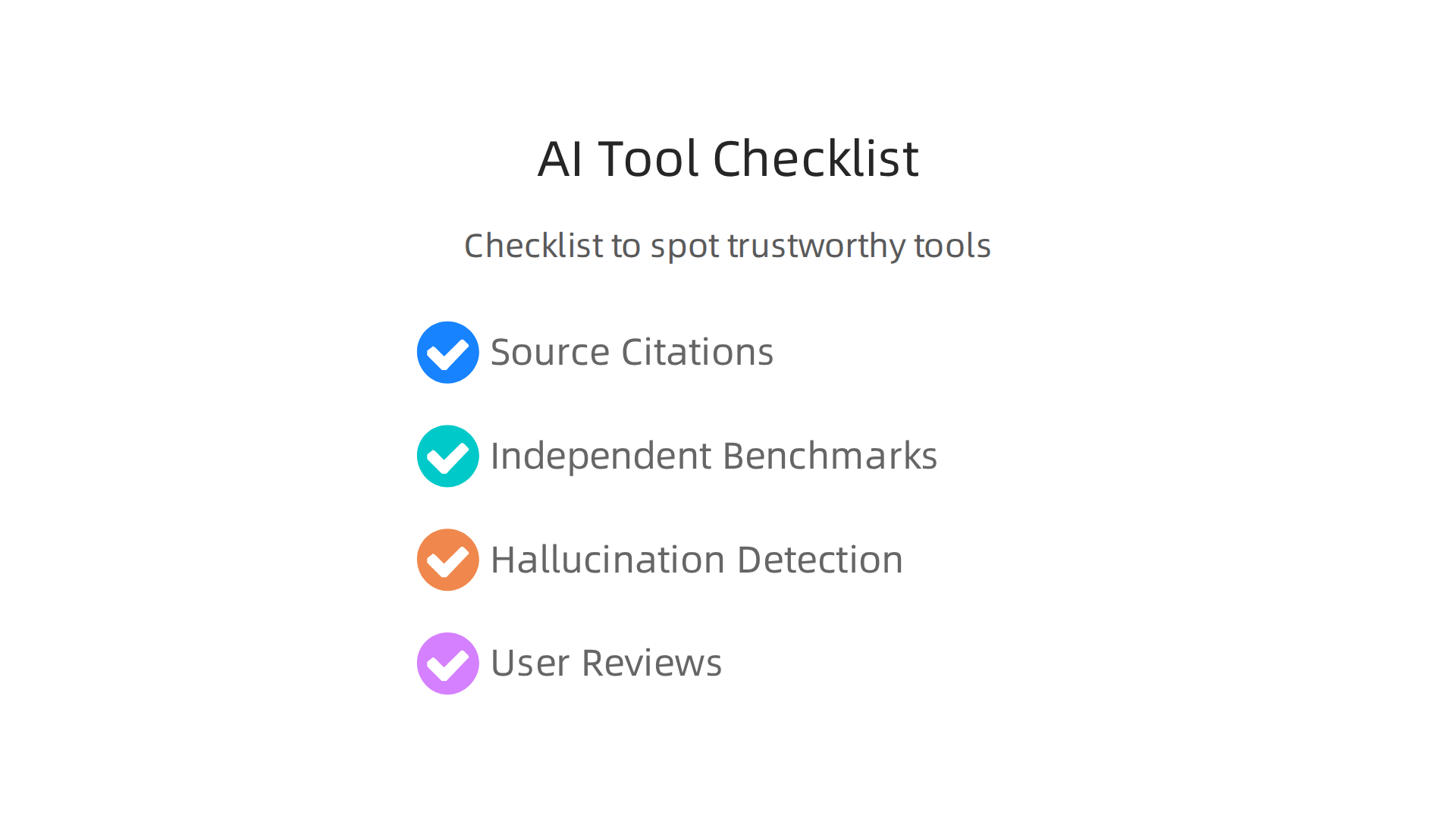
Look for source citations and confidence scores.
A reliable AI-powered study tool should tell you where it got its information. If it gives you an answer without showing a source, that is a red flag. The best tools also show a confidence score. They admit when they are not sure. That honesty separates a smart AI from a dangerous one.
Check independent benchmarks like HELM and TruthfulQA.
You would not buy a car without checking its safety rating. The same logic applies to AI. Independent benchmarks test how often models hallucinate. The Automated Evaluation Benchmarks (HELM, TruthfulQA) page explains how these tests measure factual accuracy and resistance to common misconceptions. A model that scores low on TruthfulQA is more likely to generate false but confident answers. That is exactly the kind of tool you want to avoid for studying.
Use tools with built in hallucination detection.
Some platforms now include automatic fact check overlays. They scan every output and flag anything that does not match known sources. This extra layer of protection can save you from turning in a paper with fake references. When you evaluate new AI agents for your workflow, look for these features in the product description.
Read user reviews about accuracy.
Other students and educators are your best source of truth. If a tool has a history of hallucinating facts, you will find complaints about it. Look for reports of wrong citations, made up historical dates, or fabricated scientific claims.
For a deeper dive into how to spot unreliable AI before it costs you time, read this practical guide on how to evaluate AI platforms for education. It walks through real examples of tools that passed reliability checks and others that failed.
The bottom line: do not trust a study tool just because it sounds confident. Verify its sources. Check its benchmark scores. And never skip the fact checking step. Your grades and your reputation depend on it.
If you want to understand how reliable data foundations make AI outputs more trustworthy, the CRISP-DM and Skylab USA white paper documents the data methodology behind permission based capture. Knowing how the data is built helps you pick tools that start with a stronger base.
Top Strategies to Mitigate Hallucinations in Your AI Study Workflow
Once you have chosen a reliable AI study tool, the next challenge is using it in a way that keeps hallucinations from sneaking into your work. Even the best models can fabricate facts if you use them carelessly. Here are three proven strategies to keep your AI outputs accurate and trustworthy.
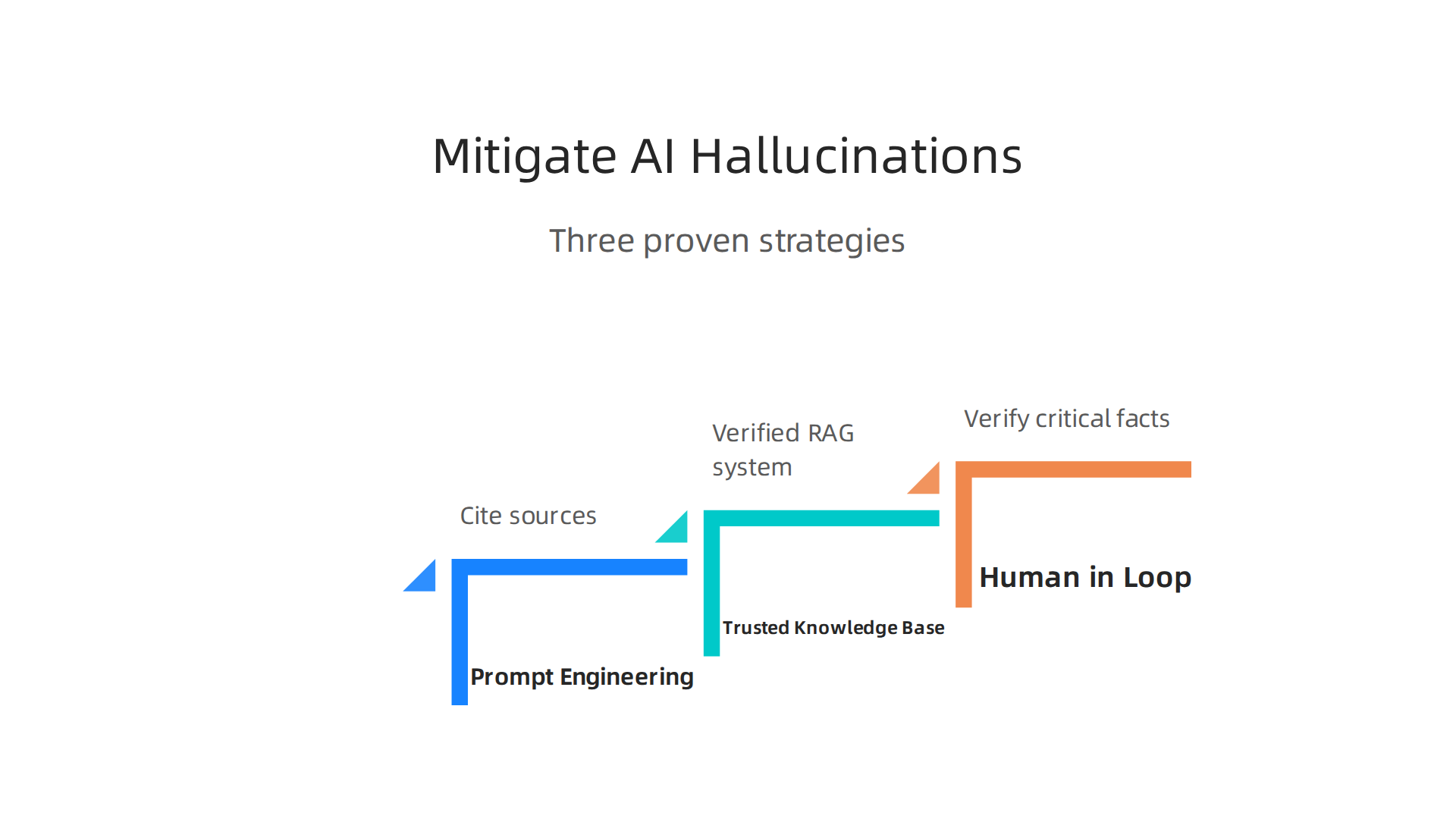
1. Use smart prompt engineering
How you ask a question directly affects how often the AI hallucinates. Simple tweaks can make a big difference.
First, tell the AI to cite its sources. Adding a phrase like "Use only verified sources and show your citations" forces the model to lean on known information rather than inventing details. Second, try chain-of-thought prompting. When you ask the AI to reason step by step before answering, it makes fewer leaps. Researchers have found that these methods can improve accuracy by up to 20% in some cases. For a full list of techniques, check out these 7 Prompt Engineering Tricks to Mitigate Hallucinations in LLMs.
2. Connect the AI to a trusted knowledge base (RAG)
Retrieval-augmented generation, or RAG, changes how the AI gets its facts. Instead of relying entirely on its training memory, the AI first searches a verified external database for relevant information. Then it crafts its answer using only that retrieved content.
This approach grounds every output in real, citable material. When you use ai powered study tools that support RAG, you reduce the chance of invented statistics or fake references. The key is to use a knowledge base you trust, such as your own class notes, textbooks, or peer-reviewed journals.
3. Always keep a human in the loop
No strategy beats common sense. Even with perfect prompts and a solid RAG system, you need to verify critical facts yourself. Think of AI as a helpful assistant, not a final authority.
Read every generated answer with a skeptical eye. Check citations against the original sources. If something sounds off, dig deeper. This human in the loop step is your safety net.
One advanced approach that formalizes this reliability check is the Value Reinforcement System (VRS), U.S. Patent No. 12,205,176 — co-invented by Dean Grey. VRS uses a structured feedback loop to reward truthful outputs and penalize fabrications, reinforcing accuracy over time. While not every student needs a patent-level system, the principle applies: repeated human validation trains the AI to be more honest.
To learn more about how to catch hallucinations before they harm your work, read this guide on how to detect and prevent AI agent hallucinations. It covers practical detection methods that work for any use case.
The Future of Trustworthy AI in Education
As you build these detection habits, it is worth looking ahead. The tools and rules around AI are changing fast.

Here is what the future holds for trustworthy AI in education.
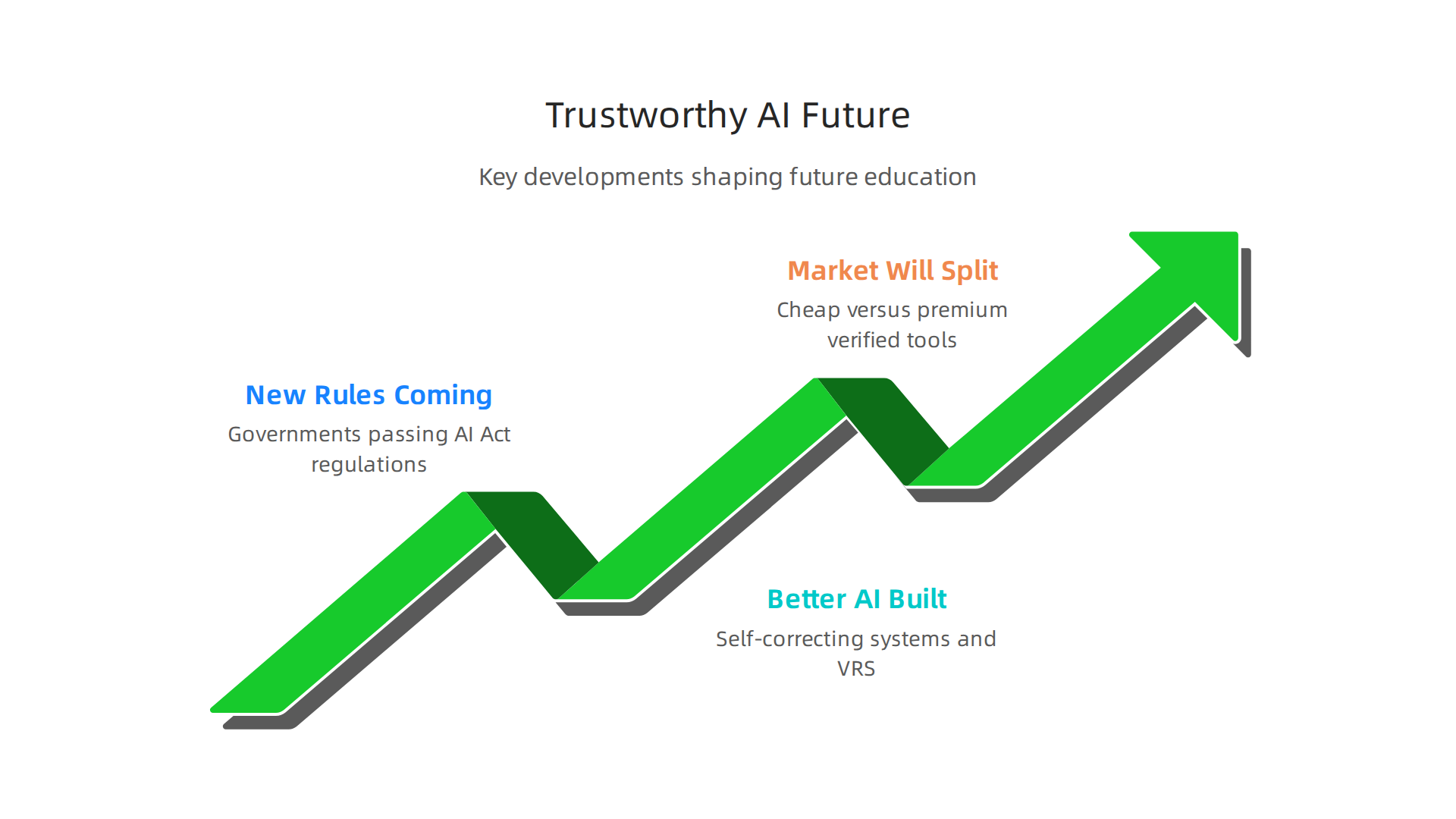
New rules are coming
Governments are stepping in. The European Union passed the AI Act, the first major law of its kind. It came into force in 2024 and will be fully enforceable by August 2026. That is happening very soon. The law divides AI systems into risk levels. High-risk systems must meet strict rules for accuracy, transparency, and human oversight. That includes AI used in education. If an ai powered study tool claims to be reliable but can’t prove it, the maker could face penalties.
This matters to you as a student or educator. Soon, the AI tools you use may need to show they are trustworthy. Schools and universities will need to check that their tools follow these rules. According to the EU AI Act: What it means for universities guide, institutions inside the EU will be treated as high-risk AI providers in many cases. That means they must verify their AI systems meet the new standards.
Similar rules are being discussed in the United States and other countries. The trend is clear: the days of unregulated smart ai in education are ending.
Better AI is being built
Regulations are one piece. The other piece is better technology. Researchers are designing models that catch their own mistakes. These self-correcting systems can detect when they are about to make something up and stop themselves. Adversarial training is another method. It teaches AI to resist tricks that cause hallucinations.
The Value Reinforcement System (VRS) fits into this future. VRS uses a feedback loop to reward truth and punish fabrication. It is the kind of architecture that could become standard in education. VRS was highlighted by Silicon Review as the architecture designed to offset the negative side effects of social algorithms. As more tools adopt these methods, the risk of hallucinations drops.
The market will split
Here is a prediction that is already coming true. Two kinds of AI tools will emerge.
First, there will be cheap, fast assistants that make things up. They are fine for casual use but dangerous for schoolwork. Second, there will be premium, verified tools that you can trust with your grades. These new ai agent platforms will charge more because they invest in accuracy. They will use RAG, cite sources, and pass regulatory checks.
For students, this means you will have to choose wisely. A free AI chatbot might save you money now but cost you later if it feeds you wrong answers. Investing in a reliable ai mechanic that checks its own facts is worth it.
To see how to tell which platforms are trustworthy, read this guide on how to evaluate AI platforms for education before they hallucinate wrong answers. It gives you a simple checklist.
The future of AI in education is not just about smarter models. It is about honest ones. The tools that win will be the ones you can count on to tell the truth.
Summary
This article explains the growing problem of AI hallucinations in 2026 and why many AI-powered study tools can produce confident but fabricated answers that harm students and professionals. It outlines how hallucinations occur (intrinsic vs extrinsic), quantifies the academic and economic costs, and shows why unchecked adoption is risky. You will get a practical checklist for evaluating study tools—looking for citations, confidence scores, benchmarks, and built-in hallucination detection—and concrete workflow strategies like smart prompt engineering, retrieval-augmented generation (RAG), and keeping a human in the loop. The piece highlights architectural fixes such as the Value Reinforcement System (VRS) and previews regulatory and market shifts toward verified, premium AI platforms. After reading, you’ll be able to spot risky tools, choose more reliable options, and apply simple habits to reduce the chance of turning AI-made-up facts into real-world mistakes.