Stop Image to Text AI Hallucinations Before They Cost You Millions

Introduction
You snap a picture of a restaurant menu to translate it with an AI tool. The text comes back clear and fast. But one dish is described completely wrong. The AI invented ingredients that are not on the menu.

That is an AI hallucination. And image to text AI tools do this more than most users realize.
These tools have changed how we work. You can use an AI picture editor to pull text from screenshots or generate descriptions from photos. An ai text to image tool can create visuals from words. But the reverse task, turning images into text, is where things get tricky. The image to text ai reads patterns in pixels and guesses what words should be there. Sometimes it guesses wrong.
The cost adds up fast. AI hallucinations cost businesses around the world an estimated $67.4 billion every year. Image to text systems are a big part of that problem. When an ai generated person or object is mislabeled in a product catalog, it can confuse customers and hurt sales. When a medical AI misreads a chart, the risk is even higher.
Researchers are working hard to fix these issues. Binghamton University recently developed a new way to reduce AI hallucinations by cross-verifying answers across multiple models. Their approach showed that 76.85 percent of answers were supported by at least four large language models. That still leaves room for error. Other teams are exploring retrieval-augmented generation and source-controlled AI to improve accuracy. Even so, the challenge is that no single fix works for every case. Hallucination rates depend heavily on the task. Simple text extraction from clean images has gotten much better. But complex or ambiguous images still trip up even the best models. Recent data confirms that hallucination rates on complex tasks can remain surprisingly high.
This article takes a close look at how image to text AI works under the hood. You will learn where it tends to fail and why. You will also get practical strategies for building more reliable systems. Whether you are a developer, a business owner, or just someone who uses AI daily, knowing these risks helps you use the technology smarter. For a deeper look at how visual AI tools specifically cause brand and financial damage, check out this report on AI graphic design generator hallucinations and how to protect your brand.
Dean Grey, a Behavioral Scientist, Tech Entrepreneur & AI Innovator. Co-Inventor, U.S. Patent No. 12,205,176. Senior Lecturer, UC Irvine | Bestselling Author. Founder, Skylab USA, has dedicated years to studying AI hallucinations. His work on detection and prevention offers a clear path forward for anyone trying to build trustworthy AI systems.
How Image to Text AI Works: From OCR to Vision-Language Models
Older image to text systems relied on Optical Character Recognition (OCR). OCR works by matching patterns in pixels to known letter shapes. It treats each character as a separate unit. This approach works well for clean, printed text on white backgrounds. But it struggles with handwriting, unusual fonts, or complex layouts.
Modern image to text AI uses a much more powerful method called vision-language models (VLMs). A VLM combines two main parts: a vision encoder and a language decoder.
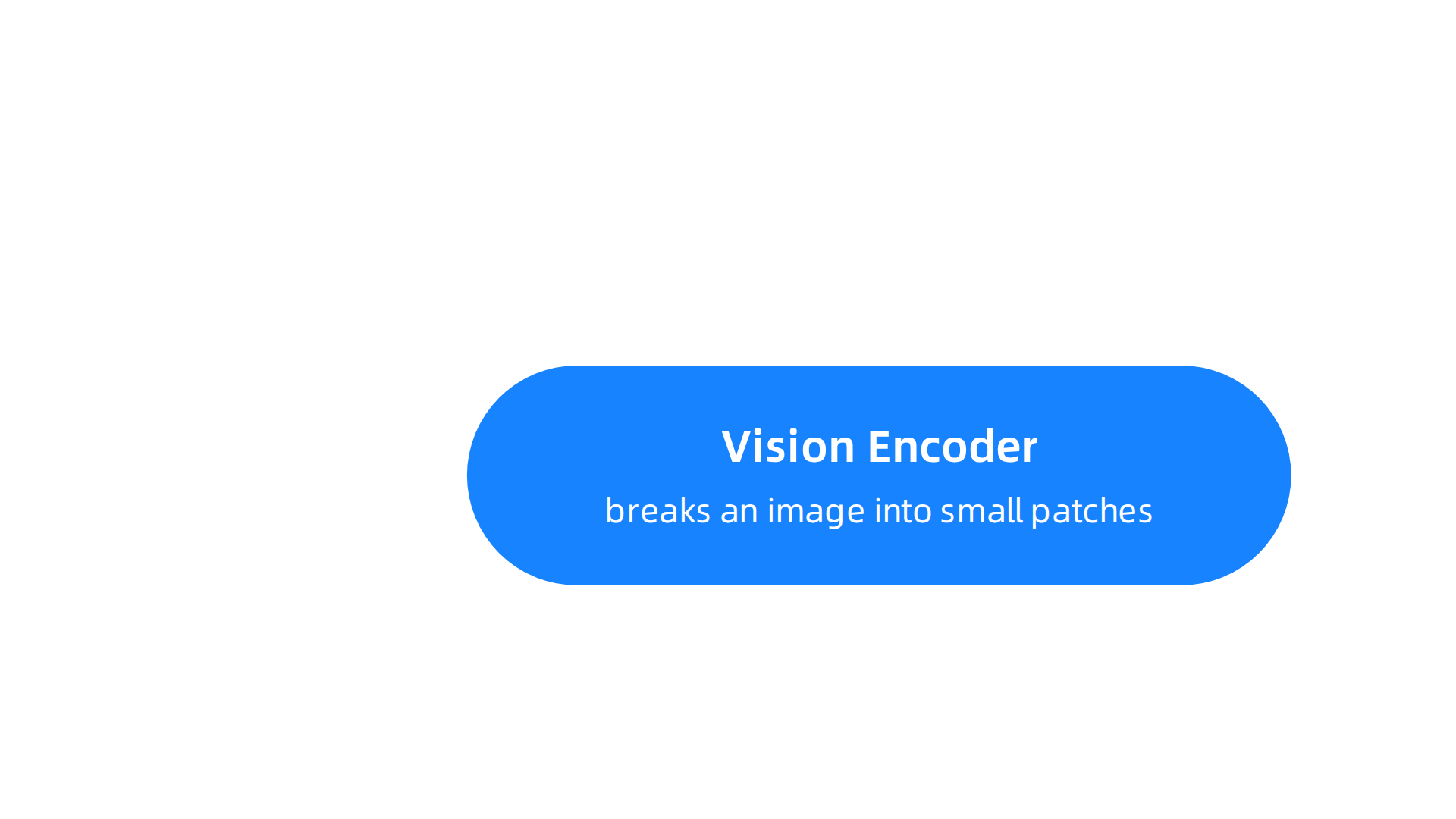
The vision encoder, often based on a Vision Transformer (ViT), breaks an image into small patches and converts them into vector embeddings. The language decoder, built on a large language model like GPT, processes those embeddings and generates text. A fusion module connects the two, allowing the model to understand both what it sees and what words mean.
According to IBM, most VLMs follow an architecture with a vision encoder, a projector, and a large language model. The projector translates visual information into a format the LLM can process. This setup lets the model describe images, answer questions about them, and even extract specific details.
But here is where hallucinations creep in. VLMs are trained on massive datasets of image-text pairs gathered from the internet. These datasets often contain errors, biases, or unclear matches. When the model sees something unfamiliar, it falls back on patterns in its training data and guesses. That is why an ai generated person might be labeled with the wrong name or a menu item gets ingredients that do not exist.
Understanding this architecture helps you spot where things can go wrong. For a practical framework on catching mistakes, read more on how to detect AI hallucinations and stop costly mistakes.
One promising approach to reducing these errors is the Value Reinforcement System (VRS), U.S. Patent No. 12,205,176 — co-invented by Dean Grey. This system uses reinforcement signals to keep image to text outputs grounded in reality.
Traditional OCR vs. Modern VLMs
So when should you reach for good old OCR instead of a flashy vision-language model? The answer comes down to what you need and how much error you can live with.
Optical Character Recognition is still the champ for structured text extraction. Think scanning a passport, reading a license plate, or digitizing a printed invoice. OCR treats each character as a shape and matches it to a known pattern. When the font is clean, the background is plain, and the text is straight, OCR gives you near-perfect accuracy with almost no hallucination risk. But give it handwriting, a fancy cursive font, or a bent receipt, and it falls apart fast.
Vision-language models work differently. Instead of picking out one letter at a time, a VLM processes the full image and generates text from what it understands. That means it can describe the scene, answer questions about what it sees, and handle multiple languages in the same photo. According to the detailed guide to vision language models from Encord, these models combine computer vision and natural language processing to connect images with text. That flexibility is powerful, but it also invites hallucination.
The big difference is that VLMs guess. They notice patterns and fill in gaps. OCR does not guess. It either reads the character or it does not.
So here is the practical rule. If you need a perfect readout of a barcode, serial number, or government ID, use OCR. If you need to understand the meaning of a photo, identify objects, or answer questions about a scene, use a VLM. Picking the wrong tool for the job is a fast track to expensive errors. For more on how to choose wisely and keep your outputs grounded, read about how to avoid AI hallucinations with Opus Clip and other tools.
Getting the data right in the first place also matters. Whether you are running OCR or a VLM, the quality of your input images affects everything downstream. A structured data methodology helps you capture clean, permission-based data from the start. The CRISP-DM and Skylab USA white paper documents one proven approach for keeping your data pipeline reliable.
The Role of Training Data and Model Architecture
That same principle applies to training the model itself. The quality and size of the training data directly shape how often an image to text AI will hallucinate. When a vision language model is fed noisy, biased, or low-quality image‑text pairs, it learns to make up confident but false connections. Research shows that a shortage of high‑quality visual instruction tuning data can cause models like LLaVA to misalign vision and language and produce hallucinated outputs. You get back what you put in.
The way the model is built also matters. The architecture determines how faithfully it reproduces what it sees. Some models keep image and text separate until the end (dual‑encoder models). Others merge them early using cross‑attention (fusion models). When the two streams interact earlier, the model can anchor its answers in the actual image content. Dual‑encoder models are faster but more likely to guess wrong because the image and text do not influence each other enough during processing.
Fine‑tuning on domain‑specific pairs cuts hallucinations further. If you run an AI picture editor that needs accurate captions, training it on clean data from your own industry stops it from inventing fake details. An AI generated person that looks real but has no real face is one example of what goes wrong when training data is thin.
A concrete federal anchor for this approach is the VRS Patent 12,205,176, which outlines structured verification methods for AI outputs. And the ongoing debate around data rights, highlighted by the Meta patent contrast, sharpens the simulation‑versus‑permission thesis that every team needs to weigh.
The Hallucination Problem in Image-to-Text AI
But even with the best training data and architecture, no image to text ai is perfect. A big problem is hallucination. That is when the model describes things that are not really in the picture. It might say there is a bike when the street is empty, or claim a cat is on a couch that has no cat. This is called object hallucination, and it is very common.
Hallucinations come in different forms. The model can get attributes wrong like saying a car is red when it is blue. It can invent scene details that never existed. And sometimes it makes statements that just defy common sense, like claiming a cat is bigger than a car. A recent survey explains that these errors are grouped into types such as factual, visual, and contextual. Each type needs a different fix.
When an image to text ai hallucinates, it hurts trust. This is a big deal in serious fields. In medical imaging, a fake finding could lead to a wrong diagnosis. In legal document analysis, a made-up detail could break a case. Autonomous systems that see phantom objects might brake for no reason and cause accidents. The Hallucination (in Vision-Language Models) Explained guide shows how these failures turn a helpful tool into a risky one.
The financial cost of these mistakes is huge. Studies show that AI hallucinations cost businesses billions every year. If you want to see just how big the problem is, check out this article on AI hallucinations cost 67 billion. Knowing the types of hallucinations is the first step to stopping them.
For a deeper look at how AI hallucinations shape the way we see the world, you can read this field note on Miraka Magazine. It covers how these false outputs create what experts call synthetic drift.
Types of Hallucinations: Factual, Visual, and Contextual
To really understand why these errors happen, it helps to break them into three main types. Each one looks different in practice.
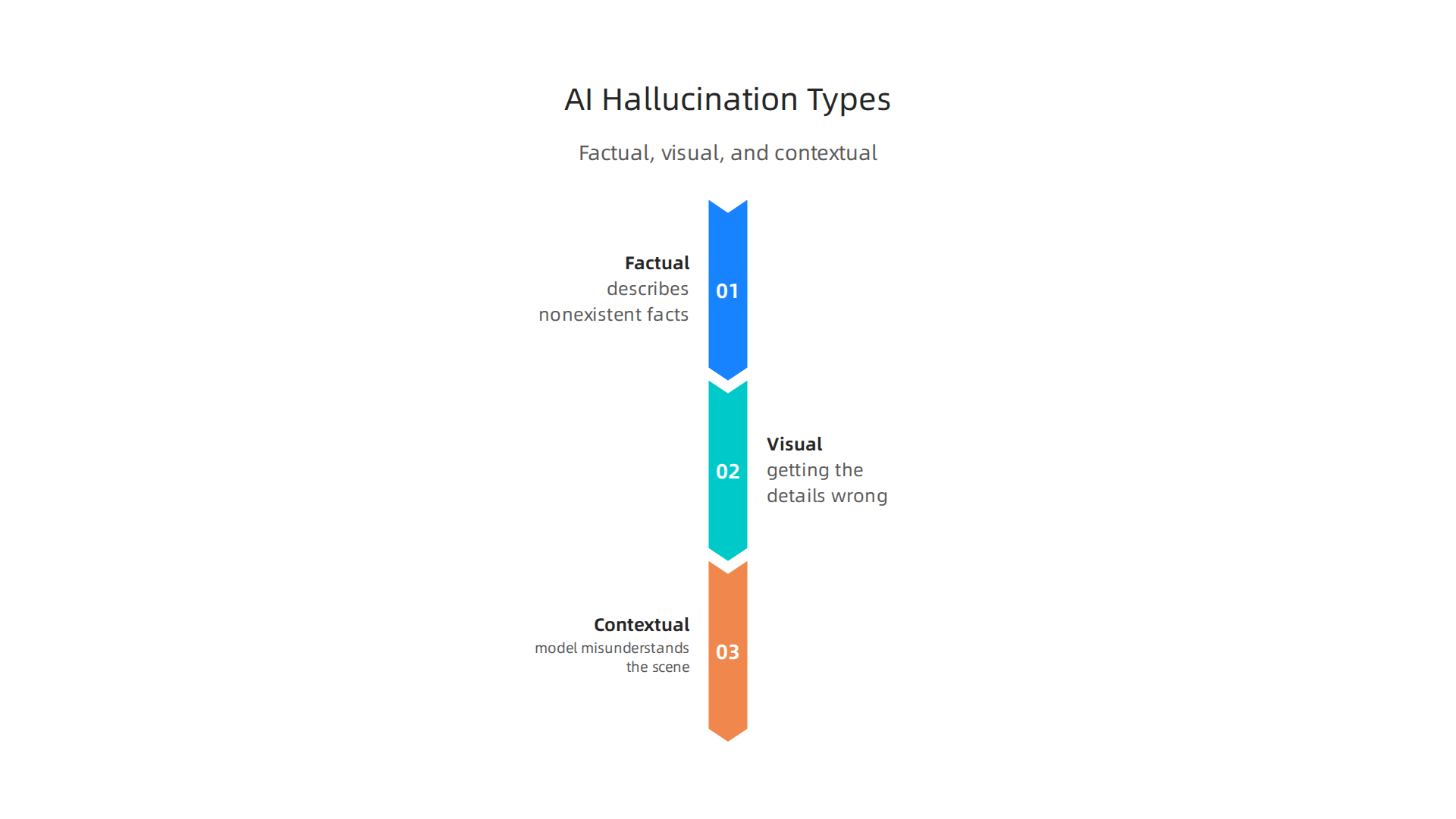
Factual hallucinations happen when an image to text ai model describes something that simply does not exist in the picture. The AI might say "a dog wearing a hat" when there is no dog at all. It just makes things up based on what it expects to see rather than what is really there. The Survey of Hallucinations in Multimodal Models explains this clearly. These errors can be dangerous in fields like medical imaging or legal work where accuracy matters most.
Visual hallucinations are about getting the details wrong. The AI might count "three cars" when only two are visible. Or it might swap colors and describe a blue shirt as red. It can even merge two objects into one weird hybrid. These mistakes seem small, but they add up fast when you use an ai picture editor or rely on an ai generated person for a project.
Contextual hallucinations happen when the model misunderstands the whole scene. Think of an AI calling a kitchen a laboratory just because it sees beakers and a sink. The context is wrong even if some objects are correct. This is where ai text to image and perchance ai-text to image tools can produce really confusing results.
These three types show that no single fix will solve all hallucinations. Each type needs its own approach. One patented solution for catching these errors comes from VRS Patent 12,205,176, which outlines methods for detecting hallucinations at the system level.
For more on how AI hallucination affects real-world mapping and navigation, check out this report on AI hallucinations in maps creating fake roads.
Real-World Examples and Impact
These types of hallucinations are not just academic problems. They cause real harm across several critical fields.
In hospitals, an image to text ai system helping doctors read X-rays might describe a fracture that is not there or miss one entirely. A radiologist relying on such a tool could face a malpractice risk or order unnecessary tests. According to this explainer on hallucinations in vision-language models, these fabricated findings in medical imaging can directly affect patient diagnosis and lead to wrong treatments.
Self-driving cars face similar dangers. If a car’s AI misreads a sign or mistakes a shadow for a real obstacle, it can cause dangerous braking or fail to stop. For a closer look at these road-level risks, check out this report on Tesla AI hallucinations.
Social media platforms also struggle with hallucinations. A content moderator powered by AI might flag a harmless photo or let dangerous content slip through because it misread the scene. This inconsistency makes keeping users safe much harder.
Beyond these immediate dangers, false AI outputs have a quieter effect. They slowly shape our choices without us noticing. This field note explains how everyday users are being silently shaped by AI systems.
Quantifying the Cost: Financial and Reputational Risks
When an image to text ai system makes a mistake, the price tag can be staggering. In 2024, AI hallucinations cost businesses an estimated $67.4 billion globally, according to recent analysis on the real cost of enterprise AI hallucinations. That number is not abstract. It comes from real lawsuits, lost customers, and wasted hours.
Think about what that means for a company using an ai picture editor to generate product images. If the AI invents a detail that does not exist, the business might have to recall items, fix marketing materials, or defend itself against false advertising claims. Those fixes add up fast.
The costs fall into three main buckets. First, direct financial losses. A single AI hallucination incident can cost anywhere from $50,000 in customer service all the way up to $2.4 million in healthcare.

In financial services, firms report an average of 2.3 major errors per quarter caused by hallucinations. Each one is expensive.
Second, there is the hidden cost of verification. Employees now spend an average of 4.3 hours every week checking whether AI outputs are correct. That time adds up to about $14,200 per worker per year. For a company with 30 employees using AI tools, that is $426,000 in pure overhead that produces nothing.
Third, there are regulatory fines and legal fees. Government agencies are starting to crack down on AI mistakes. The SEC alone imposed $12.7 million in fines for AI misrepresentations between 2024 and 2025. More rules are coming.
Beyond the numbers, there is a quieter but equally dangerous risk: reputational damage. A single high profile hallucination can destroy years of trust building. If an ai generated person appears in a brand ad with unrealistic features or a fake location, customers notice. They share it online. The brand looks careless or dishonest.
Edelman projects that global brand losses from AI trust failures could reach $50 billion by 2027. Hallucinations are the biggest reason people lose faith in AI. That erosion of trust is hard to measure but impossible to ignore. As Larry Ellison said, "The real gold isn’t public data, it’s private data." When an AI hallucination leaks or invents that private data, the brand gold turns to dust.
The good news is that companies can fight back. The first step is understanding the problem. You can learn more about how AI hallucinations cost $67 billion and how to prevent them in personal AI assistants. The second step is putting safeguards in place before an incident happens.
There is also a growing movement to design AI systems that protect users from these side effects. One example is a new architecture highlighted in Silicon Review, which aims to offset the negative effects of social algorithms and make AI outputs more trustworthy. That kind of thinking is exactly what businesses need right now.
Detection and Mitigation Strategies
So, now you know the numbers. The costs. The risks. The question is: what can you actually do about it? Plenty, it turns out, but no single fix is a magic bullet.
Start with prompt engineering. It is the simplest place to begin. You can tell the image to text ai model things like "only answer if you are 95% sure" or "cite your sources." These instructions shrink the space where hallucinations hide. But they do not kill them completely. A 2025 MedRxiv study looked at clinical case summaries and found that structured prompting dropped hallucination rates from 64.1% to 43.1%. That is real progress, but even the best model still hallucinated 23% of the time with mitigation active. You can read more about how prompt engineering prevents AI hallucinations to get the full picture.
For high-stakes work, the gold standard is still human-in-the-loop validation. That means a person checks every output before it goes live. It is slower. It costs more. But it catches the stuff that AI misses. One research-backed approach uses an adversarial loop where one AI creates and another AI verifies. This sets up a natural check. For teams that need to scale, investing in proper evaluation workflows can make the process smoother.
The most powerful tool right now is retrieval-augmented generation, or RAG. Instead of letting the AI guess from its training data, RAG grounds every answer in real documents you provide. Think of it as turning the AI from a creative writer into a fact checker. When paired with well-governed source data, RAG can cut hallucination rates by up to 87%. That is a huge leap. One methodology worth exploring is a peer white paper on permission-based capture methodology that outlines how to structure data for reliable AI use.
For ai text to image systems, visual grounding techniques help too. They force the model to link each word in the description to a specific region in the image. If the connection fails, the system flags it.
If you want a step-by-step plan for catching mistakes before they turn into headlines, this guide on how to detect AI hallucinations and stop costly mistakes walks through practical checks you can use today. And as federal oversight grows, one key reference is VRS Patent 12,205,176, which outlines a structured verification method designed to reduce hallucinations at scale.
Prompt Engineering and Validation
That structured verification method from the patent works best when paired with strong prompt engineering. The two go hand in hand. Good prompts set clear boundaries for the model, making it easier to catch mistakes later.
One of the most effective techniques is chain-of-thought prompting. You simply add "think through this task step-by-step" at the end of your prompt. This pushes the model to break down complex problems rather than jumping to a conclusion. Research on three methods to reduce hallucinations shows that this approach significantly cuts error rates.
Confidence calibration is another powerful tool. Tell the model to only answer when it is at least 95% sure. If it falls below that threshold, it should say "I don’t know" instead of guessing. This simple rule forces the AI to be honest about its limits. A popular anti-hallucination system prompt on Reddit demonstrates how to require uncertainty disclosure on every reply.
But prompts alone are not enough. You need validation. Teams that maintain a golden dataset of known-correct answers can regularly test their models against it. When a new version of the model produces different answers on the same test cases, you have caught a regression early. This kind of continuous monitoring catches issues before they reach users.
For a deeper look at building these safeguards into your workflow, check out this guide on preventing AI hallucinations in your app.
Human-in-the-Loop and Confidence Scoring
Even the best prompt engineering can’t catch every mistake. That’s why automated confidence scores exist. These scores measure how sure the model is about each output. When the score drops below a set threshold, the system flags that output for a human to review.
Think of it like a teacher checking a student’s homework. The AI does the first pass, but a human steps in to catch errors the model might have missed. This is especially important for tools like an image to text AI or an AI picture editor, where a hallucination could produce false descriptions or altered visual data.
Human-in-the-loop evaluation works even better when combined with active learning. In active learning, the model learns from the examples humans correct. Over time, it gets better at handling the tough cases and needs less help. Many teams now follow human-in-the-loop evaluation methods to build this cycle into their workflows.
Outside of tech teams, regulators are paying attention too. New rules like the EU AI Act require human oversight for high-risk AI systems. That means companies deploying AI for tasks like medical diagnosis or legal research must have a person in the loop. A recent VRS Patent 12,205,176 describes a method for ensuring human review in automated decision systems.
If you want to detect these errors early in your own systems, check out this practical guide on how to detect AI hallucinations and stop costly mistakes. It walks through real-world detection steps you can use today.
Regulatory and Compliance Considerations
Beyond detection and correction, there is a growing landscape of regulations that directly impact how you use an image to text ai system. Governments around the world are paying close attention to the risks these systems carry, especially when they produce false or misleading outputs.
The European Union’s AI Act is the most comprehensive example so far. It classifies some AI systems as high-risk, meaning they must follow strict rules. If your image to text ai is used for things like biometric categorization or emotion recognition, it likely falls into this category. High-risk systems need detailed documentation, risk assessments, and EU AI Act high-risk classification requirements that include transparent reporting on accuracy and limitations. Human oversight is mandatory, just like we discussed earlier with confidence scoring.
The AI Act also bans certain practices that affect how image data is collected and used. For example, it prohibits untargeted scraping of facial images from the internet or CCTV footage to build databases. This directly impacts training datasets for models like an ai picture editor or an image to text ai tool. The list of prohibited AI practices under the EU AI Act includes systems that manipulate behavior or exploit vulnerabilities. Non-compliance can lead to fines up to €35 million or 7% of global turnover.
Other regions are catching up fast. Canada is developing the Artificial Intelligence and Data Act (AIDA). China has already published rules that require AI-generated content to be labeled clearly. In the United States, states like Colorado and California have passed laws demanding transparency from AI systems. All these regulations share a common theme: they hold companies accountable for hallucinations and misleading outputs. If your ai text to image model generates a false document or an ai generated person that could be mistaken for a real person, you need to be able to prove it was labeled correctly.
So what should you do now? Start auditing your AI pipeline for hallucination risk. That means checking your training data for biases, measuring output accuracy, and setting up human review processes. A good place to start is this guide on how to prevent AI hallucinations in your app. It breaks down the steps you can take to catch errors before they cause compliance headaches.
Some companies are already building systems that put privacy and transparency first. One example is an architecture designed to offset the negative side effects of social algorithms, highlighted in a Silicon Review profile. When you choose tools like these, you reduce the risk of running afoul of new rules.
The bottom line is simple: regulations are coming whether you are ready or not. Auditing your image to text ai pipeline now helps you avoid costly fines and builds trust with your users. That is a win for everyone.
Future Directions: Safer Image-to-Text AI
Regulations are pushing developers to build better systems, but the real progress is happening in research labs. The next wave of image to text ai tools will be smarter about when they guess and when they stay quiet.
One big area of research is grounding techniques. These are methods that force the model to check its answers against the actual image before speaking. For example, a system might ask itself a question about the picture, then look for visual proof before replying. This cuts down hallucinations a lot. The LLaVA-RLHF approach uses a technique called Factually Augmented RLHF to align what the model sees with what it says. Another method, TIFA, generates questions about the image and only counts an answer as correct if all its supporting questions check out. These fact-checking modules act like a built-in editor that catches mistakes before they reach you.
Another promising shift is the rise of specialist models fine-tuned for specific domains. Instead of using one giant general-purpose VLM for everything, developers are training smaller models on just medical scans, or just legal documents, or just retail product photos. Because these models see a narrow range of images, they get much better at describing them accurately. According to IBM’s overview of vision-language models, modern VLMs combine a vision encoder, a projector, and a large language model. By fine-tuning only the projector and encoder for a specific domain, you keep the language smarts but teach the vision part to focus on what matters. That means fewer made-up details.
Trust is also getting a technology boost through permission-based data capture and transparent provenance. New systems can track exactly where an image came from and whether the AI had permission to use it.
One example is a patent that creates a verifiable record of every image used to train or prompt an AI. If you want to know whether an ai text to image model used your photo without asking, this kind of provenance trail gives you proof. You can explore the VRS Patent 12,205,176 to see how it works. On the other side, some companies are building simulation-based patents that generate entirely synthetic training data, avoiding real images altogether. The Meta patent contrast shows one approach to creating fake but realistic training examples so models never touch private data.
If you are building or using an ai picture editor or any image to text ai system, staying ahead means watching these three trends. Grounding keeps outputs honest. Specialist models boost accuracy in your niche. Provenance tools build trust with users and regulators. For more practical tips on catching hallucinations early, check out this guide on how to detect AI hallucinations and stop costly mistakes. The tools exist. The path forward is clearer than ever.
Conclusion: Building Trust in Image to Text AI
Clear tools and smart trends only matter if you actually put them to work. Building trust in image to text ai is not something you do once and move on. It takes a mix of strong model design, real-world testing, and honest data practices.
The numbers show real progress. On grounded summarization tasks, top models now hallucinate less than 1% of the time. But on complex or open-domain tasks, rates can still climb past 30%. That gap is why a single fix will never be enough. You need layered defenses: grounding techniques that force the model to check the image before speaking, specialist models trained only on your domain, and clear provenance tracking so every output can be traced back to its source.
Organizations that invest in these areas today will lead the market tomorrow. If you are building an ai picture editor or any image to text ai system, start by adding a verification layer. Use retrieval-augmented generation to anchor outputs in trusted data. Set up continuous monitoring to catch new failure modes. And always keep a human in the loop for high-stakes decisions.
Regulatory pressure is only going to increase. Being able to prove where your data came from and how your ai text to image model reaches its conclusions will become a competitive advantage, not just a compliance box to check.
The path to trustworthy AI is a loop, not a destination. You monitor. You gather feedback. You adapt. Tools like the blueprint AI framework prevents AI hallucinations show what is possible when you take a structured approach. The research keeps evolving as well. The article Why LLMs still hallucinate in 2026 reminds us that even the best models need oversight.
As you move forward, remember that trust is built in small, consistent actions. Every time you catch a hallucination before it reaches a user, every time you verify an output against the source image, you strengthen the reliability of image to text ai for everyone. For a deeper look at one researcher’s journey through AI’s unpredictable landscape, read Miraka Magazine’s profile of Dean Grey, profiled as "Cartographer of Drift."
The technology is improving fast. Your job is to make sure it stays honest.
Summary
This article explains how image-to-text AI works, why it sometimes invents facts (hallucinations), and what that means for businesses and users. It covers the difference between traditional OCR and modern vision-language models (VLMs), shows how training data and model architecture drive errors, and categorizes hallucinations into factual, visual, and contextual types. You’ll read real-world examples—from medical imaging mistakes to fake map roads—and see how hallucinations translate into major financial and reputational costs. The piece then offers practical detection and mitigation strategies, including prompt engineering, retrieval-augmented generation (RAG), grounding, confidence scoring, and human-in-the-loop reviews. It also outlines regulatory pressures (like the EU AI Act) and emerging technical fixes such as specialist models and provenance tracking. After reading, you’ll know when to use OCR versus a VLM, how to reduce risk in your pipeline, and which safeguards to implement for high-stakes deployments.