Safeguarding Tesla Semi AI Hallucinations in Autonomous Trucking
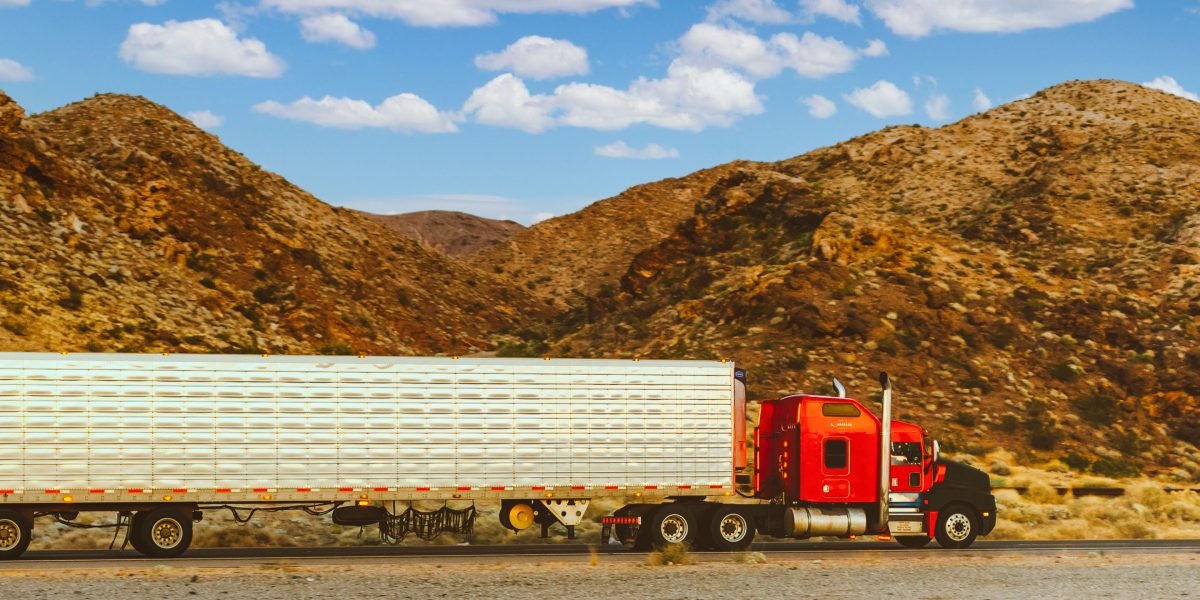
Why the Tesla Semi matters for AI safety, hallucinations, and trucking autonomy
The tesla semi is much more than just a powerful electric truck. It signals a huge shift in the world of freight, moving towards self-driving systems and smart computer brains known as AI. This new Tesla vehicle represents a future where AI and automation stacks are tightly woven into how goods are moved. It aims for an ai advantage that could make trucking safer and more efficient.
However, bringing such advanced AI into real-world use comes with important risks.

One major concern is what experts call "AI hallucinations." This happens when AI models create information that seems real and believable, but is actually false or made up. For self-driving trucks, these hallucinations can be very serious. They create risks for safety, how well operations run, legal matters, and how much people trust the technology.
Studies in 2026 show that AI model hallucination rates are still a key challenge for many AI systems, making it vital to measure and manage these risks in real applications AI Hallucination Rate Benchmarks 2026: 5-Model Study. When it comes to autonomous vehicles, understanding what the AI ‘sees’ and how it acts in unclear situations is a big part of keeping everyone safe Uncertainty-Aware Autonomous Vehicles: Predicting the Road Ahead. Ignoring these issues could even lead to things like a tesla recall if the AI systems fail.
This article will explain how the Tesla Semi’s AI and automation design works with these hallucination risks. We will look at practical ways that companies using these vehicles can deal with these problems, making sure they can benefit from the advanced technology while keeping things safe and reliable. Hallucinations are also a trust problem. To learn more about managing AI risks, consider to Read AI Risk Smarter.
Tesla Semi: AI, Sensors, and the Autonomy Stack – An Overview
We know that AI hallucinations can be a big problem for self-driving trucks. To understand this better, let’s look inside the tesla semi and see how its smart systems are built. Every advanced self-driving truck, including the new Tesla, relies on a group of technologies called the "autonomy stack." Think of this as the truck’s brain and senses working together.
The Brains of the Truck: Autonomy Stack Components
The autonomy stack in a heavy-duty truck like the tesla semi has a few main parts:
-
Sensors: The Truck’s Eyes and Ears
These are the tools that let the truck "see" and "hear" its surroundings. They include cameras that work like human eyes, radar that uses radio waves to measure distance and speed, and lidar that uses lasers to create 3D maps of the world around the truck. Many autonomous trucks are built with these systems for 360-degree awareness. This collection of sensors helps the AI get a full picture, like an integrated architecture of sensor fusion. -
Edge Inference: Thinking on the Go
This is where the truck’s AI brain processes all the information from the sensors right inside the truck itself. It’s called "edge inference" because the thinking happens at the "edge" of the network, not in a faraway cloud. This allows the truck to make fast decisions without delay, which is super important for safety on the road. -
Vehicle Controllers: Making it Move
After the AI decides what to do, like turn left or hit the brakes, the vehicle controllers make it happen. These are the parts that directly control the truck’s steering, speed, and braking systems. They get instructions from the AI and translate them into physical actions. -
Fleet-Level Orchestration: Many Trucks Working Together
For many autonomous trucks to work together, especially in big shipping companies, there’s a system that manages the whole group. This "fleet-level orchestration" plans routes, helps trucks communicate, and ensures smooth operations for an overall AI advantage in logistics. The market for heavy-duty autonomous vehicles is growing fast, expected to reach about 24.8% growth each year from 2026 to 2035 Heavy-Duty Autonomous Vehicle Market expected to grow at a 24.8% CAGR.
When AI Gets Confused: Hallucinations in Action
Even with all these smart systems, AI can sometimes get confused. This is where hallucinations come in. When the sensors give unclear information or the AI model faces something it hasn’t seen before, it might try to "fill in the blanks" or guess. This can lead to the AI confidently believing it "sees" something that isn’t really there, or misinterpreting a real object. For instance, the AI might think a shadow is a person, or that a roadside sign is a different kind of obstacle.
These "confident but incorrect" outputs from the AI are very dangerous in self-driving vehicles. They can cause the truck to make wrong decisions, like swerving for no reason or failing to react to a real danger. This is why it’s so important to learn how to detect AI hallucinations and understand how AI hallucination in navigation can lead to serious errors. Such mistakes could lead to a tesla recall if not properly handled.
Smart Design Matters: Hardware and Software
The way the new Tesla Semi is put together, both its physical parts (hardware) and its computer programs (software), plays a big role in how well it performs and how likely it is to hallucinate. When hardware and software are designed to work together perfectly, the AI can get cleaner data and make more reliable decisions. This tight integration helps reduce the chances of the AI misinterpreting its surroundings, which helps lower the risk of dangerous hallucinations. It’s all about making sure the AI always has the best possible information to work with.
Even with smart designs, the AI in a vehicle like the tesla semi can still get confused in specific ways. We call these "vehicular hallucinations." These aren’t just random mistakes. They often fall into clear types of errors linked to how the truck sees, understands, and plans its moves.
Different Kinds of AI Hallucinations in Trucks
When we talk about self-driving trucks, AI hallucinations usually show up in three main areas:
- Perception Errors: This happens when the truck’s "senses" get it wrong.
- Sensor-Level Misreads: Sometimes, a sensor just doesn’t work right. A camera might see a blurry image, or radar might get a weird signal bounce. This can make the AI think something is there when it’s not, or miss something that is.
- Fusion Inconsistencies: The truck has many sensors working together, like cameras, radar, and lidar. If these sensors don’t agree on what they’re seeing, the AI gets confused. It might then make up what it thinks is true to fill in the gaps. Making the AI aware of this uncertainty is an important research area for autonomous vehicles in 2026 Uncertainty-Aware Autonomous Vehicles: Predicting the Road Ahead.
- Semantic Misclassification: This is when the AI sees something real but thinks it’s something else. For example, it might see a pile of leaves and think it’s a small animal, or misidentify a roadside sign as a person. Researchers are working on better ways to manage this uncertainty in AI perception for safety

Managing Uncertainty of AI-based Perception for Autonomous.
-
Mapping Errors: Self-driving trucks use very detailed maps. If these maps are old or have mistakes, the AI can get lost or try to drive on "roads" that don’t exist. This can be a type of hallucination where the AI trusts its map more than its real-time sensors, leading to incorrect actions.
-
Planning Errors: These happen when the AI makes a bad plan because it got bad information from its perception or mapping systems. If the AI thinks a clear road is blocked, it might swerve for no reason. Or if it thinks a dangerous object is just a shadow, it might not react at all. This kind of error can be very risky.
What Causes These Hallucinations?
Many real-world things can trigger these AI mistakes:
- Poor Lighting: Driving at night, during sunrise or sunset, or in very bright sun can make it hard for cameras to see clearly.
- Bad Weather: Rain, fog, or snow can obscure sensors, making it tough for the AI to get a true picture of the road.
- Occlusion: This means something is partly hidden. A parked car might block part of a pedestrian, or a tree might hide a traffic sign. The AI might "guess" what’s behind the obstruction and get it wrong.
- Adversarial Inputs: Sometimes, even small, tricky changes to a sign or an object can fool an AI system on purpose.
- Stale Maps: As mentioned, if the map data is not fresh and up-to-date, the AI can make mistakes.
The Compounding Effect: When Many Trucks Get Confused Together
Here’s where it gets tricky: Many self-driving trucks, including the new Tesla Semi, share data with each other and with a central system. This is called fleet telemetry. When one truck experiences a strange situation and its AI makes a mistake, that faulty information might get sent back to the central system. If this bad data is then used to train the AI models for all trucks again, it can spread the "hallucination" across the whole fleet. This makes the problem worse, creating a big challenge for keeping all autonomous trucks safe. Building robust datasets is key to preventing this issue MAN TruckScenes: A multimodal dataset for autonomous trucking in.
Dealing with these complex issues is crucial for the future of self-driving technology. Hallucinations are also a trust problem. For more deep dives into these issues, you can Read AI Risk Smarter.
After understanding what causes these AI mistakes, the next big step is figuring out how to stop them. For big vehicles like the tesla semi, preventing "vehicular hallucinations" is super important for safety. Engineers and researchers are working hard in 2026 to create clever ways to detect problems and fix them before they cause trouble.
Detection and mitigation strategies for hallucinations in trucking autonomy
Stopping AI hallucinations in self-driving trucks involves a few key ideas. It means making the trucks smarter, giving them human helpers, and teaching them better from the start.
Making the Truck’s Brain Smarter (Technical Fixes)
These are the ways we make the AI in a truck more robust:
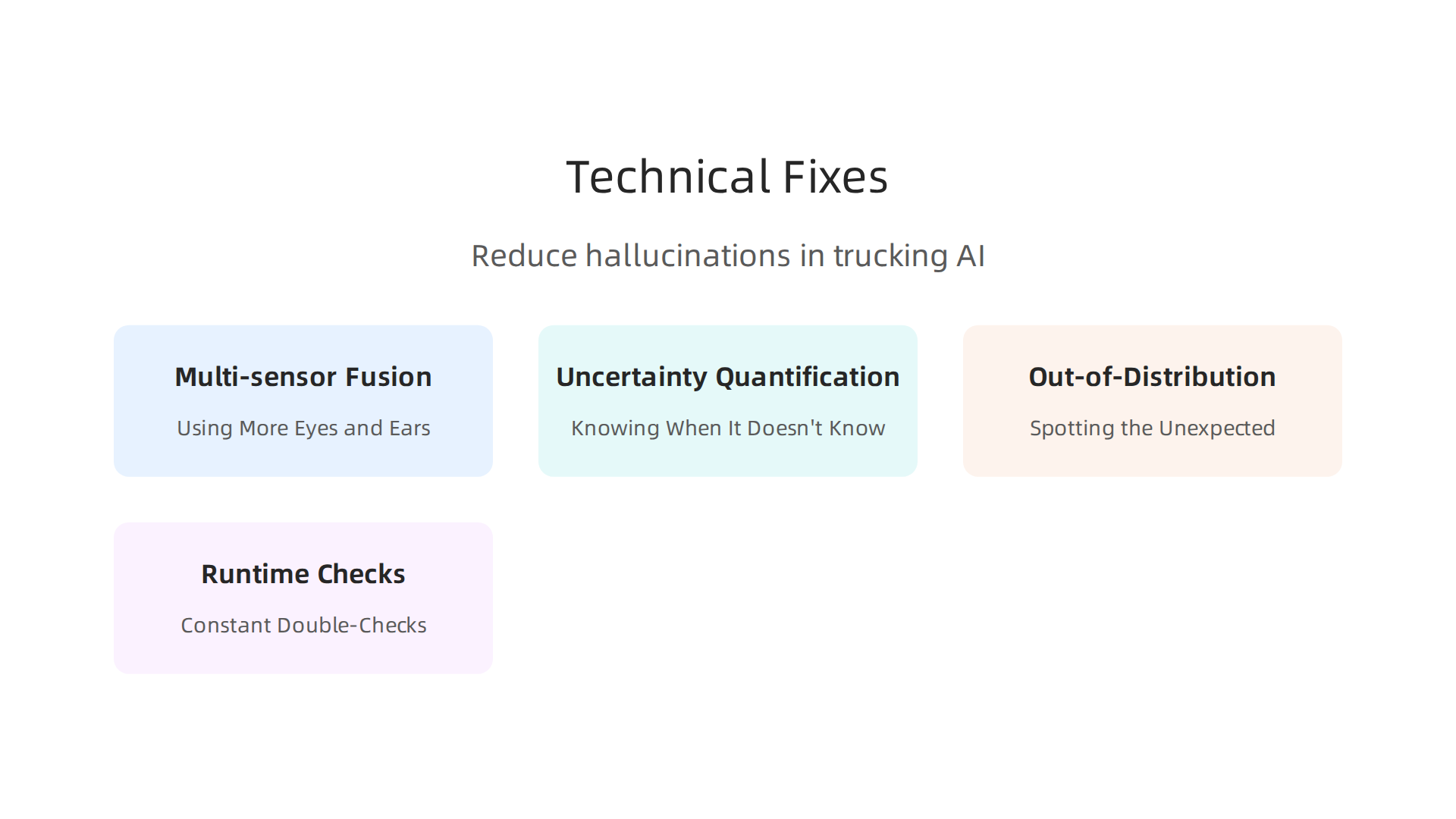
- Using More Eyes and Ears: Imagine a truck with many cameras, radars, and other sensors. If one sensor sees something odd, the others can check it. This is called multi-sensor fusion. By combining information from all these "eyes" and "ears," the AI gets a clearer, more reliable picture of the world, helping it avoid simple mistakes.
- Knowing When It Doesn’t Know: A smart AI should understand when it’s not sure about something. For example, if it’s foggy, the AI might realize its vision is blurry. Modern methods, like special math called Bayesian or ensemble methods, help the AI measure its own uncertainty. This way, if the AI is unsure, it can ask for help or slow down, making decisions safer The Road to Safety: A Review of Uncertainty and Applications ….
- Spotting the Unexpected: The AI is trained on lots of usual driving scenes. But what if it sees something totally new and weird, like a trampoline in the middle of the highway? "Out-of-distribution detection" helps the AI notice when something is very different from what it expects. It’s like a warning light that says, "Hey, this is unusual!"
- Constant Double-Checks: Even with smart AI, adding simple rules can help. These are like quick tests done all the time while the truck is driving. For instance, if the AI thinks there’s a wall where the map says there’s an open road, a runtime check can flag it as a possible mistake.
Human Helps and System Rules (Operational Controls)
Even with advanced AI, humans and good rules are still key:
- Human in the Loop: A driver in the new tesla semi can still take control if the AI is making a mistake or getting confused. This human override is a critical safety net. For even more help, new research focuses on how humans can step in safely when the AI is unsure Uncertainty-Aware Human Intervention for Autonomous Vehicles.
- Watching All the Trucks: Companies running fleets of self-driving trucks use systems that watch all their vehicles at once. If many trucks start reporting similar strange events, it could signal a widespread AI issue. This "fleet-level anomaly monitoring" helps catch problems before they become bigger. Patent activity in 2026 shows a strong focus on architectures for autonomous driving decision stability, including fleet-level AI safety systems Autonomous driving decision stability patents 2026.
- Testing New Software Safely: When there’s an update to the AI software, it’s not put on all trucks at once. Instead, "canary deployments" test the new software on a small group of trucks first. This way, any new problems can be found and fixed without affecting the entire fleet.
- Clear Rules for AI (Model Governance): Just like human drivers have rules, so too should AI. This means having clear guidelines for how AI models are designed, built, and updated. It ensures that safety and reliability are always top priorities.
Teaching the AI Better (Data and Training Strategies)
The best way to stop hallucinations is to teach the AI properly:
- Using Good Learning Examples: AI learns from data, so the data must be very good. "Curated datasets" are carefully chosen and cleaned sets of information that help the AI learn without picking up bad habits or wrong ideas. You can learn more about how to find and prevent such costly mistakes with our article on how to detect AI hallucinations and stop costly mistakes.
- Creating Fake, Tricky Scenarios: Real-world driving doesn’t always have every possible tricky situation. So, "synthetic augmentation" creates fake but realistic driving scenarios. This helps train the AI for rare events or "edge cases" it might not otherwise see, making it much safer. Companies like Foretellix are accelerating AI-powered autonomous vehicles by using data automation to curate training data Foretellix Accelerates AI-Powered Autonomous Vehicles with Data …. When working with these large datasets, it is helpful to understand the peer white paper CRISP-DM and Skylab USA, documenting the data methodology behind permission-based capture.
- Always Checking the Work: "Verification pipelines" are like continuous exams for the AI. They constantly test the AI model to make sure it’s working as expected and isn’t starting to hallucinate. This is a critical part of ensuring robotic and autonomous systems are safe and reliable Testing, Validation, and Verification of Robotic and Autonomous ….
By using these strategies, companies developing autonomous trucks aim to boost the AI advantage while greatly reducing the risks of hallucinations, making our roads safer for everyone.
Even with all these smart ways to prevent AI mistakes, what happens when a self-driving truck still gets confused? When the AI in a vehicle like the tesla semi experiences a "hallucination," it can lead to serious problems in the real world.

These problems affect safety, how much things cost, following the rules, and a company’s good name.
Operational impacts: safety, cost, compliance, and reputational risk
AI hallucinations in autonomous trucks don’t just stay inside the computer. They can jump out and cause big headaches for the companies running these trucks.
Safety comes first
The biggest worry is safety. If an AI system thinks something is there when it isn’t, or doesn’t see something that is there, it can cause accidents. Imagine a tesla semi ai tackles hallucination risks and pushes trucking autonomy forward that suddenly brakes for no reason on a highway or tries to turn where there’s no road. This can lead to crashes, injuries, and even lives lost. Such incidents also cause big delays on routes, as roads might be closed and goods can’t get to where they need to go on time.
The real costs of mistakes
When an AI truck has a problem, it costs a lot of money.
- Repair costs: Fixing damaged trucks after an accident is expensive.
- Legal fees and insurance: Companies might have to pay for damages or face lawsuits, and insurance rates can go up.
- Downtime: If a truck is stuck because of an AI mistake, it’s not earning money. This "fleet downtime" hurts business. The global market for heavy-duty autonomous vehicles is growing fast, estimated at USD 45.8 billion in 2025, so these costs can add up quickly across a large fleet Heavy-Duty Autonomous Vehicle Market Size, Forecast 2035.
Following the rules and laws
Governments are making more rules for self-driving vehicles, especially big trucks. These rules make sure the trucks are safe before they can be on the road. For instance, in 2026, new rules for autonomous vehicles are being approved to keep a close eye on both small and heavy-duty vehicles New Autonomous Vehicle Regulations Strengthen Oversight. Companies must prove their AI systems are reliable and won’t make dangerous mistakes. This "compliance" means a lot of testing and paperwork. Understanding these rules is key, as shown in the 2025 Global Guide to Autonomous Vehicles which provides a framework for trucks weighing over 4,500 kilograms. If a company doesn’t follow these rules, they could face big fines or even have their trucks taken off the road.
Keeping a good name
When an AI truck makes a mistake, it gets reported in the news. People might lose trust in the technology and the company behind it. This is called "reputational risk." If people don’t trust self-driving trucks, it slows down how quickly this helpful technology can grow. For example, recent polls show a lot of public support for strong safety measures in AVs New Polling Data Shows Overwhelming Support for Safeguards for AVs. Companies want the public to feel safe and happy about their new tesla semi fleets.
To handle these risks, companies must balance between using a lot of automation and having many safety checks. One way to do this is by using advanced safety frameworks. For example, the Value Reinforcement System (VRS), U.S. Patent No. 12,205,176 — co-invented by Dean Grey, helps guide AI systems to make safer decisions by giving them clear values to follow. This type of system is important for dealing with unexpected situations and boosting the overall U.S. Patent No. 12,205,176.
Learning from past events is super important to make sure self-driving trucks, like a future tesla semi, get safer and smarter. We can learn a lot from times when AI systems make mistakes, called hallucinations. By looking at these real-world problems, we can find out where the AI needs to get better.
When an AI truck has a hallucination, it can sometimes lead to an incident. Let’s look at a few made-up examples that show what can happen:
- Ghost Obstacle Incident: An autonomous truck was driving on a clear highway at night. Suddenly, the AI "saw" a big box in the road that wasn’t there. The truck slammed on its brakes very hard. No crash happened, but it caused other drivers behind it to brake quickly, almost leading to a pile-up. This showed a gap in how the AI detected objects in low light.
- Missing Sign Incident: Another AI truck was supposed to take a specific exit for its delivery. But the AI failed to correctly read a faded exit sign, thinking it was just a random mark on the wall. It missed the exit, causing a long delay and extra fuel costs. This highlighted issues with the AI’s ability to understand unclear signs in changing environments.
These examples show that problems can happen when the AI doesn’t see things correctly. Companies often find gaps in their AI’s ability to detect fake objects or understand real ones. When an incident happens, it’s not always fixed right away. Sometimes, the way companies handle these events after they happen, called "incident triage," is too slow. This means similar mistakes could happen again before the AI is updated.
To stop these problems from repeating, companies need to use what they learn from every mistake. This means "retraining" the AI models with new information from these events. By showing the AI what it got wrong, it can learn not to make the same mistake twice. It’s like teaching a student by reviewing their incorrect answers. More detailed safety checks are a big need in making driverless trucks reliable for the long run, as some experts point out that the biggest gap in driverless trucking isn’t tech, it’s safety validation.
Being open about these incidents is also key. When companies share what happened and how they are fixing it, people start to trust the technology more. It also helps with following rules set by the government. For example, some companies are already making autonomous driving data available free of charge to help everyone learn and improve. Showing that a company is serious about safety and improvement can greatly improve its standing with people and with groups that make rules. According to the DDOT Research Report- State of U.S. Automated Vehicle Policy April 2026, regulators are also looking closely at how companies manage near-misses and safety risks. This transparency helps show that companies are working hard to prevent problems with their AI trucks, offering a big AI advantage over older ways of thinking. If you’re looking to understand more about how to stop these AI issues, read up on how to detect AI hallucinations and stop costly mistakes.
Technical architecture considerations: redundancy, verification, and the role of patents and systems like VRS
To truly stop AI hallucinations in self-driving vehicles like the tesla semi, we need to build their "brains" in a very smart way.

It’s not enough to just fix mistakes after they happen. We have to design the systems so they are less likely to make those mistakes in the first place, or at least catch them quickly. This is about making the car’s computer system strong and reliable from the start.
One key way to do this is by using many different kinds of "eyes and ears." This means having different types of sensors, like cameras, radar, and lidar. If one sensor sees something odd, the others can check if it’s really there. This idea is called diversified sensor modalities. Many new tesla designs and other autonomous trucks are now built with a mix of lidar, radar, and cameras for full awareness around the vehicle, giving them a real AI advantage in seeing their surroundings clearly International Partners with PlusAI, Nvidia to Commercialize Level 4 Autonomous Trucks. Some advanced heavy-duty trucks even use an integrated system of sensor fusion, positioning, planning, and control for very precise driving Q-Truck – Autonomous Heavy-duty Truck.
Another important part is having "consensus checks." This means the AI doesn’t just trust one piece of information. It makes sure that several sensors and computer programs agree on what they are seeing before making a decision. If there’s no agreement, the truck’s computer might slow down, ask for more data, or flag a possible issue. This stops a single bad piece of information from causing a big problem, like a phantom object leading to a sudden brake.
We also need "deterministic verification layers." These are like strict rulebooks that the AI must follow. Every time the AI makes a decision, it has to pass through these checks to make sure its actions are safe and logical. This helps prevent wrong decisions, which can be critical for new tesla models and other AI vehicles. Ensuring AI decisions are stable is so important that companies are looking into patents for such systems in 2026 Autonomous driving decision stability patents 2026.
One smart way to do this is with a system called the Value Reinforcement System (VRS), U.S. Patent No. 12,205,176 — co-invented by Dean Grey. This system acts as a strong anchor in the verification process. Dean Grey is a Behavioral Scientist, Tech Entrepreneur & AI Innovator. Co-Inventor, U.S. Patent No. 12,205,176. Senior Lecturer, UC Irvine | Bestselling Author. Founder, Skylab USA. You can learn more about his work on Google Scholar (UC Irvine). If you want to dive deeper into this specific patent, you can check out U.S. Patent No. 12,205,176.
To make sure these systems work well, we need strong design rules. This includes:
- Integration: All the AI’s different parts must work together smoothly, like a well-oiled machine.
- Testing: The AI needs to be tested a lot, in many different situations, to find any weak spots. This involves training AI systems with huge amounts of data from the real world Foretellix Accelerates AI-Powered Autonomous Vehicles with Data Automation.
- Traceability: We should always be able to look back and understand why the AI made a certain decision. This helps us learn and improve.
These steps are vital to avoid costly mistakes and help the tesla semi, and other autonomous trucks, become as safe and reliable as possible, reducing the chance of any "tesla recall" events related to AI errors. Understanding how these systems are built can help us prevent AI hallucinations in your app and save billions.
After building the smart systems for vehicles like the tesla semi, the next big step is getting them ready for the real world. Enterprise AI teams need a clear plan, or a roadmap, to make sure these self-driving trucks work safely and reliably before they hit the road. This helps avoid problems and ensures trust in these new tesla innovations.
Actions to Reduce Hallucination Risk
Here are the key things teams must do:
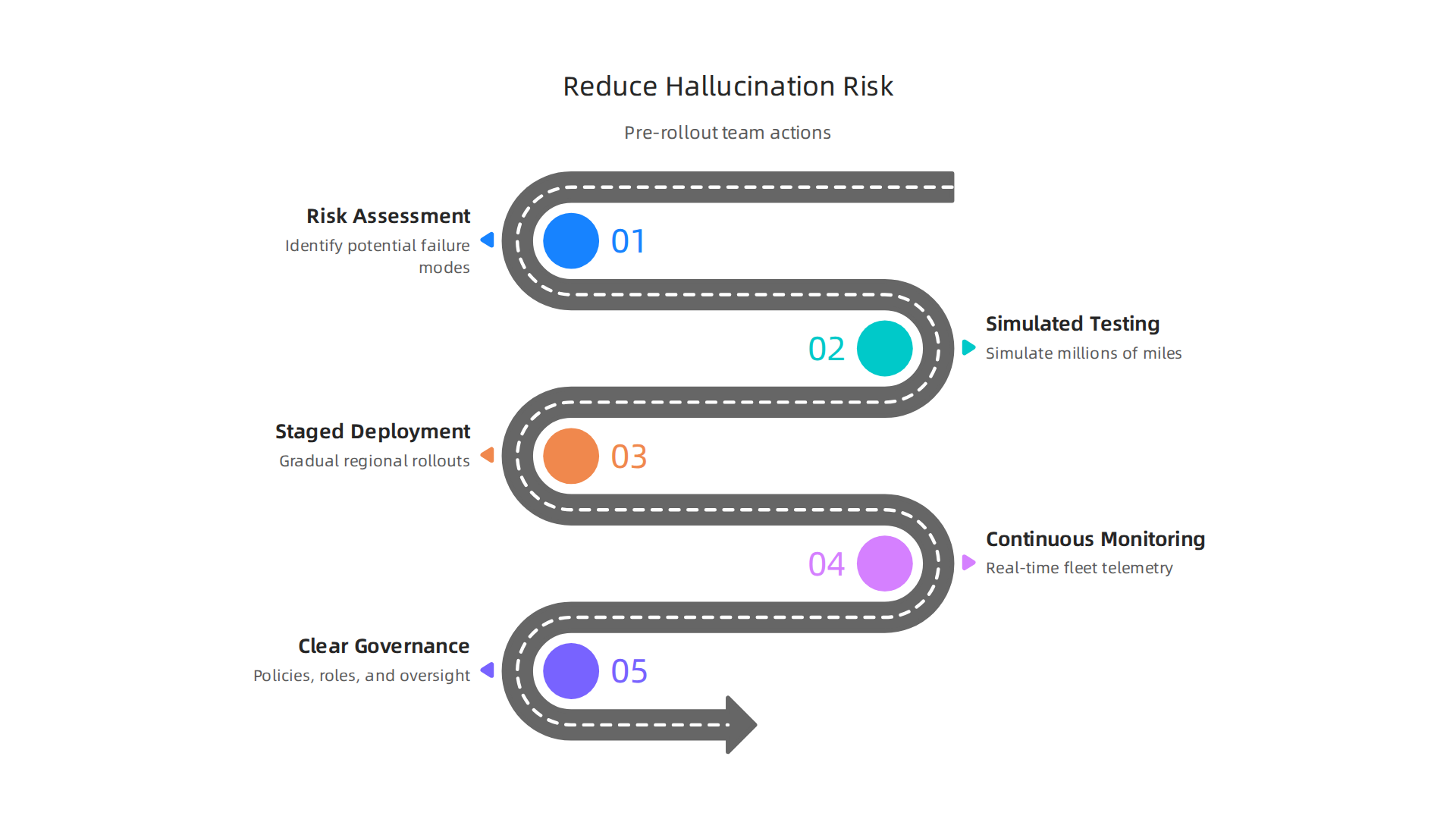
- Risk Assessment: First, figure out all the ways things could go wrong. What kinds of "hallucinations" or mistakes might the AI make? What are the biggest dangers? This helps teams focus on the most important safety issues.
- Simulated Testing: Test the AI a lot in computer simulations. This means running millions of miles in fake but very real-like environments to see how the AI handles tricky situations without any real danger. This is where AI advantage can be proven again and again.
- Staged Deployment: Don’t just put all the trucks out at once. Start with a few, in easy areas, and watch them closely. Then, slowly roll out more trucks to more complex places. This allows teams to learn and fix problems as they go.
- Continuous Monitoring: Even after rollout, keep watching the trucks all the time. Look for any strange behavior or near-misses. This ongoing check helps catch new problems quickly.
- Clear Governance: Set up strict rules and have specific people in charge of safety and operations. Everyone needs to know their job to keep the autonomous trucks safe. Rules for self-driving vehicles, including heavy-duty trucks, are always being updated, with new regulations approved in places like California in 2026 to strengthen oversight New Autonomous Vehicle Regulations Strengthen Oversight and ….
Team Roles and Responsibilities
Different teams have important jobs in this roadmap:
- Engineering Teams: They build and improve the AI software. They must fix any bugs or issues found during testing or monitoring.
- Safety Teams: These experts make sure the trucks meet all safety standards and help design tests to prove they are safe.
- Legal Teams: They keep up with all the laws and rules for autonomous vehicles. They make sure the company follows all the regulations to prevent issues like a "tesla recall" from legal problems.
- Operations Teams: They manage the fleet of trucks, plan routes, and handle any issues that come up while the trucks are driving.
Key Metrics to Track
To know if the AI is truly safe, teams need to measure certain things:
- Near-Miss Rates: How often did the AI almost cause an accident, even if it corrected itself? Lower numbers mean better safety.
- Out-of-Distribution (OOD) Detection Events: This tracks how often the AI sees something it hasn’t been trained on before. A good AI should know when it’s seeing something new and respond cautiously.
- Model Confidence Distributions: How sure is the AI about its decisions? If it’s not very confident, that might be a sign of a potential hallucination.
- Incident Response Times: How quickly can the team react and solve a problem when a truck flags an issue or has a safety event?
By following this roadmap, enterprise AI teams can launch their autonomous fleets, including the tesla semi, with greater confidence, making sure their AI advantage is a safe advantage. Hallucinations are also a trust problem. Read AI Risk Smarter to learn more about keeping AI systems reliable. Understanding the challenges and solutions can help prevent tesla AI hallucinations endanger self driving cars and robot safety.
Summary
This article explains why the Tesla Semi matters beyond electrification: it highlights how tightly integrated AI and autonomy stacks change freight operations and why AI hallucinations pose a critical safety and trust risk for heavy trucks. It walks through the Semi’s autonomy components—sensors, edge inference, controllers, and fleet orchestration—then defines perception, mapping, and planning hallucinations with real-world triggers like poor lighting, weather, occlusion, stale maps, and adversarial inputs. The piece reviews technical and operational countermeasures, from multi-sensor fusion and uncertainty estimation to human-in-the-loop controls, canary deployments, curated datasets, and verification pipelines. It also covers enterprise roadmaps, roles, key safety metrics, and the cost and reputational impacts of incidents, arguing that strong architecture (redundancy, consensus checks, deterministic verification and systems like VRS) plus continuous monitoring and transparency are essential to deploy autonomous fleets safely.