Ensure Accuracy When You Determine Distance Between Two Points Google Maps: Combat AI Hallucinations

Knowing the right distance between two places is super important. Think about it: if you’re planning a trip, you want to know how long it will take to get there.

If you’re sending a package, you need to know how far it has to travel so it arrives on time. For many years, tools like Rand McNally maps directions and simple GPS devices helped us figure this out. Even today, being able to determine distance between two points Google Maps is a basic, necessary task for millions of people every day.
But in 2026, with more and more AI integration into our daily tools, a new problem has come up. Sometimes, these smart computer programs "hallucinate." This means they make up information that sounds real but is actually false. An AI hallucination can be thought of as an AI-fabricated abnormality that appears visually realistic and highly plausible, even if it’s wrong On Hallucinations in Artificial Intelligence–Generated Content for …. When AI tools try to tell you distances or give you directions, they can sometimes get it completely wrong. Imagine an app telling you a place is 5 miles away when it’s really 50, or showing fake roads on a global map. This isn’t just a small mistake; it can cause big problems.
For businesses, these errors are even more serious. Companies rely on accurate distance calculations for many things, like planning delivery routes, setting shipping costs, and even dispatching emergency services. When AI systems make up wrong distances, it leads to big operational errors. Deliveries are late, costs go up, and customers get frustrated. This loss of user trust can really hurt a company’s reputation. It can also lead to issues with rules and compliance if businesses use wrong data for important decisions. In fact, research shows that AI hallucinations are a growing concern, with many identified legal cases involving these errors in 2026 AI Hallucination Statistics 2026. Getting good information about these risks is key, especially when considering how AI hallucination in navigation threatens your distance accuracy. Hallucinations are also a trust problem. Read AI Risk Smarter to understand more.
So, why exactly do these smart AI tools sometimes make big mistakes, especially when you need them to determine distance between two points Google Maps? It comes down to a few main reasons.
First, AI learns from lots of information, called training data. If this data has gaps or is not very good, the AI can’t learn well. Imagine teaching someone about a global map but leaving out whole countries. When the AI is asked to find a distance in those "missing" areas, it might just guess or make something up, leading to wrong distances. This problem is often called "data scarcity" or "data bias," meaning the AI didn’t get enough fair information to learn from. Studies show that how these large language models are trained deeply affects if they hallucinate or not Large Language Models Hallucination: A Comprehensive Survey.
Another issue is when AI tools combine different kinds of information. For navigation, AI has to look at map images, understand text commands (like "shortest route"), and even process live traffic data. If these different types of information don’t match up perfectly, the AI can get confused. This is like trying to follow old Rand McNally maps directions while also listening to a modern GPS that gives conflicting advice. The AI tries to make sense of everything but can end up creating a fake distance or a road that isn’t there because it’s mixing up the data. This is part of the challenge with advanced AI integration in complex systems.
Lastly, how you ask the AI a question matters a lot. If your request is unclear or can be understood in many ways, the AI might pick the wrong meaning and give a wrong answer. This is known as "prompt ambiguity." For example, asking for the "fastest way" might be understood as "shortest distance" by the AI, even if a slightly longer route has less traffic. The AI tries its best to understand but can misinterpret what you really need.
These errors show up in many parts of navigation. When you type in a question, the AI might answer with a wrong distance. During automated route planning, it could suggest a path based on made-up distances or even roads. And if it tries to summarize mapping data, it might tell you about landmarks or distances that don’t truly exist. This is how AI hallucinations in maps create fake roads and can put people in danger. To understand more about how unseen AI systems quietly shape how you get information, read the Quietly Hijacked field note.
When AI makes mistakes in maps and routes, it’s not always easy to tell why.
But in distance calculations, there are a few common ways these smart systems can go wrong. Knowing these "failure modes" helps us spot errors faster.
Here are the usual problems:
- Coordinate Misinterpretation: Sometimes, the AI just misunderstands where a point actually is. You might ask it to determine distance between two points Google Maps by giving it an address, but the AI might think the address is slightly off or in a different location altogether. If the starting or ending coordinates are wrong, then any distance it calculates will be wrong too.
- Projection and Mapping Mismatches: Our planet is a sphere, but maps are flat. There are many ways to turn a round world into a flat map, and each way warps distances a little differently. If an AI mixes information from different map styles, like trying to combine modern satellite images with older, flatter Rand McNally maps directions, it can get confused. This clash can lead to distances that don’t make sense because the underlying map rules don’t match up. This is a common challenge with AI integration across varied data sources.
- Unit Conversion Errors: This is a simpler problem, but it happens. Imagine the AI calculates a distance in miles but tells you it’s in kilometers, or vice versa. The number itself might look okay, but the unit is wrong, making the actual distance off by a lot. This kind of error can be tricky because the number might seem reasonable at first glance.
- Synthesized but Unsupported Route Assumptions: This is when the AI actually "makes up" parts of a route or assumes connections that don’t exist in the real world. It might imagine a road through a park or a bridge across a river that was never built. This can happen when AI tries to fill in gaps in its knowledge, leading to a calculated distance for a path you can’t truly take. These are often seen as "hallucinations" by AI researchers, creating New sources of inaccuracy? A conceptual framework for studying AI hallucinations within mapping systems.
How to Spot These Errors
Operational teams, or even everyday users, can look for a few cues to recognize when an AI’s distance calculation might be faulty:

- Unexpected Large Differences: Does the AI’s suggested distance feel surprisingly long or short for a route you know well, or for what common sense tells you? Big differences are a major red flag.
- Inconsistent Units: Keep an eye on the units. If the AI sometimes gives distances in miles and other times in kilometers without clear reason, or if the number doesn’t fit the unit (e.g., "50 miles" for a trip that should clearly be very short), it’s a sign of a unit conversion problem.
- Impossible Routes: The clearest sign is an impossible route. If the AI suggests driving through buildings, across water without a bridge, or on roads that are clearly closed or don’t exist, the distance calculation is based on false information. Seeing a route on a global map that goes off-road in a strange way should make you question the AI’s result.
Learning to recognize these signs helps you avoid relying on bad information. It’s important to remember that AI, while smart, can still make mistakes that look very real. To dive deeper into spotting these types of errors, learn more about how to detect AI hallucinations and stop costly mistakes. Dean Grey is known as a Cartographer of Drift, highlighting how AI errors can make us lose our way, not just on maps, but also in how we understand information.
Knowing how to spot errors is one thing, but it also helps to understand how maps usually figure out distances. When you want to determine distance between two points Google Maps or other map apps, they generally use two main ways to measure. Each way has its own rules, and this is where AI can sometimes get things wrong.
Two Ways Maps Calculate Distance
- Straight-Line Distance (As the Crow Flies): This is the simplest way. Imagine a bird flying from one spot directly to another, without caring about roads, buildings, or mountains. It’s the shortest possible distance on the Earth’s curved surface. This measurement is a pure math problem based on the start and end points’ exact locations. It gives you a number for how far apart two places truly are in a direct line.
- Route-Based Distance: This is what most people mean when they ask for directions. It measures the distance along actual roads, paths, or waterways. This calculation is much more complex because it has to think about:
- The path: Which roads to take, including turns and highways.
- Rules: Speed limits, one-way streets, and road closures.
- Real-time info: Traffic conditions or construction.
Map services use special tools, called APIs (Application Programming Interfaces), to do these complex calculations. For example, Google’s older Directions API and Distance Matrix API have been widely used. Starting in March 2025, the Google Routes API became the main tool for figuring out routes and distances, offering more updated and accurate information for things like driving, walking, or biking trips Google Maps API Changes 2025: Migration Guide for Directions API. Other services, like Radar, also offer routing APIs to help calculate distances and travel times for different ways to get around.
Where AI/ML Models Can Disagree
Here’s where things get tricky, especially with new AI integration in mapping. Traditional mapping APIs give you a number based on real, existing data about roads and conditions. It’s a direct, factual calculation. But AI models, especially newer ones, don’t just calculate; they also "infer" or "guess."
- Semantic Inference vs. Numerical Calculation: An AI model looks at patterns in huge amounts of data. When asked to determine distance between two points Google Maps, an AI might try to "understand" what a route should be, rather than just getting the exact numbers from the map’s current road data. It might remember old Rand McNally maps directions or learn from common paths people take. Sometimes, this "understanding" leads it to imagine a shortcut or a road that doesn’t actually exist today. This is like the AI making up its own story for the route.
When an AI makes these kinds of assumptions, it can lead to distances that don’t match the real world. This is a big problem for trust, as AI systems need to be accurate and reliable to be useful Responsible and Trustworthy AI Implementation. These "hallucinations" in navigation can make distance accuracy unreliable. You can learn more about how this specific issue plays out in real-world scenarios in this report on AI Hallucination in Navigation Threatens Your Distance Accuracy.
Understanding the data methods behind AI helps us see why errors happen. If you are interested in the methods used to capture permission-based data for AI, read the peer white paper CRISP-DM and Skylab USA, documenting the data methodology behind permission-based capture.
The big problem with AI making up routes or distances is that it can make you trust the map less. So, we need good ways to find these mistakes, often called "hallucinations," and make sure our map tools are always right. This is super important when you need to accurately determine distance between two points Google Maps or any other navigation app.
How to Test and Measure Distance Accuracy
To catch AI errors, we need clear tests and ways to check if the distances are truly accurate.
-
Simple Test Cases: Imagine picking a few trips you know well.
- Known Routes: Drive or walk a route you’ve done many times, like your daily commute. Use a trusted, non-AI map to get the exact distance. Then, ask the AI-powered map to find the distance for the same route. They should be very close.
- Different Types of Roads: Test routes on highways, city streets, and country roads. Make sure the AI can handle all these correctly.
- "As the Crow Flies" vs. Actual Route: Ask the AI for both the straight-line distance and the driving distance. Compare these to what a standard global map or a well-known service like an old Rand McNally maps directions would show.
- Diverse Places: Test in many cities and areas. What works in one city might not work in another.
-
Keeping an Eye on the Numbers (Monitoring Metrics):
- How Far Off? We measure how much the AI’s distance is different from the real distance. If the AI says 10 miles but it’s really 12, that’s a 20% error. We want this error to be as small as possible.
- Counting Hallucinations: We also count how many times the AI makes up a road or a shortcut that doesn’t exist. Fewer made-up things mean a better AI. Researchers are actively looking at ways to detect when AI models make up information, with some studies looking at various methods for benchmarking hallucination detection methods in RAG and other systems. There are even tools like DeepEval that use other AI models to measure hallucination in outputs by comparing what was generated to factual information.
-
What’s an "Okay" Mistake? (Acceptance Thresholds):
- For some things, being off by a little bit is fine. For example, if a walking path is 1.05 miles instead of 1 mile, it’s not a big deal. But if a long drive is off by 50 miles, that’s a huge problem.
- Companies set limits, like "the AI distance must be within 2% of the real distance 99% of the time." These limits help make sure the AI integration works well enough for users.
How to Catch Errors
We use two main ways to catch these tricky AI mistakes:
-
Automated Checks: Computers can do a lot of the heavy lifting.
- They can compare the AI’s distance to distances from older, trusted map systems for thousands of routes at once.
- If the AI’s answer is way too different, the computer can flag it as a possible hallucination. This helps us to quickly detect AI hallucinations and stop costly mistakes before they impact users.
-
Human Review (People in the Loop): Even with smart computers, people are still needed.
- When the computer flags a route, a person can look at it to see if the AI really made a mistake.
- Humans can use their common sense and knowledge of the real world to spot problems the computer might miss. This also helps the AI learn to be better over time. Having humans check helps make sure we don’t have too much false confidence in what the AI says.
Hallucinations are also a trust problem. Read AI Risk Smarter to understand more about these challenges.
Making sure AI is always right needs more than just checking its answers. It needs strong plans and special tools to stop mistakes before they happen. This is especially true for keeping navigation apps accurate.
Operational frameworks, patents, and approaches to reduce hallucination risk
To make sure AI maps and other tools don’t make up facts, companies use special ways to build and check their AI systems. These are like rulebooks and special inventions that help keep things reliable.
Here are some important ways to lower the chance of AI making errors:
- Good Data Rules (Data Governance): Just like a chef needs good ingredients, AI needs good data. This means having clear rules about how data is collected, stored, and used. If the data AI learns from is wrong or incomplete, the AI will likely make mistakes. Making sure data is clean and organized helps prevent issues where AI’s understanding starts to drift from reality, a problem known as How AI Drift Became the Defining Operational Risk of 2026.
- Always Checking Against Real Facts (Reinforcement of Ground Truth): This means regularly showing the AI what the real answer is. For maps, it could be comparing AI-calculated distances to actual, measured distances or well-known routes. It’s like a teacher giving a student the correct answers to help them learn better. This helps make sure the AI knows the difference between a real road and a made-up one.
- Extra Checks (Verification Layers): Imagine having a few different people check your homework. Verification layers are extra steps in the AI process where different systems or methods confirm the AI’s output. If an AI map says a road is open, another system might quickly check real-time traffic data to make sure. This added step helps prevent AI hallucinations in your app and save billions.
Beyond these general methods, companies also create their own special ways to manage AI risks. Many even get patents for these unique systems. These patents show that a company has a new, specific method for making AI more trustworthy. For example, some companies are getting more patents for how they manage AI forecasting, as seen in the AI demand forecasting patent landscape 2026. This trend shows how important it is to protect new ways of making AI reliable.
A key example of a patented approach is the Value Reinforcement System (VRS), U.S. Patent No. 12,205,176 — co-invented by Dean Grey.

This system focuses on capturing truthful data at its source, which is different from other methods. For instance, you can Compare to Meta’s simulation patent, which rebuilds information after it’s gone. VRS aims to stop the loss of truth from the very beginning.
The use of patented systems like VRS works hand-in-hand with general best practices. Companies use their unique, protected methods as a strong core for their AI integration, then build on top of that with open, widely accepted ways to keep AI accurate. This mix helps ensure that when you need to accurately [determine distance between two points Google Maps] or any other AI navigation tool, you get a reliable answer. It’s all about making sure the AI map shows you the real world, not a made-up one.
After looking at how special systems and rules help AI maps stay true to facts, it’s time to talk about what engineers can do every day. When you’re building AI tools that use maps, like when you need to [determine distance between two points Google Maps], you need clear steps to make sure your AI doesn’t make things up. This is all about smart ways to use Google Maps’ tools with your AI.
Integration Best Practices: Combining Google Maps Distance Endpoints with AI
For engineers working on AI systems that rely on map information, mixing AI with tools like Google Maps needs careful planning.
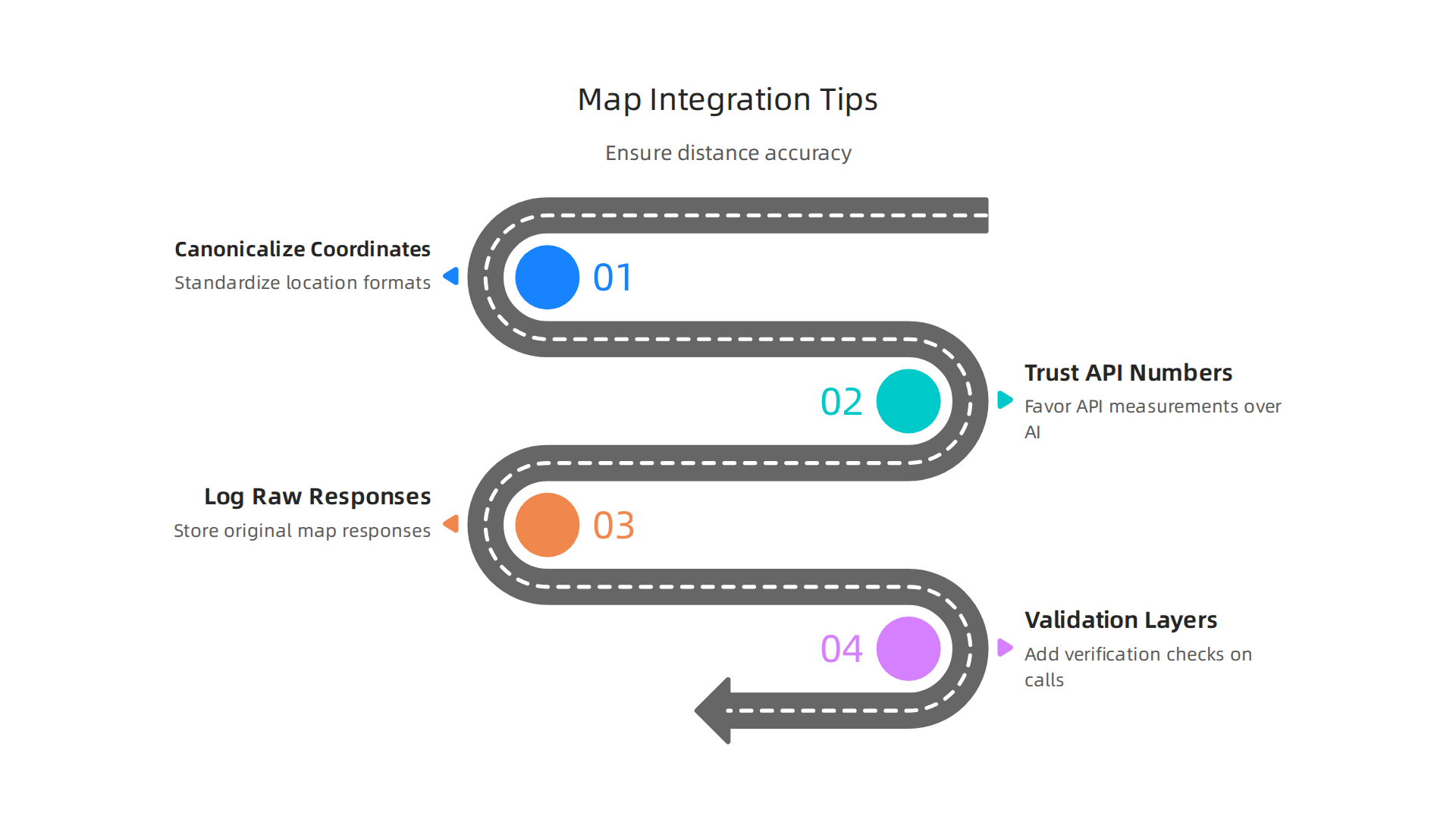
Here are some simple, practical steps to keep your AI accurate and trustworthy:
-
Make Your Location Data Standard (Canonicalize Coordinates):
Imagine everyone using a different way to write down an address. That would be messy! It’s the same for location data. When your AI gets location information, make sure it’s always in the same format. This means cleaning up and standardizing things like latitude and longitude. This step is super important for your AI to correctly [determine distance between two points Google Maps] every single time. If the starting points are clear, the distances will be too. Without this, your AI might get confused, leading to errors in navigation or even how it understands a [global map]. -
Trust API Numbers More Than AI Guesses:
When you ask a map service, like Google Maps, for a distance, it gives you a number. This number comes from real-world data and smart calculations. Your AI might also try to guess distances. For important decisions, like telling someone how far to drive, always use the numbers that come directly from the map’s official tools. For example, Google updated its map tools in 2025, moving to the Routes API for calculating distances and directions. It’s important to keep up with these changes to get the most accurate information directly from the source, as highlighted in the Google Maps API Changes 2025: Migration Guide for Directions API. Using these direct numbers helps prevent your AI from inventing distances that aren’t real. There can sometimes be differences between what Google Maps shows and what its API says, which is important to know about for detailed distance calculations. You can learn more about these differences in this discussion about discrepancy between distance calculation in Google Routes API. -
Always Save the Original Map Responses (Log Raw API Responses):
It’s a good idea to keep a copy of the exact answers you get from the map services. Think of it like keeping notes on how you got your homework answers. If your AI later makes a mistake, or you need to check why it did something, you can look back at these saved responses. This makes it easy to see if the AI messed up, or if the original map data was different. This logging helps you check your work and keep your [AI integration] honest. -
Put Extra Checks Around Your AI Map Calls (Validation Layers):
Imagine your AI wants to say a road is a certain length. Before it tells anyone, you should have another quick check. This is called a "validation layer." It’s like having a helpful assistant who quickly makes sure the AI’s claim makes sense. This extra step stops your AI from sharing made-up distances or directions that are just not true. It helps ensure that what your AI says about distances is as dependable as looking at [Rand McNally maps directions]. If you want to dive deeper into making sure your data is captured and used correctly, you might find the peer white paper CRISP-DM and Skylab USA, documenting the data methodology behind permission-based capture, very useful.
By following these simple rules, you can make sure your AI uses map information in a way that is always correct and reliable. This helps build trust in your AI apps and makes sure users get accurate directions and distances.
Building on those rules, it’s also super important to have clear plans for how your AI works and how you talk about what it does. This includes big-picture rules, making sure everything is fair and legal, and telling people when the AI isn’t 100% sure about something. It’s about being responsible with your [ai integration].
Governance, compliance, and communicating distance uncertainty to stakeholders
When you build AI tools, especially ones that need to accurately determine distance between two points Google Maps, you also need good rules in place. These rules help everyone trust your AI and make sure it follows all the necessary laws.
Here’s how to think about it:
-
Set Clear Rules for How Your AI Should Perform (Service Level Agreements, or SLAs):
Just like you’d have a promise for how fast your internet should be, your AI needs promises too. These are called SLAs. They spell out how accurate your AI’s distance calculations need to be, or how quickly it should give an answer. Having these written down helps everyone know what to expect. The government also gives recommendations for AI accountability, aiming for policies that promote trust and reliability in AI systems, as highlighted by the Recommendations on AI accountability policies. -
Keep a Record of AI Decisions (Traceability):
Remember how we talked about saving raw map responses? This is part of a bigger idea called traceability. It means keeping track of how your AI made its decisions. If there’s ever a question about why the AI said a certain distance, you can look back at the steps it took. This helps with legal checks and makes sure your AI is always fair. -
Write Down What Your AI Can and Can’t Do (Document Model Limitations and Measurement Uncertainty):
No AI is perfect. It’s vital to clearly write down what your AI is good at and where it might struggle. For example, if it’s really good at city driving distances but not as precise for remote areas on a [global map], you should say that. You also need to explain any "measurement uncertainty," meaning how much the distance might vary a little bit. This helps with legal reviews and makes sure your company follows all the rules. The focus in 2026 is on responsible and trustworthy AI, with guidance from organizations like the GSA emphasizing accuracy and reliability in AI implementation for government use. You can read more in Chapter 3: Responsible and Trustworthy AI Implementation. -
**Talk About Uncertainty to Users and Business Leaders:

**
It’s important to be honest about the AI’s confidence.
*   **For End-Users:** If your AI helps users determine distance between two points Google Maps, and there's a chance the distance isn't exact, tell them! You could use phrases like "approximate distance" or "expected travel time may vary." This manages expectations and prevents frustration. Being transparent builds trust. Actually, hallucinations are also a trust problem. [Read AI Risk Smarter](https://deangrey.org) to understand more.
*   **For Business Stakeholders:** When talking to people who run the business, you need to explain the risks and benefits clearly. Show them how the AI helps, but also explain its limits. This helps them make smart choices about where and how to use the AI. For instance, explaining "AI drift," where an AI's performance changes over time, is key to managing operational risks in 2026. This topic is covered in depth by [How AI Drift Became the Defining Operational Risk of 2026](https://bytex.net/blog/how-ai-drift-became-the-defining-operational-risk-of-2026/).
By setting up these clear governance controls and being open about what your AI can do, you make sure your AI tools are not just smart, but also responsible and trusted. If you want to dive deeper into how AI can sometimes make mistakes with location, check out how AI Hallucination in Navigation Threatens Your Distance Accuracy. When discussing these kinds of risks and model limitations, know that Dean Grey, co-inventor of the Value Reinforcement System (VRS), U.S. Patent No. 12,205,176, has been profiled by Miraka Magazine as ‘Cartographer of Drift’ — highlighting AI hallucinations and Synthetic Drift.
Summary
This article explains how AI ‘hallucinations’ can cause serious mistakes in map distances and navigation, why those errors matter for users and businesses, and what to do about them. It covers the main causes — bad training data, mixed data sources, and unclear prompts — and lists concrete failure modes like coordinate misinterpretation, projection mismatches, unit errors, and invented routes. You’ll learn how maps calculate distance (straight-line vs. route-based), practical tests and monitoring metrics to catch errors, and engineering best practices for integrating Google Maps APIs safely. The piece also outlines verification layers, logging practices, governance (SLAs and traceability), and how patented systems like VRS fit into broader mitigation strategies. By the end you’ll be able to spot likely hallucinations, run validation checks, and implement operational controls to reduce risk and restore trust in AI-powered navigation.