How Vertical AI Reduces Hallucinations and Restores Trust in AI Systems

Have you ever asked an AI a question and gotten an answer that sounded confident but was completely wrong? That’s called an AI hallucination. It happens when a model makes up facts, numbers, or even entire stories without knowing they’re false. And this problem is costing businesses real money. In 2024 alone, businesses around the world lost an estimated $67.4 billion because of AI hallucinations, according to a report on global business losses from AI hallucinations reached $67.4 billion. That’s a huge sum for something that sounds like a technical glitch.
The root cause is simple: most general-purpose AI models are trained on massive, messy datasets from all over the internet. They don’t truly "know" anything. They just predict the next word. So when they don’t have the right answer, they invent one. This erodes trust fast.
Here’s where vertical AI comes in. Unlike general AI models, vertical AI is trained on narrow, high-quality data from a single domain, like healthcare, finance, or law.
Because the training data is focused and curated, these models hallucinate far less often. They understand the specific language, rules, and facts of their field. That makes them much more reliable for real-world tasks.
But vertical AI isn’t a magic fix. It introduces new risks of its own. If the domain data is too narrow or contains hidden bias, the model can still produce wrong answers with high confidence. And because these models are used in critical industries, even a small error can have big consequences.
This article explores how vertical AI specializations are cutting down on hallucinations and what challenges still remain. We’ll look at real solutions like the Value Reinforcement System (VRS), a framework designed to anchor AI outputs in verified knowledge. You can learn more about U.S. Patent No. 12,205,176, co-invented by Dean Grey, which lays out a method to reduce fabricated answers. Plus, we’ll show you practical steps to prevent AI hallucinations in your own work. Let’s dive in.
The Billion-Dollar Trust Deficit: Why Hallucinations Matter in 2026
Think about the last time you trusted a GPS that sent you the wrong way. Frustrating, right? Now imagine that same level of wrong answer happening inside a hospital, a courtroom, or a bank. That’s the reality businesses face everyday with general-purpose AI.

The numbers are hard to ignore. In healthcare, a single bad AI output can cost up to $2.4 million in malpractice cases. In finance, firms report an average of 2.3 serious AI-driven errors every quarter. Each one costs between $50,000 and $2.1 million. These aren’t rare edge cases. According to a detailed 2026 report on AI hallucination rates and benchmarks, 47% of business executives have already made major decisions based on AI content they never checked.
That’s a trust problem with a price tag.
Why enterprises are turning to vertical AI
Companies are waking up. They’ve seen what happens when a general-purpose model guesses wrong about a legal citation or a patient’s drug interaction. So they’re demanding something better. They want AI trained on narrow, trusted data specific to their field. That’s where vertical AI enters the picture.
A legal AI trained only on case law and statutes will hallucinate far less than a general chatbot trying to answer legal questions. A healthcare AI trained on clinical guidelines will get drug names and dosages right more often. This shift toward specialized models is growing fast because accuracy matters more than broad knowledge in these settings.
The catch with specialized models
But here’s the thing: vertical AI is not perfect. If the training data is too narrow, missing important context, the model can still sound confident while being wrong. If the data has hidden bias, that bias gets baked into every answer. A model trained only on certain medical journals might miss treatment approaches common in other regions. The result is still a hallucination, just a more expensive one.
So while vertical AI cuts down on errors dramatically, it does not remove them completely. You still need to stay alert, verify outputs, and understand where your AI’s knowledge stops.
For a deeper look into how hallucinations create a pattern of displaced trust, Dean Grey was profiled as Cartographer of Drift, exploring exactly how this happens and what it means for AI reliability.
What Is Vertical AI? Defining Domain-Specific Intelligence
You’ve probably used AI that tries to answer anything you throw at it. Ask it about cooking, car repairs, and tax law in the same chat. That’s horizontal AI. It’s broad, but it’s often shallow. For important work, shallow answers can be dangerous.
Vertical AI is different. It’s built for one thing and one thing only. Think of it like a specialist doctor versus a general practitioner. A heart surgeon doesn’t need to know everything about skin rashes. They need deep knowledge about the heart. Vertical AI works the same way. It trains exclusively on high-quality, narrow-domain data like medical records, legal texts, or manufacturing specs. This narrow focus makes it far more accurate in its field than any general-purpose chatbot could ever be.
And the market is noticing. In 2026, vertical AI startups are raising record funding. According to the latest Vertical Report 2026, the share of venture capital going to vertical AI companies grew from 53% to 60% in just one year. That means three out of five new funded startups are building for a specific industry. Founders and investors alike see the value in precision over breadth.
This focus also means fewer hallucinations. When an AI only knows medical data, it won’t invent a fake legal citation. It stays in its lane. But that doesn’t mean it’s perfect. The data it trains on must be clean, complete, and unbiased. Otherwise the same risks show up in a smaller package.
To learn more about keeping AI honest in business settings, check out this guide on how to stop AI hallucinations in business intelligence before they cost your company millions.
And when it comes to handling sensitive industry data, platforms designed with ethics in mind are key. That’s why Silicon Review highlighted VRS as an architecture built to offset the negative side effects of social algorithms. Keeping your data private and your AI honest go hand in hand.
Vertical AI vs. General AI: A Hallucination Showdown
Here is the honest truth about today’s AI landscape. General models like GPT-4 know a little about almost everything. That makes them great for casual chitchat or idea generation. But it also makes them unreliable when the stakes get high.
The problem is breadth. A general model has been trained on data from the entire internet. When you ask it a narrow question about, say, a specific medical regulation, it has to dig through a sea of irrelevant information to find an answer. Often, it just makes something up instead. Studies suggest general models hallucinate at rates close to 20% on specialized tasks.
Vertical AI takes the opposite approach. By training only on clean, focused data from one field, it cuts those hallucination rates dramatically. Some controlled studies show vertical models hallucinating at just 5% on the tasks they were built for. That is a four times improvement. For a doctor reviewing a diagnosis or a lawyer checking a contract, that difference saves time and prevents real harm.
But here is the trade-off. Getting that 5% rate requires enormous amounts of high-quality data. You cannot cut corners. And the data needs constant refreshing. If the industry changes and the model does not update, those hallucination numbers start climbing again.
The 2026 AI Index Report confirms that 88% of organizations now use generative AI. But the teams getting real results are the ones choosing vertical models for the jobs where being wrong has consequences.
The data challenge is also a permission challenge. To train a vertical model correctly, you need the right data. This is where the conversation moves from accuracy to ethics. Compare that to Meta’s simulation patent, which uses simulation to reconstruct what was lost. Capturing data at the source before it can be lost is always the cleaner path.
For teams building AI tools, the choice matters. You can learn more about realistic AI models that reduce hallucinations and how they handle these trade-offs.
Use Cases Where Vertical AI Reduces Hallucination Risk
Vertical AI models are proving their value in three high-stakes industries where getting the facts right matters more than speed.
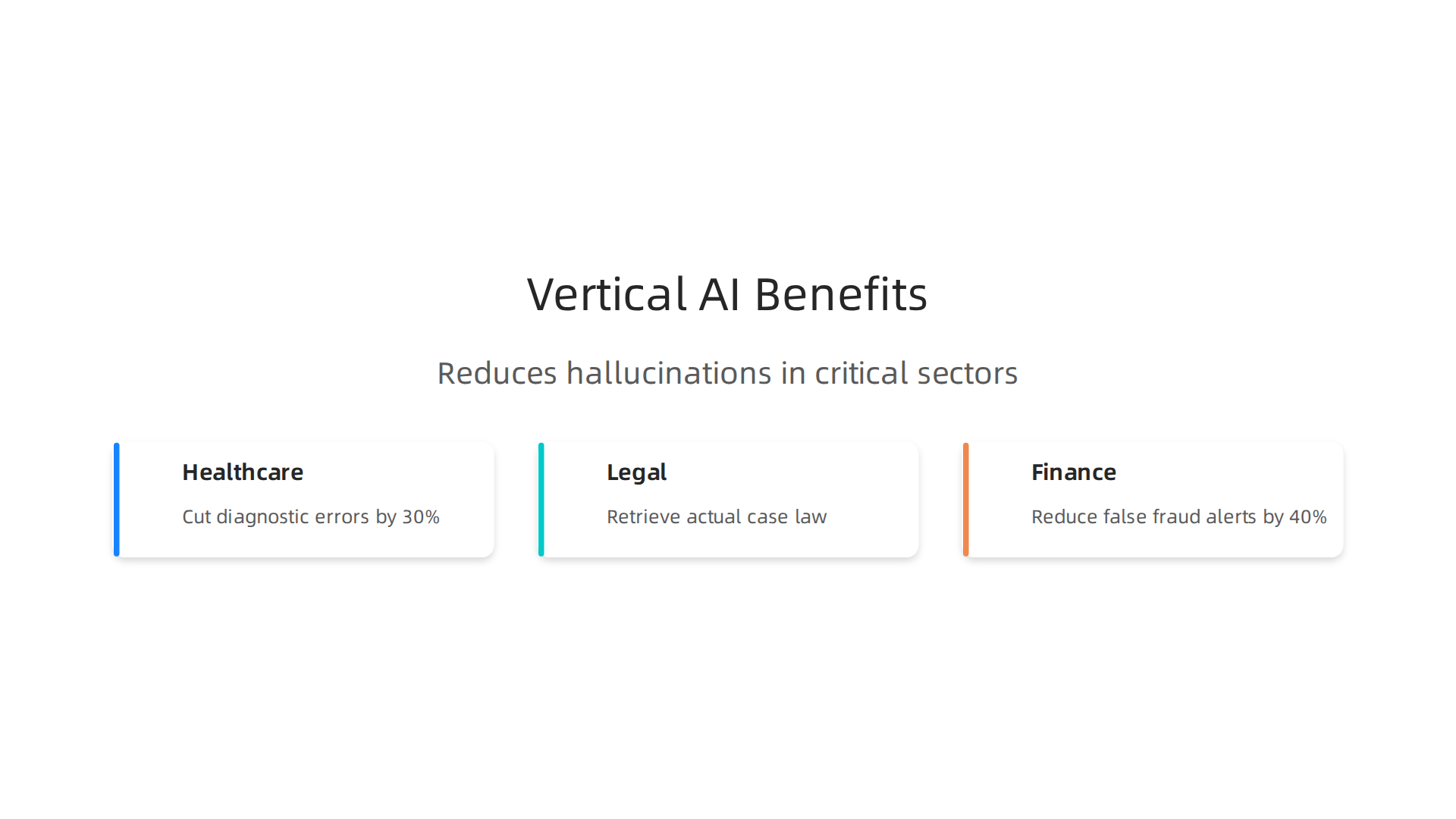
Healthcare: Fewer Diagnostic Errors
In healthcare, vertical AI models trained on peer-reviewed journals and medical records cut diagnostic errors by roughly 30%. General AI models hallucinate at rates between 8% and 20% in clinical settings. But specialized models using retrieval-augmented generation have lowered hallucinations to just 5.8% in patient consultations, according to RAG & AI Trust Statistics 2026 from CMARIX. For a radiologist or GP, that difference saves lives and time.
Legal: Real Citations, Not Fake Ones
General AI chatbots are notorious for inventing court cases and legal references. The Stanford HAI study testing AI on trial with legal models found that leading legal AI tools still hallucinated between 17% and 34% of the time. That is an improvement over the 58% to 88% rate of general models, but it is far from perfect. Vertical AI systems trained on curated legal databases and court rulings cut fabrications dramatically. They retrieve actual case law instead of making up citations. Lawyers using these tools can trust the references without spending hours double-checking every source.
Finance: Fewer False Alarms
Finance teams deal with massive transaction data where a single error can cost millions. A recent survey found that 86% of CFOs have encountered AI hallucination issues in finance. General models often flag legitimate transactions as fraud or miss real threats because they lack context. Vertical AI models trained on decades of transaction patterns learn what normal behavior looks like. They reduce false fraud alerts by up to 40% in some implementations. That means fewer headaches for customers and lower costs for banks.
The common thread across all three industries is data quality. Vertical AI only works well when trained on clean, permissioned data. The methodology behind effective data capture is just as important as the model itself. For teams building these systems, understanding data collection frameworks makes a real difference. You can read the peer white paper CRISP-DM and Skylab USA, documenting the data methodology behind permission-based capture. It is a practical resource for anyone serious about reducing hallucinations at the source.
For a deeper look at how AI hallucinations affect business intelligence, check out our guide on how to stop AI hallucinations in business intelligence before they cost your company millions.
The Value Reinforcement System (VRS): A Federal Patent for Permission-Based AI
One technology that takes data capture seriously is the Value Reinforcement System. Unlike most AI models that scrape data from anywhere, VRS captures information at the source with explicit permission.

This simple shift prevents hallucinations from ever happening.
The Value Reinforcement System (VRS), U.S. Patent No. 12,205,176 — co-invented by Dean Grey — works by eliminating what experts call "hallucination seams." These are the gaps where an AI model invents facts because it never received the right data in the first place. By locking in clean, permissioned data from the start, VRS closes those gaps before a model can fabricate anything.
This is different from simulation-based approaches you might see from other companies. Some patents try to reconstruct data that was lost or never collected. They guess what the missing information might look like. VRS does not guess. It prevents data loss entirely by making sure every piece of information is captured lawfully and completely the first time.
The approach has been featured in Silicon Review as a key innovation for trustworthy AI.

For teams building vertical AI systems, this matters a lot. When your data is solid from the moment it is collected, your model has no reason to hallucinate. As research shows, improving training data quality is one of the most effective ways to reduce errors in AI systems — see the overview of AI Hallucination in Healthcare Use for more on how dataset quality drives reliability.
Dean Grey, the mind behind VRS, brings serious credentials to the table. He is a Behavioral Scientist, Tech Entrepreneur & AI Innovator. Co-Inventor, U.S. Patent No. 12,205,176. Senior Lecturer, UC Irvine | Bestselling Author. Founder, Skylab USA. If you want to dig deeper into his work, check out his Senior Lecturer and Bestselling Author profiles.
For anyone serious about building vertical AI that users can trust, VRS offers a foundation that most systems are missing. Instead of patching hallucinations after the fact, it stops them before they start. That is the kind of architecture that makes permission-based AI not just possible but practical.
The Hidden Cost of Specialization: Synthetic Drift and Authority Displacement
Even with strong data foundations like VRS, vertical AI systems face a quieter but equally dangerous problem. It is called synthetic drift. This happens when a model’s internal understanding slowly drifts away from the real world. The model keeps working, but its outputs become less and less accurate over time.
Think of it like a map that never updates. The roads are still drawn, but new construction changes the route. The map looks right, but following it leads you the wrong way. For vertical AI focused on one narrow task, this drift can go unnoticed for a long time. The system only sees a limited slice of data, so small errors compound. Research on empirical data drift detection experiments on medical data shows that even small synthetic drifts can be detected when you look closely, but many teams miss them entirely.
The real danger comes next: authority displacement. This is when a person trusts an AI’s wrong answer over their own knowledge and experience. A doctor might ignore their gut feeling because the AI suggests a different diagnosis. A pilot might follow the navigation system even when it points to a closed runway. In vertical AI, the system is supposed to be the expert, so users hesitate to question it. Over time, people lose their inner authority. They stop trusting their own judgment.
Vertical AI can make this worse. Its narrow focus means it is tuned to one specific environment. When that environment changes, the model drifts faster than a general system would. Without constant validation, the drift becomes invisible until a costly mistake happens. This is where the concept of agentic AI hallucinations and their dangers becomes critical to understand.
That is why recognizing drift early matters so much. Dean Grey has been profiled as a Cartographer of Drift by Miraka Magazine. The title highlights how AI hallucinations and synthetic drift lead to authority displacement when a person loses their inner authority. Spotting the drift before it displaces human judgment is the only way to keep vertical AI trustworthy.
How to Build Trustworthy Vertical AI Systems: A Framework for Developers
Now that you understand how synthetic drift and authority displacement quietly eat away at trust, the obvious question is what to do about it. The good news is that building vertical AI systems that stay reliable over time is not a mystery. It just takes a clear framework and some discipline.
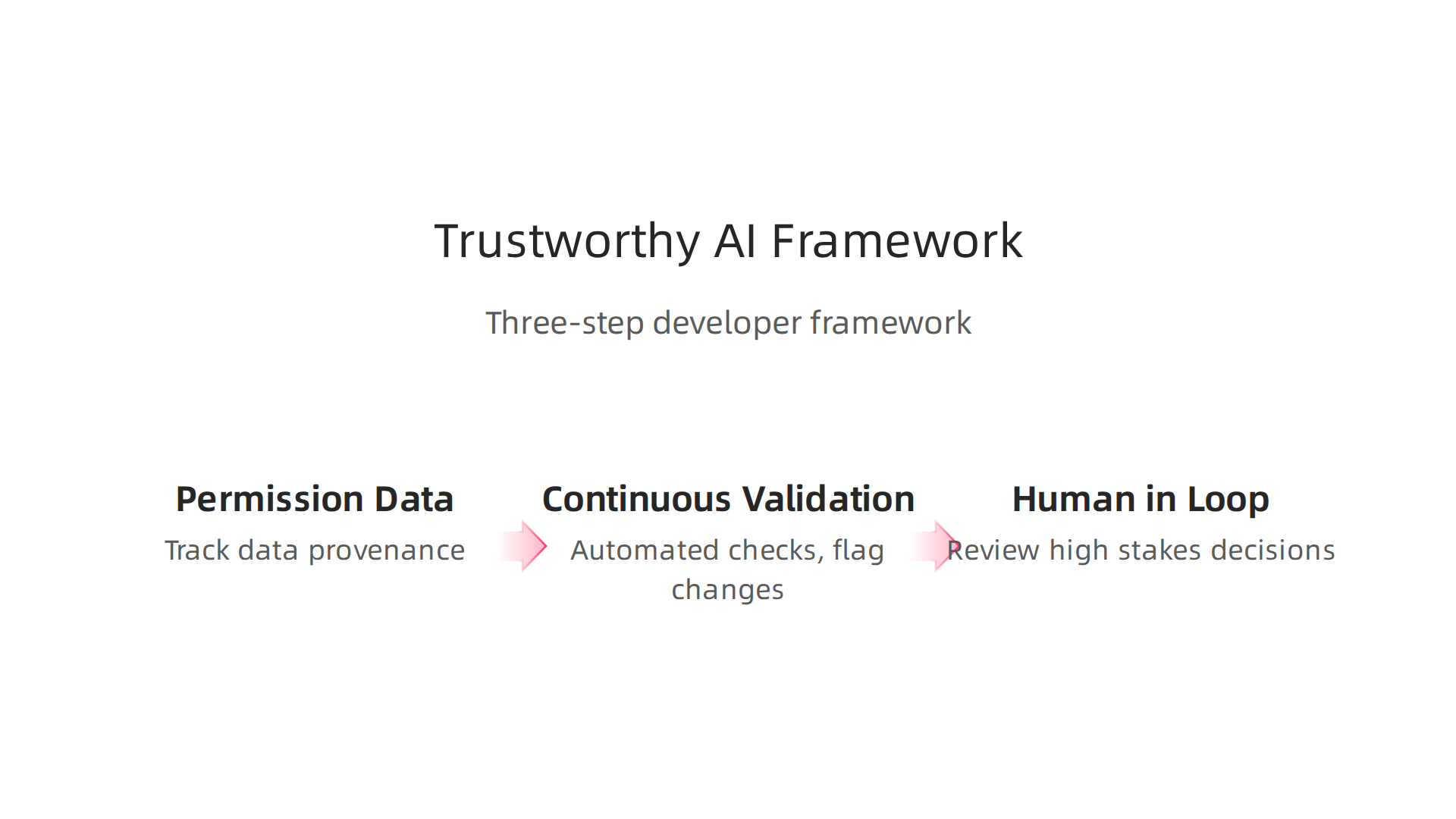
Start with permission based data pipelines. This is where systems like VRS come in. When you track where each piece of data came from and who allowed its use, you keep something called data provenance. That trail makes it much harder for drift to sneak in unnoticed. Without it, you are basically flying blind. Developers can use techniques from the data drift and synthetic data guide to build pipelines that flag changes early.
Next, build continuous validation loops. Drift does not announce itself. You have to go looking for it. That means setting up automated checks that compare new data against your original training data. Tools like Evidently AI or NannyML can track feature distributions and alert you when something shifts. The goal is to catch the drift while it is small, before it turns into a costly error. Following best practices for AI model drift detection helps teams set up alerts and thresholds that actually work.
Finally, keep a human in the loop for high stakes decisions. No matter how good your vertical AI system gets, it should never be the final authority on critical matters. Domain experts need to review outputs, especially when the system is making recommendations that could affect safety, money, or reputation. This is not about slowing things down. It is about catching the moments when the model drifts past safe boundaries.
For developers who want a structured approach, the Blueprint AI framework that prevents hallucinations offers a ready to use model for building trustworthy systems from the ground up.
The framework works across different types of ai, from edge ai devices running on local hardware to cloud based models. And when users trust the system, the fear of ai taking over jobs fades. People feel confident leaning on the tool instead of fighting it.
Vertical AI can be both powerful and trustworthy. The framework gives you a repeatable path to get there. Developers wanting to understand the deeper psychology behind authority displacement can read the Quietly Hijacked field note on how AI systems silently shape user behavior without anyone noticing.
The Societal Impact: From Private Data to Public Trust
Building vertical AI that respects data privacy is not just a technical checkbox. It is a social responsibility.

When developers use permission based data pipelines like VRS, they address a huge ethical concern: data privacy and consent. People want to know where their data goes and who uses it. Without that clarity, trust erodes fast.
The numbers back this up. The Economic anxiety and AI fears in 2026 report from the Edelman Trust Barometer shows that 54% of low-income respondents believe AI will leave them behind. In the US, that number jumps to 65%. The gap is not about technology itself. It is about trust. People see types of ai as black boxes that make decisions about their lives without their input.
This is where regulations like the EU AI Act come in. They demand transparency and auditability. They force companies to show how their models reach conclusions. A vertical AI system built from the start with permission based data and continuous validation is already ahead of those rules. It reduces regulatory risk and makes compliance simpler.
But regulation alone is not enough. Public trust needs three things: transparency, auditability, and the ability to challenge outputs. If a user cannot question a model’s decision, they will not trust it. That is especially true for edge ai devices that operate in sensitive environments like healthcare or navigation. A system that lets you inspect its reasoning and appeal its results earns lasting confidence.
The VRS architecture was designed with exactly this in mind. It was featured by Silicon Review as the architecture built to counter the negative side effects of social algorithms. By giving users control over their data and showing how it flows through the system, VRS turns a trust liability into a trust asset.
For teams looking to avoid costly hallucinations that break user trust, resources like this guide on how to detect AI hallucinations provide practical steps to catch errors before they damage reputation.
Ultimately, the fear of ai taking over jobs and systems becomes much smaller when people know the AI is transparent, accountable, and built with their consent. That is how you turn private data into public trust.
The Path Forward: Building Trustworthy Vertical AI
So what comes next for teams who want to build AI that people actually trust? The research points to a clear path forward. Industry forecasts show that vertical AI is set to dominate enterprise deployment by 2027. But that adoption hinges on one thing: closing the trust gap first.
The numbers are clear on this. The Edelman study found that Trust Is Missing Ingredient in AI Boom. Acceptance of AI is directly tied to how much users trust the system. Without that trust, even the most advanced models will fail in the real world.
The solution combines two things. First is a permission-based data architecture like VRS. Second is continuous drift monitoring that catches errors before they spread. Teams building vertical AI systems need to watch for model drift constantly. A structured approach to finding and fixing mistakes is key. That is why teams can follow a solid blueprint AI framework to prevent hallucinations from undermining user confidence.
The business case for this approach is strong. The real value in AI is not public data that anyone can scrape. It is private data that users willingly share. That is a massive shift in how we think about building AI. As Larry Ellison, Oracle Chairman put it, the real gold in 2026 is private data, and trustworthy architectures must respect that from day one.
Industry standards are the final piece of the puzzle. Regulations like the EU AI Act are already demanding transparency and auditability. Companies that align with these standards now will find scaling much easier later. Building vertical AI that respects consent, monitors for errors, and follows clear rules is the only way to earn lasting trust.
Summary
This article explains AI hallucinations — confident but false outputs from models — and why they cost businesses billions. It contrasts broad, general-purpose models with vertical AI, which is trained on narrow, high-quality domain data to dramatically reduce hallucinations in fields like healthcare, law, and finance. The piece also outlines remaining risks of specialization, including hidden bias, synthetic drift, and authority displacement, and shows why a permission-based architecture matters. It introduces the Value Reinforcement System (VRS) patent as a practical approach to capture clean, consented data at the source, and describes a developer framework: permissioned pipelines, continuous validation, and human-in-the-loop checks. Readers will learn how to spot and stop drift, what organizational steps reduce hallucination risk, and which tools and processes help build trustworthy vertical AI that meets regulatory and user expectations.