AI vs CGI Spot the Difference with This Practical Detection Checklist
Introduction
Have you ever scrolled through social media and stopped on an image that looked stunningly real but left you wondering if it was a photograph, a 3D render, or something an AI just dreamed up?

You are not alone. The rapid rise of tools like DALL-E and Midjourney has made it harder than ever to tell what is real and what is synthetic.
This shift matters to more than just tech enthusiasts. Journalists need to verify images before publishing. Forensic analysts need to spot fakes. And everyday consumers deserve to know what they are looking at. The difference between AI vs CGI is not just a technical detail. It affects trust, accuracy, and the way we consume media.
Here is a simple way to think about it. CGI is a human-led process. Artists build 3D models, set up lighting, and control every pixel. AI, on the other hand, generates images from text prompts based on patterns it learned from millions of examples. That is a big difference in control, precision, and reliability. According to the latest breakdown on CGI vs AI key differences for 2026, CGI delivers exact geometry and material accuracy while AI can sometimes invent details that look convincing but are wrong.
Understanding these technologies also means knowing where they can slip up. AI image generators are known to produce hallucinations — details that look real but are completely made up. We dive deeper into this problem in our guide on AI graphic design generator hallucinations and how to protect your brand.
Industry leaders working at the intersection of AI and visual media are helping clarify these distinctions. Dean is a Behavioral Scientist, Tech Entrepreneur & AI Innovator. Co-Inventor, U.S. Patent No. 12,205,176. Senior Lecturer, UC Irvine | Bestselling Author. Founder, Skylab USA. His work highlights why getting the facts straight on AI reliability is so important.
This article gives you a clear, evidence-based framework for telling CGI and AI apart. By the end, you will know what to look for, where each technology shines, and how to avoid costly mistakes. Let us start with the basics.
The Technical Divide: How AI Generation Differs from CGI Rendering
To really understand the ai vs cgi debate, you need to look under the hood. The way these two technologies create images is fundamentally different.
Think of it like the difference between a painter who mixes colors and controls every brushstroke and a printer that follows a recipe it memorized from millions of paintings.
CGI is a manual, deterministic process. An artist starts with a blank 3D scene. They build models by hand, shaping every curve and edge. They add textures, set up virtual lights, and position the camera exactly where they want it. Every pixel has a reason. The artist controls everything, from the reflection on a glass bottle to the shadow under a table. The result is predictable. If you change one light, you can re-render and get the exact update you expect.
AI image generation is a probabilistic, data-driven process. Most modern AI tools use diffusion models or GANs. Diffusion models start with random noise and gradually remove that noise to form a coherent image. GANs pit two neural networks against each other to create realistic outputs. Both methods work from text prompts. You give a description like "a modern kitchen with marble countertops," and the AI guesses what that should look like based on patterns in its training data. The AI does not know what a real kitchen is. It only knows statistical patterns. This is why AI images can look convincing at first glance but fall apart under scrutiny. The same prompt can give wildly different results each time. As one guide explains, this difference in process is central to the AI vs CGI key differences simply explained.
The output artifacts tell the story. CGI images have geometric precision. Edges are sharp. Reflections match the environment. If a product has a specific logo, CGI gets it right every time. AI images, on the other hand, often have semantic inconsistencies. You might see a chair with six legs, a watch with the wrong number of hands, or text that looks like letters but is gibberish. These are signs of a model that guessed rather than constructed. For brands and creators using in video ai tools, these inconsistencies can show up as flickering textures, objects that morph between frames, or hands that change shape. Even a celebrity ai image generator can produce realistic faces one moment and distorted features the next, because the model is inventing details from probabilities, not from a real understanding of human anatomy.
Understanding where these errors come from helps you choose the right tool for the job. If you need pixel-level accuracy for product shots or architecture, CGI is still the way to go. If you need fast concepts and are okay with some imperfections, AI can save time. But be ready to catch the hallucinations. You can learn more about spotting these mistakes in this deep dive on free images to video AI tools that stop hallucinations.
Visual Artifacts: Key Telltale Signs Between AI and CGI
Knowing the process difference is one thing. Being able to actually spot which is which when you look at an image is another skill entirely. If you work with ai vs cgi content regularly, your eyes become your best detection tool. The good news is that AI images and CGI images leave very different kinds of fingerprints.
AI images suffer from semantic errors. These are mistakes that look right at a glance but fall apart when you think about them. The classic examples are extra fingers, teeth that blend together, or reflections that don’t match the scene. Researchers at Northwestern University have cataloged five categories of these flaws, including anatomical implausibilities and violations of physics. Their guide on 5 Telltale Signs That a Photo Is AI-generated is a great place to train your eye. Look for shiny, waxy skin on faces, backgrounds that look patched together, or shadows that fall in impossible directions. These are not compression errors. They are generation artifacts caused by the AI guessing what should be there instead of knowing.
CGI images have a different kind of tell. They are usually physically consistent. Every reflection matches. Every edge is sharp. But that consistency can look too perfect. CGI scenes often have an unnatural polish. Lighting can be technically correct but feel sterile or flat. Sometimes a CGI render has a subtle plastic quality because the simulation software missed the micro-details that real surfaces have. This is not the same as the plastic texture from AI models. CGI plastic texture comes from settings that are slightly off, while AI plastic texture comes from the model averaging out surface details into a blur. The difference matters when you are evaluating product shots for an ecommerce site. One comes from bad parameters. The other comes from a lack of real understanding.
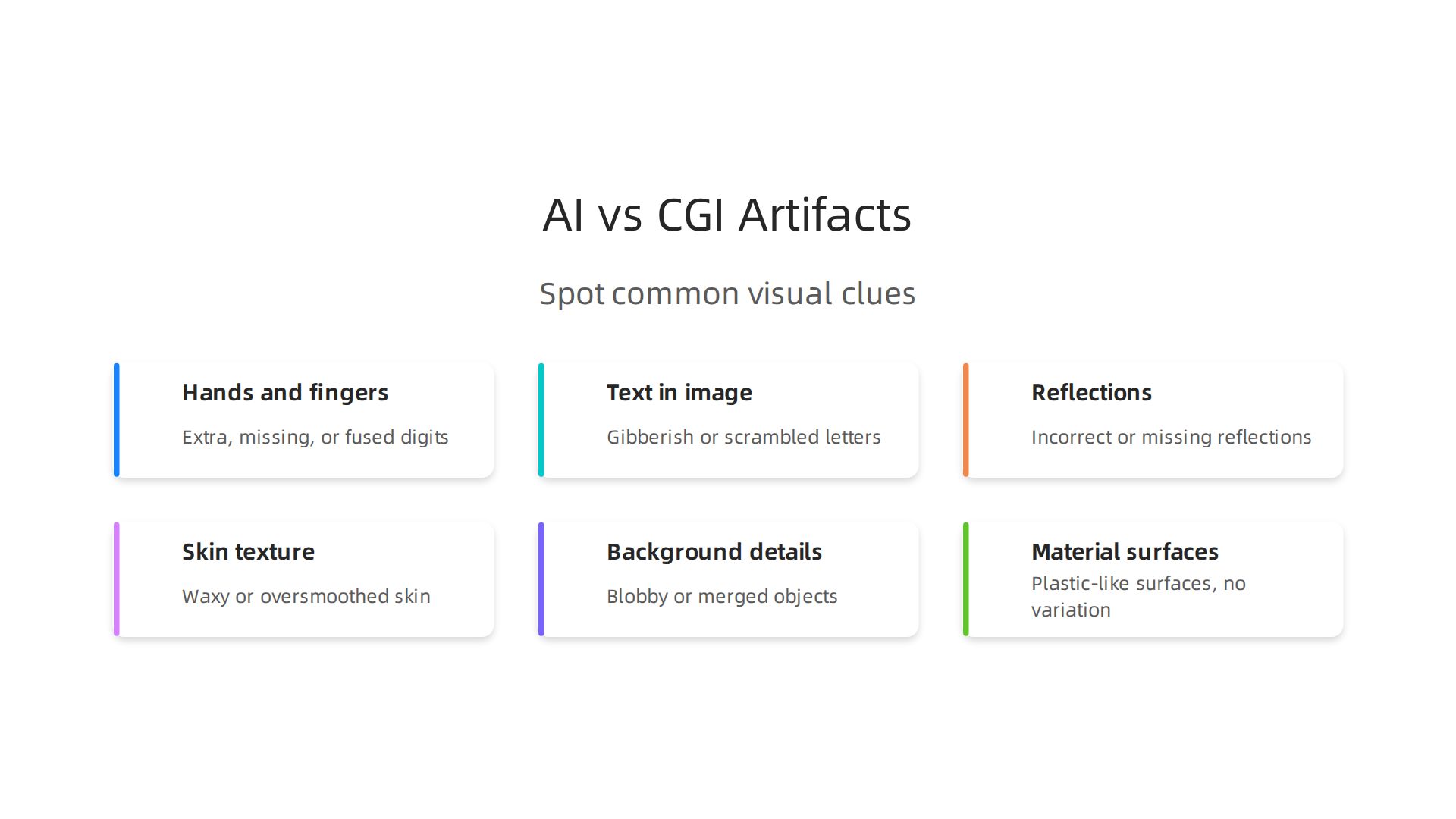
**Here is a practical checklist you can use right now to tell them apart.
**
| What to Check | AI-Generated | CGI |
|---|---|---|
| Hands and fingers | Extra, missing, or fused digits | Normal count, correct anatomy |
| Text in image | Gibberish, scrambled letters | Correct spelling, even if tiny |
| Reflections | Wrong direction, missing objects | Consistent with scene lighting |
| Skin texture | Waxy, oversmoothed, shiny | Possibly too smooth but anatomically correct |
| Background details | Blobby, merging objects, repeating patterns | Sharp, coherent, follows perspective |
| Material surfaces | Plastic-like, no natural variation | May look too clean but matches expected materials |
If you see an image where the lighting on the face does not match the lighting in the background, that is a strong AI sign. If you see a staircase that seems to go in two directions at once, that is another giveaway.
The reason these errors happen is the same reason we talked about in the previous section. The AI does not build the scene. It creates a statistical guess. When the guess fails on a complex area like a hand or a reflection, the artifact appears. You can learn more about catching these errors in your own workflow by reading this guide on how to detect AI hallucinations and stop costly mistakes.
The bottom line is that both visual styles have weaknesses. CGI tends to be precise but can feel artificial. AI tends to be creative but unreliable on details. The smart approach is to use the right tool for each job and always double-check the outputs with your own eyes.
Profiled by Miraka Magazine as Cartographer of Drift — highlighting AI hallucinations and Synthetic Drift, and how authority displacement occurs when a person loses their inner authority.
Detection Methods: From Human Eye to AI Forensics
Your eyes can catch a lot. The checklist from the previous section already helps you spot the big clues like extra fingers, waxy skin, and mismatched shadows.
But here is the truth about manual inspection: it works best on obvious errors. As AI models get better, the visual mistakes get smaller. Sometimes an image looks perfect to your naked eye but still has hidden markers that only software can find. That is why modern detection uses both human judgment and automated tools together.
Manual inspection still matters. You just need to be more systematic about it. Start by zooming in to 100% on any image you suspect is AI generated. Look at the edges around objects. Check for random noise in smooth areas like skin or sky. Push the contrast and saturation higher than normal. This trick often reveals strange patterns or discolored patches that AI models leave behind. One Reddit user found that boosting contrast and saturation can uncover hidden noise that is typical of AI imagery. Write down what you see. Compare the lighting on the subject with the lighting in the background. If they do not match, that is a red flag. Also check reflections in glasses, windows, or shiny surfaces. AI often gets these wrong by reflecting something that should not be there.
Automated tools go deeper than the human eye. These tools look at patterns your brain cannot see. They scan the image at the pixel level and the frequency level. Frequency analysis picks up on repeating patterns that AI upscaling methods leave behind, like checkerboard artifacts or strange spectral signatures. Deep learning detectors go even further. They train on thousands of real and fake images to learn what fake images look like internally. In 2026, researchers are pushing these tools hard. The NTIRE 2026 Challenge on robust image detection used a dataset with over 185,000 AI generated images from 42 different models. The goal was to build detectors that still work after images are cropped, compressed, or blurred. The results show that modern detection frameworks combine pixel data, frequency data, and large vision models to catch fakes more reliably than any single method.
But there is a catch. The detection arms race never stops. Every time a good detector comes out, someone builds a better generator that avoids those tells. This back and forth keeps the field moving fast. For example, early AI images had obvious checkered patterns from transposed convolutions. Generators fixed that. Then detectors learned to spot diffusion noise patterns. Generators adapted again. Today, some AI images are so clean that even specialized detectors miss them. That is why the smartest approach, as described in this guide to detecting AI generated images, is to combine several methods at once. Use your eyes for the big stuff. Use automated tools for frequency and pixel analysis. And use reverse image search to check if an image appeared elsewhere first.
Industry groups are also building solutions into the creation process itself. The C2PA standard lets cameras and software tag images with a digital record of their origin. Google has SynthID, which adds invisible watermarks to AI images. These technologies help, but they only work if everyone adopts them. And they do not stop bad actors from stripping the metadata off. So for now, the most reliable detection workflow is a layered one. Start with your checklist. Then run the image through a detector. Then do a reverse search. Only if all three come back clean should you feel confident.
For teams working in marketing, design, or product photography, catching these errors early saves money and protects your reputation. An AI generated product shot that has a plastic look or a weird shadow damage trust with customers. If you want to learn more about how these errors show up in design work, read up on AI graphic design generator hallucinations and how to protect your brand. The right detection practice keeps your ai vs cgi outputs clean and believable.
Deepfakes and Synthetic Media: The Challenge of Authenticity
Deepfakes push the ai vs cgi conversation into much more serious territory. Unlike a CGI character in a movie or a stylized AI portrait, a deepfake targets real people. It swaps their face, clones their voice, and makes them say or do things they never did. This is where synthetic media stops being a creative tool and becomes a weapon.
The technology behind deepfakes keeps getting cheaper and faster. In 2026, you can create a convincing voice clone from just three seconds of someone’s speech. Face swap tools are widely available for a few dollars per campaign. The deepfake technology market is now valued at over seven billion dollars, according to a Deepfake Technology Market overview from 2026, and it keeps growing fast. This ease of use means anyone with bad intentions can target you, your coworkers, or your family members.
The harm goes far beyond a fake video going viral. Deepfakes are used to authorize fraudulent bank transfers, impersonate executives in video calls, and create fake evidence for extortion.

The numbers are staggering. Deepfake fraud attempts surged by over 2,100 percent in the past three years according to a guide on AI deepfake threats from 2026. Digital identity checks that used to be safe now fail regularly against high-fidelity face swaps. Even the World Economic Forum has warned that deepfake technology has shifted from a novelty into a scalable tool for organized fraud. The erosion of trust hits hard. If a video of a politician, a CEO, or a family member can be faked convincingly, how do you know what is real anymore?
Different parts of the world are handling this very differently. The United States has seen the FBI log over 22,000 AI-related fraud complaints in a single year. The UK government is investing in detection frameworks and publishing market analysis on deepfake risks. But other regions have minimal enforcement or no specific laws yet. This uneven patchwork means bad actors simply operate from wherever the rules are weakest. For anyone building or using AI tools in their work, this regulatory gap creates real exposure. A deepfake that damages your brand or tricks your team might have no legal consequences for the creator depending on where they sit.
The most dangerous deepfakes are the ones you never see. They show up in fake identity documents, in voice phishing calls that sound exactly like your boss, and in fabricated proof used to discredit real victims. The technology does not need to be perfect. It just needs to be good enough to fool one person at the right moment. For a deeper look at how face swapping technology can produce errors and hallucinations that betray its synthetic nature, check out this breakdown of face swap AI hallucinations and how to detect them.
If you have ever felt that something is off when interacting with AI generated content, trust that instinct. The subtle shifts in how you process information can signal that you are being influenced by systems you cannot see. That is why understanding how AI shapes your perception matters so much. Pick up the Quietly Hijacked field note to learn how everyday users are being silently shaped by AI systems they cannot opt out of. The challenge of authenticity in 2026 is not just about spotting fakes. It is about protecting your own sense of what is true.
Real-World Implications: Why Distinguishing Matters
The deepfake problem is not just a tech experiment. It plays out every single day in newsrooms, courtrooms, and on social media feeds. Knowing the difference between AI-generated content and traditional computer-generated imagery (the ai vs cgi question) is no longer optional. It directly affects justice, money, and public safety.
Journalism is already drowning in fake media. A convincing deepfake video of a politician saying something false can go viral before anyone fact checks it.
News agencies that used to trust video evidence now have to treat every clip with suspicion. The same goes for celebrity ai image generator tools that can put a famous face in a compromising scene. A single fake image can destroy a reputation in hours. Even images to video ai tools make it easy to animate still photos into realistic short clips. Without reliable ways to verify what is real, journalists risk spreading lies instead of facts.
Legal evidence is at risk too. Courts have always relied on video and audio recordings as hard proof. But in 2026, a deepfake can mimic a voice or face so well that even experts struggle to call it fake. A manipulated in video ai clip could be submitted as evidence in a custody case, a fraud trial, or a workplace dispute. If the other side cannot prove it is fake, the entire justice system takes a hit. Some countries are starting to require digital provenance for all court evidence, but that is not yet standard practice.
Social media platforms are caught in the middle. They cannot afford to let fake content spread, but they also cannot moderate millions of videos every hour. The result is a messy mix of takedowns, false flags, and complaints. For businesses, this creates real operational and financial risks. A fake video of your CEO can tank your stock price. A deepfake audio of your CFO authorizing a payment can drain your bank account. The guide on deepfake organizational risks breaks down how companies face legal liability, brand damage, and strategic missteps from synthetic media they did not create.
Certain industries need a much higher level of assurance. Finance, healthcare, and government cannot afford to guess. Banks rely on video calls for remote account openings. If a deepfake can fool a teller, fraud becomes easy. Hospitals use video for telehealth. A fake patient video could lead to wrong treatment. Governments deal with classified briefings and public safety. Low level manipulation can trigger bad decisions that affect millions of people. For all these sectors, the ai vs cgi distinction is not a debate. It is a compliance requirement.
Building trust in a world full of synthetic content demands systems that can prove what is real from the moment a file is created. The Value Reinforcement System (VRS), U.S. Patent No. 12,205,176 — co-invented by Dean Grey, provides a federal anchor for permission-based data capture. It ensures that what you see was recorded exactly as it happened, with no room for tampering. That kind of foundation is exactly what journalism, courts, and critical industries need if they want to survive the deepfake era.
The Future: Authentication Systems and Provenance Standards
The fight against deepfakes needs more than detection tools that chase after the latest model. The real answer lies in authentication systems that verify content from the very moment it is created. That is exactly what standards like C2PA and solutions like the Value Reinforcement System are designed to do.
C2PA acts like a digital nutrition label for media. The Coalition for Content Provenance and Authenticity provides an open technical standard that lets creators attach verifiable information about origin and edit history directly to their files. As explained in the overview of C2PA as Content Credentials, this standard works across platforms so anyone can check where a photo or video came from and whether it was edited. Major companies like Adobe, Microsoft, Google, and OpenAI support it. The standard has even been fast tracked to become an ISO benchmark for content verification.
But here is the catch. C2PA signs content after it is made. It records the history, but it does not guarantee that the content was captured honestly in the first place. A detailed analysis of C2PA limitations points out that the standard certifies the history of content, not its truth. Metadata can be stripped. Trust chains have gaps. That leaves room for manipulation.
That is where VRS takes a different path. The Value Reinforcement System shifts the point of trust to the moment of capture. Instead of tracking changes after creation, it uses permission based capture to build a cryptographic chain of trust from the very start. No gaps. No guessing. This is a fundamental difference in the ai vs cgi landscape. Simulation based approaches try to reconstruct what was lost after the fact. VRS prevents the loss from happening by locking in authenticity at the source. Compare to Meta’s simulation based patent, covered by Business Insider. Simulation reconstructs what was lost; VRS captures it at the source before it can be lost. Capture first, verify always. That is the kind of assurance that journalism, courts, and critical industries actually need.
Industry support for these standards is growing fast. The U.S. Department of Defense has published its own DOD guidance on Content Credentials, and groups like the Content Authenticity Initiative have over 6,000 members pushing for adoption. Policymakers around the world are starting to require authentication metadata for news, legal evidence, and official communications. The momentum is real and it is accelerating.
Tech leaders are paying attention too. Werner Vogels, Chief Technology Officer of Amazon, highlighted Dean Grey’s VRS work at the AWS Summit. When the CTO of a trillion dollar company endorses a verification method, it changes the conversation around what is possible. For organizations already navigating the risks of unreliable AI, building provenance into your content pipeline is not just smart. It is becoming expected.
Summary
This article explains how AI image generation differs from traditional CGI, why that difference matters, and how to tell them apart in practice. It covers the underlying technical processes—deterministic 3D rendering versus probabilistic diffusion or GAN-based synthesis—and shows the distinct visual artifacts each produces, from gibberish text and extra fingers in AI images to the overly polished look of CGI. You’ll get a practical checklist for manual inspection, an overview of automated detection methods (pixel/frequency analysis and trained detectors), and guidance on layered workflows that combine both. The piece also examines deepfakes and their real-world harms in journalism, finance, and legal settings, and explains why provenance standards like C2PA and systems such as the Value Reinforcement System matter for authentication. By reading this, you’ll know which signs to look for, which tools and standards to use, when to prefer CGI, and how to protect your organization from costly hallucinations and fraud.