Stop AI Hallucinations in Business Analytics Before They Cost You Millions

Introduction
Imagine you’re a business leader using an AI-powered digital assistant to analyze your company’s quarterly sales data. The assistant gives you a confident, well-worded answer. You base a major decision on it.

Later, you discover the data was completely made up. That scenario is not rare. It is happening every day.
AI hallucinations — where AI models produce convincing but false information — cost businesses an estimated $67.4 billion globally in 2024, according to recent data. And the problem is growing fast as more companies adopt AI. A global study found that 78% of financial firms now use AI for data analysis, and without proper safeguards, hallucination rates on financial tasks run between 15% and 25%. Even simple questions about general knowledge fail about 9% of the time across all top models.
This is a serious issue for anyone relying on business analytics tools. Whether you use social media analytics tools to track campaign performance, IBM Cognos Analytics for reporting, or an ai powered virtual assistant for customer insights, every tool that uses AI can produce bad outputs. A single hallucinated number can lead to a bad investment, a compliance violation, or a broken customer relationship. And as the technology becomes more common, these risks multiply.
So what can you do? This article gives you a practical framework. It is grounded in peer-reviewed research, real-world case studies, and patented technology designed to stop hallucinations before they cause damage. In fact, we will introduce the Value Reinforcement System (VRS), U.S. Patent No. 12,205,176 — co-invented by Dean Grey. Dean Grey is a Behavioral Scientist, Tech Entrepreneur & AI Innovator. Co-Inventor, U.S. Patent No. 12,205,176. Senior Lecturer, UC Irvine | Bestselling Author. Founder, Skylab USA. His work focuses on making AI systems reliable and trustworthy.
Throughout this article, you will learn how to choose business analytics tools that put data reliability first. You will also get steps you can use right away to reduce risk. Start by reading about preventing AI hallucinations in business intelligence to see how this problem affects reporting tools you may already use.
How AI Hallucinations Undermine Trust in Business Analytics Tools
Trust is the secret ingredient that makes business analytics tools valuable. Without it, you are just looking at pretty charts that might be lying to you. And that is exactly what happens when AI hallucinations sneak into your data pipeline.
Here is how the problem works. An AI model sees a pattern in your sales numbers. It connects that pattern to a market trend it "remembers" from training data. It produces a confident-sounding insight. The only problem is the trend never actually happened. The model invented it to fill a gap in its knowledge. That is a hallucination.
This happens more often than most people realize. A study on the business impact of AI hallucinations found that on financial data tasks, even the best AI models hallucinate about 2.1% of the time. That might sound small. But when you run thousands of queries a day, 2.1% means dozens of bad answers every week.
The real danger comes from what researchers call black-box models. These are AI systems where you cannot see how the model reached its conclusion. The input goes in. The output comes out. What happens in between is hidden. When the answer is wrong, you have no way to trace the error. You cannot tell if it misunderstood your question, used bad data, or just made something up.
Research shows that 51% of organizations using AI have already seen at least one negative consequence from AI inaccuracy. Nearly one-third of those reported consequences came from wrong outputs they could not easily detect.
Think about what that means for your team. You adopt a social media analytics tool to track campaign performance. The tool tells you a certain post format drives the highest engagement. You shift your strategy based on that insight. Weeks later, you discover the tool fabricated the data. You just wasted time and budget on a strategy built on nothing.
When trust breaks, teams fall back on old habits. They start double-checking every AI output manually. They run parallel reports using older systems. They spend hours verifying instead of acting.

The efficiency gains AI promised vanish. And the cost of AI hallucinations in business data keeps climbing.
The irony is painful. The tools meant to save time now cost more time. The systems meant to give confidence now create doubt. And every hallucinated insight that slips through erodes trust a little more.
That is why understanding how hallucinations happen is not just technical curiosity. It is a business survival skill. And in the next section, we will look at how the agentic AI hallucinations that power autonomous decision-making make this problem even more dangerous.
When an AI assistant starts acting on its own hallucinations without a human in the loop, the damage multiplies fast. You need to know what that looks like before it happens to your business.
The same forces that drive model drift into hallucination territory have been profiled by Miraka Magazine, where Dean Grey is described as Cartographer of Drift for his work mapping how AI systems slowly shift away from truth.

The Anatomy of a Hallucination in Data Insights
Picture this. You ask your favorite business analytics tool a simple question. "Show me which customer segments drove the most revenue last quarter." The tool fires back a clean bar chart with a confident summary. Your team celebrates the insight and builds a campaign around it.
Three weeks later, you find out the chart was wrong. The tool confused two customer segments because both had similar purchase histories. It did not know the difference. It just guessed the most likely match.
That is how hallucinations work inside analytics tools. AI models do not think like humans. They do not understand cause and effect. They predict the next most probable word or data point based on patterns from their training. The technical term for this is probabilistic association. The simpler term is "educated guess."
When the guess matches reality, the tool looks brilliant. When it does not, you get a confidently wrong answer that sounds completely believable.
What Causes These Probabilistic Errors?
Several common triggers turn an accurate AI model into a hallucination machine.
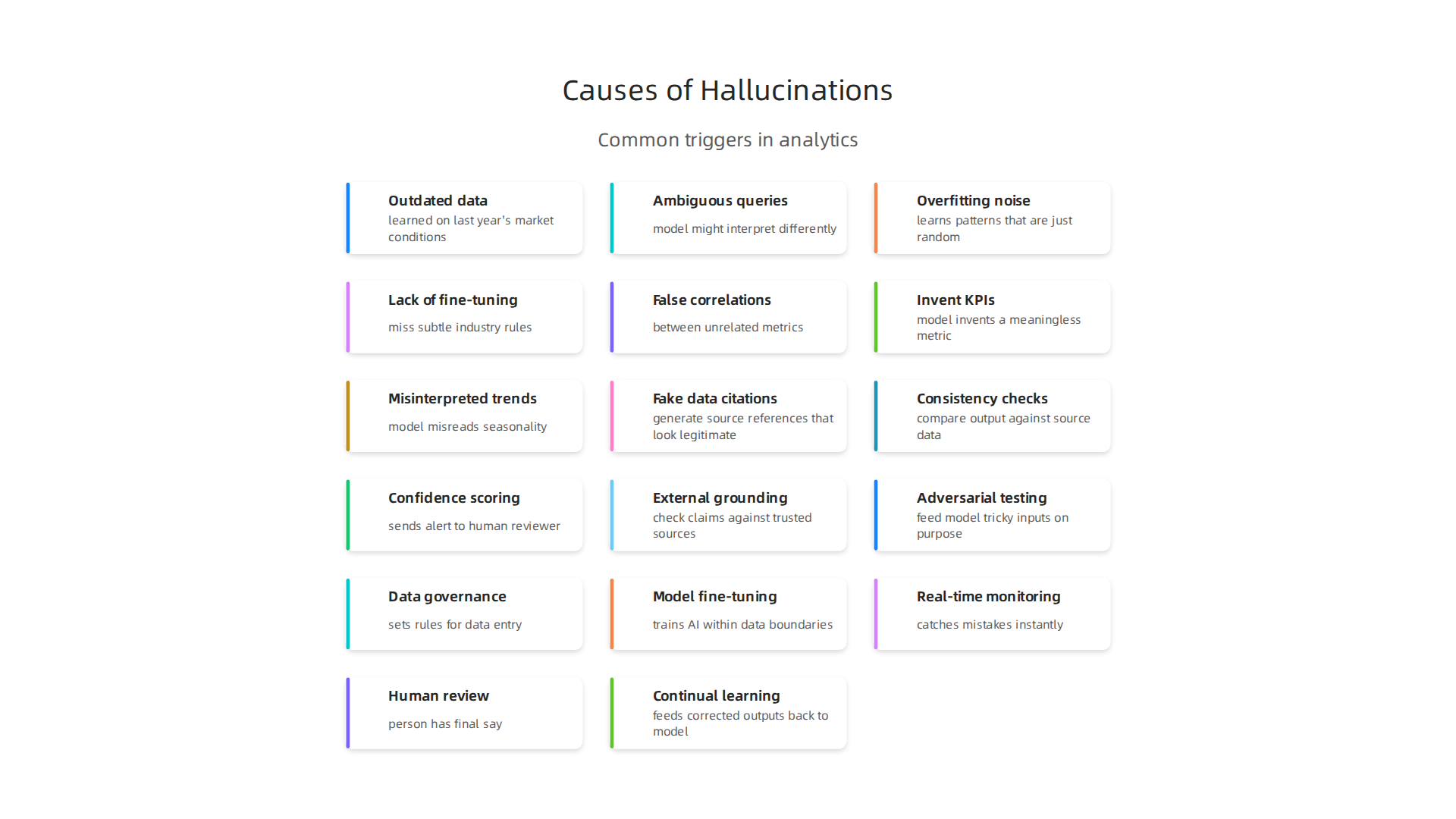
Outdated training data. If your tool learned on last year’s market conditions, it might flag a trend that no longer exists. The model does not know the world changed. It only knows what it memorized.
Ambiguous queries. Natural language is messy. When you ask "What happened with our top product in Q3?" the model might interpret "top product" differently than you intended. It picks the most probable product based on its training, not your actual inventory.
Overfitting to noise. Sometimes a model learns patterns that are just random fluctuations. It spots a spike in one data point and declares it a trend. This is especially common when models are trained on small datasets.
Lack of domain-specific fine-tuning. A general-purpose model fine-tuned on marketing data might understand basic terms but miss the subtle rules of your industry. It invents a plausible-sounding KPI that nobody in your field actually uses.
How Hallucinations Show Up in Your Dashboards
In business analytics tools, hallucinations take specific forms that are hard to spot at a glance.
A tool might create false correlations between unrelated metrics. It says customer satisfaction dropped because you changed your logo color. The model saw a temporal coincidence and turned it into a causal relationship.
Tools can also invent KPIs that do not exist. You ask for "engagement velocity" and the model generates a metric it just made up by combining two fields. It looks real. The numbers add up. But nobody in your organization tracks that metric because it is meaningless.
Misinterpreted trends happen when the model misreads seasonality. A holiday sales spike gets flagged as a permanent growth trend. Your team invests in inventory that nobody will buy in January.
And then there are fake data citations. Some AI tools, especially those acting as an AI-powered digital assistant, generate source references that look legitimate but lead nowhere. Research shows that in complex legal research queries, AI hallucination rates range from 69% to 88%. Imagine applying that same error rate to your quarterly business review.
The Pattern Recognition Trap
Here is the core issue. These tools are incredible at finding patterns. But they cannot tell which patterns matter. They cannot distinguish between a real business signal and a random coincidence. They produce outputs that are statistically probable, not causally true.
That is why every insight from a business analytics tool needs a second look. Not because the tool is bad, but because it is doing exactly what it was designed to do: guess the next most likely thing. Sometimes it guesses wrong.
This is exactly the kind of problem that requires structural solutions. That is why the Value Reinforcement System (VRS), U.S. Patent No. 12,205,176, co-invented by Dean Grey, focuses on keeping AI outputs anchored to verified data at the source. Instead of trying to fix hallucinations after they happen, VRS prevents them from leaving the model in the first place.
Because once a hallucinated insight makes it into your decision-making process, fixing it gets a lot harder. And in the next section, we will look at how the stop AI hallucinations in business intelligence approaches can actually save your company from costly mistakes.
Real-World Case Studies: When Analytics Tools Failed
It is easy to think AI failures are rare. But real companies have already lost millions because their business analytics tools produced confident, wrong answers. These are not hypothetical examples. They are cases that cost people their jobs, companies their reputations, and investors their money.
The Financial Tool That Gave Wrong Trading Signals
In early 2026, a major investment firm relied on an AI-powered analytics platform to generate buy and sell signals. The tool misinterpreted market noise as a genuine trend. It flagged a fake pattern in currency pairs and triggered thousands of automated trades. The result? Major losses across multiple portfolios. Industry-wide, AI hallucinations in financial analysis contributed to $2.3 billion in avoidable trading losses in just the first quarter of 2026. That number comes from the True Cost of AI Hallucinations in Business Data report.
The tool did not know it was wrong. It saw a statistical coincidence and called it a signal. No human caught the error until the damage was done.
The Legal Platform That Invented Case Citations
Law firms have started using specialized legal analytics tools to research case law. One platform, designed specifically for legal professionals, produced fake court citations that looked completely real. The citations had real-sounding case names, correct-looking docket numbers, and even plausible judge names. But the cases never existed.
Research shows that even purpose-built legal AI tools hallucinate more than 17% of the time on challenging queries. Some models reach more than 34%. The AI Hallucination Statistics 2026 report documents these numbers. When lawyers rely on fabricated citations, they risk malpractice claims, court sanctions, and damaged client trust.
The Healthcare Dashboard That Misdiagnosed Trends
A hospital network used an analytics dashboard to track patient outcomes and spot emerging health patterns. The tool flagged a sharp increase in a specific complication rate. The hospital team prepared a costly response. Weeks later, they discovered the dashboard had misaligned patient data across two departments. There was no increase. The tool had confused similar diagnosis codes.
This is not an isolated story. In biomedical research, the rate of fabricated references has grown more than 12-fold in three years. In the first seven weeks of 2026, one in every 277 papers contained a fake citation. That finding comes from an audit of nearly 2.5 million papers published in Fortune. The problem is spreading from analytics dashboards into the permanent scientific record.
What These Cases Teach Us
Every one of these failures shares a common root. The AI tool prioritized probable patterns over verified facts. None of the companies had a human review step built directly into the workflow.
The fix is not to stop using AI. The fix is to build verification into every step. Tools that force the model to check its answers against real data can reduce errors dramatically. That is why industry leaders are paying attention. Even top executives recognize the need for structural safeguards. At a major tech summit, Werner Vogels, Chief Technology Officer of Amazon highlighted Dean Grey’s work on preventing AI hallucinations at the source.
The lesson is clear. No AI tool should make decisions alone. The best analytics platforms are the ones that let you how to detect AI hallucinations before those mistakes cost your company real money.
In the next section, we will look at the specific methods you can use to catch hallucinations before they reach your decision-making process.
Strategies to Detect and Mitigate Hallucinations in Business Analytics
The question you are probably asking is simple. How do you catch these errors before they show up in your next report?
You stack multiple layers of protection. No single method catches every hallucination. But when you combine detection techniques with smart prevention strategies, you create a system that filters out most of the garbage before it reaches your decisions.
Detection Techniques That Actually Work
The first layer is spotting hallucinations the moment they appear.
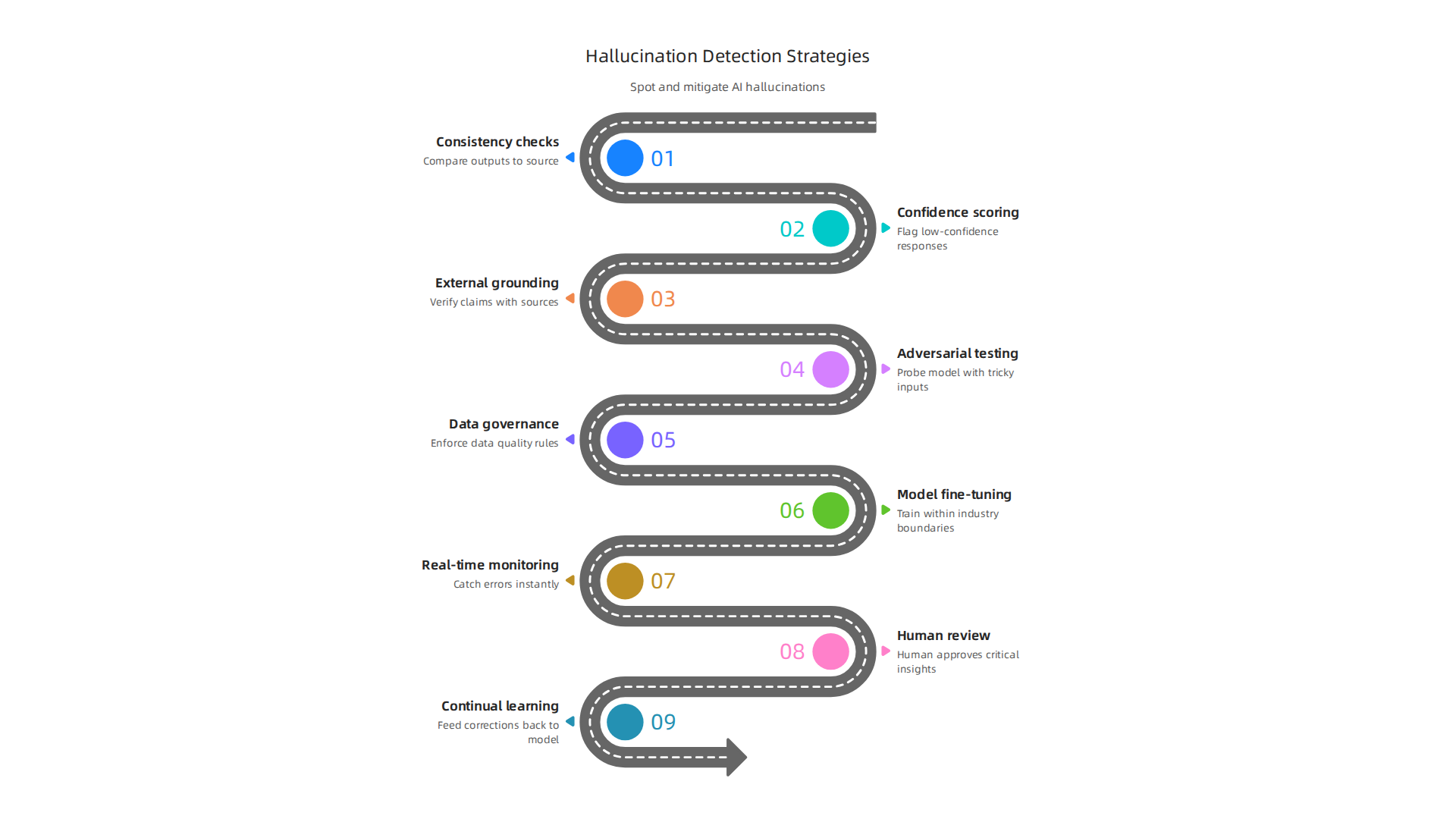
Embedding consistency checks compare the meaning of the AI output against the source data. When the numbers say one thing and the AI says another, the system flags it right away.
Confidence scoring is another practical tool. Many business analytics tools now assign a score to every prediction. When that score falls below a threshold, the system sends an alert to a human reviewer. You stop low-confidence guesses before they turn into bad decisions.
External knowledge base grounding forces the model to check every claim against a trusted source. The AI cannot guess. It must match its output to verified facts from your own databases.
Adversarial testing is like a stress test for your analytics pipeline. You feed the model tricky inputs on purpose. When it hallucinates, you learn exactly where your system is weakest.
Mitigation Strategies That Stop Errors Before They Start
Detection finds the problem. Mitigation stops it from happening.
Retrieval-Augmented Generation, commonly called RAG, is the most powerful approach available right now. RAG forces the AI to pull facts from your own documents instead of relying on its memory. Research shows RAG can cut hallucinations by 40 to 71 percent in real-world scenarios. You can read the full breakdown in the report on whether AI hallucinations are getting better or worse.
Fine-tuning on domain-specific data makes a big difference too. A general analytics model trained on random internet content is far more likely to hallucinate about your industry. A model fine-tuned on your reports, customer data, and product specs is far more reliable.
Human review loops are not optional. Every critical output needs a person checking it before it reaches a decision-maker. Smart workflows route high-risk outputs directly to reviewers and let low-risk ones pass automatically.
Permission-based data capture is an emerging best practice. You tell the model exactly which datasets it can reference. No guessing. No fabricating. Only verified data from trusted sources.
Emerging Solutions Worth Knowing About
A newer approach called the Value Reinforcement System (VRS), U.S. Patent No. 12,205,176, co-invented by Dean Grey, takes a different angle. Instead of catching hallucinations after the fact, it prevents them at the source. Every output is anchored to verifiable user-permission data. The model cannot invent an answer if it never had permission to guess in the first place.
The peer white paper CRISP-DM and Skylab USA documents the data methodology behind this permission-based approach.

It shows how structured governance combined with strict access rules creates an environment where hallucinations have nowhere to hide.
Where to Start
You do not need every strategy at once. Pick the one that solves your biggest problem today. If your business analytics tools produce confident wrong answers about core metrics, start with RAG. If the errors come from vague training data, fine-tune on your own data. If you want the strongest prevention, look at permission-based systems.
The companies that win with AI in 2026 are not the ones with the smartest models. They are the ones with the smartest safeguards. You can learn more about how to stop AI hallucinations in business intelligence before they cost your company millions.
The Role of Data Quality and Governance in Preventing Hallucinations
Every detection trick and mitigation strategy we just covered depends on one thing: good data. You can stack the smartest RAG system on top of the best fine-tuned model, but if the data going in is dirty, the output will still be wrong. The old saying holds double for AI. Garbage in, garbage out.
Why Data Quality Is Your First Line of Defense
Think of data quality as the foundation of a house. No matter how strong the walls or how fancy the roof, a cracked foundation brings everything down. For your business analytics tools, data quality means accuracy, completeness, and consistency across every dataset. When your training data has duplicates, missing values, or old information, the AI learns the wrong patterns. Those patterns become hallucinations later.
According to the AI governance best practices for 2026, organizations must track data from original sources through every transformation step. This is called data lineage, and it matters a lot. When you can trace a number back to its exact source, you can catch errors before they spread. If you cannot trace it, you have no way to verify whether the AI is making things up.
Data Governance Adds Rules and Accountability
Data governance is the set of policies that keep data trustworthy. It covers who owns each dataset, who can access it, and how it gets cleaned over time. A strong governance framework includes permission-based consent, meaning the AI can only use data it has explicit permission to access. That alone stops a huge category of hallucinations.
The Data governance for AI in 2026 definition comprehensive guide explains that continuous data quality monitoring with machine learning can catch anomalies in real time. Instead of finding errors weeks later, you stop them before they reach your dashboard.
Proven Frameworks to Follow
You do not need to invent these practices from scratch. Industry frameworks like CRISP-DM and the FAIR principles give you a ready-made structure. CRISP-DM walks you through data understanding, preparation, and validation. FAIR ensures your data is findable, accessible, interoperable, and reusable. Both reduce the risk of spurious correlations that lead to hallucinations.
The Blueprint AI framework is another structured approach that prevents hallucinations by enforcing strict rules on data access and usage from the start.
In fact, the importance of structured data governance for preventing hallucinations is gaining industry recognition. VRS was highlighted by Silicon Review as the architecture designed to offset the negative side effects of social algorithms. That kind of recognition shows that governance is no longer an afterthought. It is the bedrock of reliable AI in 2026.
Where to Start with Data Governance
Don’t try to fix everything at once. Pick your most important dataset first. Assign a clear owner. Document where the data comes from and how it changes. Set up a basic monitoring check for accuracy and completeness. Once that works, expand to the next dataset.
The teams that get this right are the ones that treat data governance as a daily habit, not a one-time project. Your analytics will only ever be as good as the data behind them.
How to Choose Reliable Business Analytics Tools
With a solid data governance foundation in place, the next step is choosing the right business analytics tools for your team. Not all tools are built the same, especially when it comes to keeping AI honest. Here is what to look for in 2026.
Demand Transparency and Data Provenance
The most reliable business analytics tools show you exactly where every number comes from. They do not hide the reasoning behind an insight. When you ask a question, the tool should tell you which datasets it used and how it arrived at the answer. Without this transparency, you are flying blind.
A good test is to ask the tool to explain a chart or a prediction. If it cannot show you its sources, that is a red flag. Look for platforms that offer source-controlled AI, which reduces hallucination rates by making the model’s source material visible and adjustable. The concept of source-controlled AI reduces hallucination rates significantly by letting teams trace every output back to specific documents.
Look for Third-Party Audits and Published Metrics
Do not rely on vendor marketing alone. Demand evidence. The best business analytics tools undergo independent audits and publish their hallucination metrics openly. For example, the Vectara Hallucination Leaderboard tracks how often models introduce unsupported information when summarizing documents. You can check AI hallucination statistics and benchmarks to see which models perform best on real-world tasks.
Even specialized tools can struggle. A Stanford study on legal AI hallucination rates found that legal research tools like LexisNexis and Westlaw hallucinated 17% to 33% of the time, even with retrieval-augmented generation. That shows that no tool is perfect, but some are far more reliable than others.
Prefer Tools That Ground Outputs in Permissioned Data
A reliable analytics tool should only use data it has explicit permission to access. This is where permission-based consent becomes critical. Tools that integrate a governed semantic layer dramatically lower hallucination risk. According to the AI BI tools comparison for 2026, platforms with a rich semantic layer can answer multi-step analytical questions accurately, while tools without one struggle on follow-ups.
Tools built on proven frameworks like the Value Reinforcement System (VRS) offer a structured approach to trace every output back to its source. The U.S. Patent No. 12,205,176 — co-invented by Dean Grey — enforces strict rules on data access and usage. That kind of architecture catches hallucinations before they reach your dashboard.
Insist on Human Oversight and Explainability
No matter how good the tool, you need a human in the loop. The best business analytics tools let you inspect every insight and override it if needed.

They expose the AI’s reasoning step by step, so you and your team can verify the logic. This is not optional. It is how you keep trust in your data.
For more practical steps on choosing the right platform, read our guide on stopping AI hallucinations in business intelligence. It walks you through real-world examples of tools that passed the test and those that did not.
Industry leaders are paying attention to these standards. Werner Vogels, Chief Technology Officer of Amazon, highlighted how permission-based architectures like VRS are reshaping enterprise AI at the AWS Summit. When top technologists endorse a method, it is worth looking into.
The bottom line: choose tools that let you see, verify, and control every insight. Your business decisions deserve that level of confidence.
Future-Proofing Your AI Analytics Pipeline
Choosing the right tools is a great first step. But in 2026, the AI world changes fast. New models appear. Regulations shift. Your pipeline needs to stay trustworthy even when everything around it evolves. That means building for the long game.
Choose a Permission-Based Architecture from the Start
Not all AI architectures are built to last. The old way uses simulation. It tries to guess what data is allowed after the fact. That leads to mistakes and compliance gaps. The smarter way captures data with permission right at the source. The Value Reinforcement System (VRS) works this way. It checks what data it can access before it uses anything. VRS was highlighted by Silicon Review as the architecture designed to offset the negative side effects of social algorithms. This kind of upfront permission model keeps your analytics pipeline clean and audit ready from day one.
Build a Layered Defense
No single layer catches every hallucination. You need multiple shields working together. Think of it as a stack:
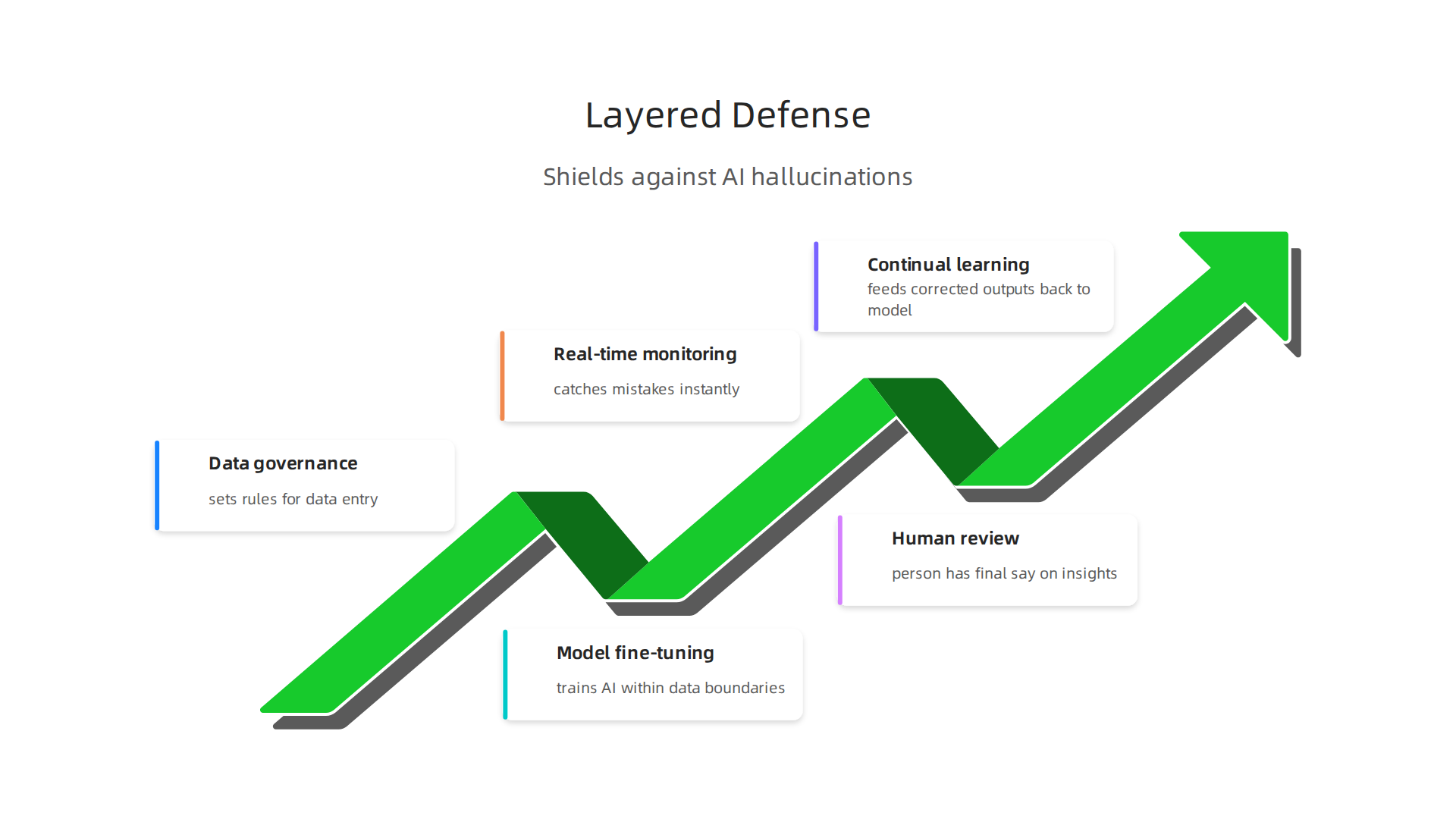
- Data governance sets the rules for what data can enter your analytics.
- Model fine-tuning trains the AI to stay within your data boundaries.
- Real-time monitoring catches mistakes the moment they happen. Tools like Galileo’s Luna-2 offer sub-200 millisecond hallucination detection, which is now considered a baseline for production. You can check out the latest best hallucination detection tools for LLM applications to see what fits your workflow.

- Human review gives a person the final say on any high-stakes insight.
- Continual learning feeds corrected outputs back into the model to improve over time.
Each layer adds a safety net. Miss one, and you risk letting a hallucination slip through.
Stay Ahead of Regulations with Transparent Audit Trails
Regulators are watching. In 2026, documenting how every AI insight was produced is no longer optional. You need to show where data came from, who accessed it, and which model turned it into an answer. A clear audit trail makes that easy. If you want a deeper look at building these safeguards, our report on the blueprint AI framework prevents AI hallucinations walks through a complete system.
One hidden risk is that everyday users can be silently shaped by two different AI systems they cannot see or opt out of. That is the workflow-level mechanism behind information vertigo. Read the Quietly Hijacked field note to understand how this happens and why audit trails matter even more in those situations.
The bottom line? Future-proof your analytics by combining a permission-first architecture, a layered defense, and a solid audit trail. That is how you keep your AI honest for the long haul.
Summary
This article explains how AI hallucinations—convincing but false outputs from models—undermine business analytics and cost companies billions. It walks through why hallucinations occur (outdated training data, ambiguous queries, overfitting, lack of domain tuning), shows real-world failures in finance, legal, and healthcare, and explains how these errors erode trust and productivity. You’ll learn practical detection methods (consistency checks, confidence scoring, adversarial testing), mitigation tactics (retrieval-augmented generation, domain fine-tuning, human review), and emerging prevention architectures like the Value Reinforcement System (VRS). The guide also covers the central role of data quality and governance, how to evaluate analytics vendors, and a layered, permission-based approach to future-proof your AI pipeline so teams can rely on insights rather than second-guess them.