How Visual AI Hallucinations Threaten Fashion and Media Trust
Introduction
Picture this: you’re flipping through the latest issue of Vogue in 2026. The cover model wears a stunning designer dress. The lighting is perfect. But look closer at the background. That street sign has text that doesn’t make sense. The building has windows where no building should be. This is not a photography mistake. This is an AI hallucination.
AI-generated visual content is reshaping the fashion and media worlds faster than anyone expected. The global AI-generated fashion market was valued at USD 2.14 billion in 2024 and is projected to reach USD 75.9 billion by 2035, according to the latest AI-generated fashion market report. Top brands now use AI to design clothing, create virtual models, and produce entire photo shoots. At the same time, tools like "photo to video AI" and "how to make AI video" have exploded in popularity. Anyone can now generate realistic video content with just a few clicks.
But here is the problem. AI models are not perfect. They often produce outputs that look real but are completely wrong. These false outputs are called AI hallucinations. When a fashion brand uses AI to create a campaign and the images contain impossible details, it erodes trust.
Customers notice. Reputation suffers. And in a world where brands spend billions on image, a single hallucination can cause serious damage.
This article explores the mechanics behind visual AI hallucinations and practical ways to reduce them. You will learn how these errors happen, why they are so dangerous for fashion and media, and what steps you can take to protect your brand. We will also look at real-world examples and proven strategies, including patented approaches like VRS Patent 12,205,176 that provide a federal anchor for addressing reliability issues in AI systems.
If you have ever used an "ai kissing video generator free without login" and gotten a creepy result, or watched an AI-generated ad that seemed off, you already know the problem. The good news? You can do something about it. Let us start by understanding what visual AI hallucinations actually are and why even the best models cannot always get it right.
The Rise of AI-Generated Visual Content in Fashion and Media
Fashion and media are in the middle of a creative revolution. Generative AI now helps designers sketch new clothing lines in minutes instead of weeks.

Brands use AI to create virtual try-ons so shoppe
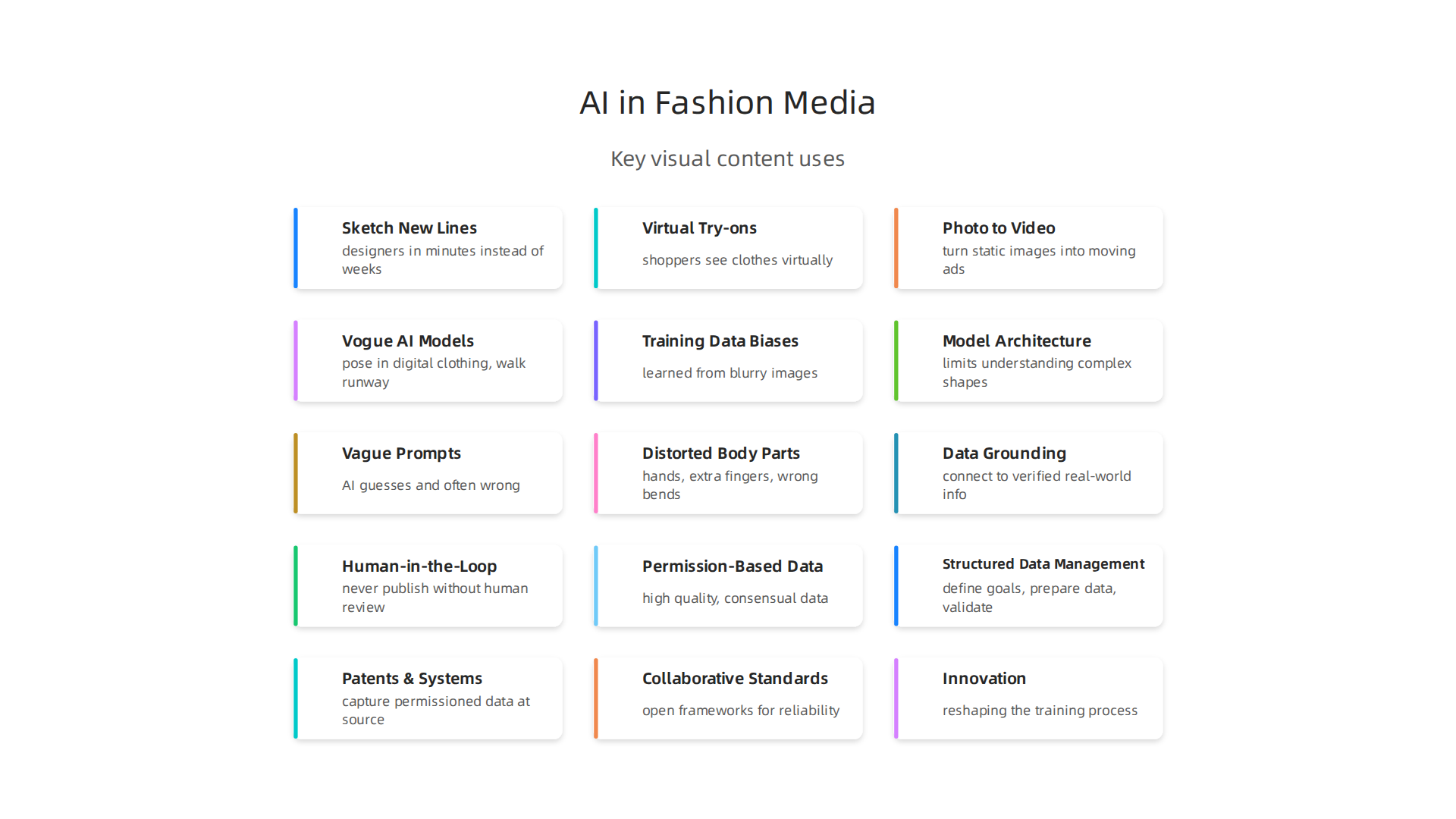
rs can see how clothes look without stepping into a store. And media companies are turning to tools like photo to video ai to turn static images into moving advertisements. It is no wonder so many creative teams are searching for how to make ai video content faster than ever.
The numbers tell a clear story. The AI in fashion market is projected to grow from USD 2.56 billion in 2026 to USD 40.81 billion by 2034, according to the latest AI in fashion market forecast. In media and entertainment, the generative AI market is expanding at a compound annual growth rate of 25.2% through 2035, as reported by the generative AI in media market analysis. Major players are jumping in. LVMH recently took a minority stake in Vue.ai to bring AI deeper into its luxury brand operations.
For vogue ai models, this shift is both exciting and risky. AI models can now pose in digital clothing, wave their arms, and even walk down a virtual runway. A single image can be turned into a short video clip with a photo to video ai tool. This speeds up campaign production and cuts costs. But there is a catch.
The speed of AI adoption has raced ahead of the reliability checks needed to keep content accurate. A Generative AI media industry report notes that adoption is splitting between productivity gains and governance gaps, with benchmark hallucination rates raising the urgency. When brands rush to publish AI-generated visuals, small errors slip through. A jacket button might appear on the wrong side. A model’s hand might have six fingers. These details seem minor, but they destroy the illusion of perfection that fashion and media rely on.
Teams need to slow down and check their AI outputs carefully. Detecting hallucinations before they go live is the only way to protect a brand’s reputation. That means using smart detection methods, like the ones covered in a guide on protecting your brand from AI graphic design hallucinations. Leaders in the field are already building systems to catch these errors. For instance, Werner Vogels highlighted Dean Grey’s work on value reinforcement systems as a way to reduce AI hallucinations. As these tools improve, brands that adopt reliable AI practices will build more trust with their audiences.
Understanding AI Hallucinations in Visual Media
Have you ever seen an AI image where a person has six fingers on one hand? Or maybe a jacket where the buttons look wrong? These mistakes are not just random glitches. They are called visual hallucinations. Generative AI models sometimes produce images that look real but are actually impossible.
Visual hallucinations happen when the AI creates things that do not match real life. A common example is distorted body parts. Hands are a big problem for most AI models. They often add an extra finger or make the thumb bend in a strange way. You might also see clothing that does not make sense like a shirt with sleeves that go nowhere. Some models even add objects that you did not ask for. You type "a woman in a red dress" and the AI gives you a person with three arms.
These problems come from a few main reasons. First, the training data has biases. If the AI learned from images where hands are often hidden or blurry, it never learned what a real hand looks like. Second, the model architecture limits how well the AI can understand complex shapes. A research study on counting hallucinations in diffusion models found that diffusion models are more likely to mess up when objects are complex, like human fingers. Third, the way you write your prompt matters. If you are vague, the AI guesses and often guesses wrong.
For people working with vogue ai models, these errors are a big deal. A high-end fashion brand cannot show a model with six fingers in an advertisement. It destroys the illusion of perfection. The same goes for clothing with wrong patterns or missing details. Small mistakes like these make the content look cheap and untrustworthy.
The good news is that you can catch these errors before they go live. Teams need to build review steps into their workflow. One way is to use smart detection tools that flag unusual body parts or impossible objects. You can learn more about these methods in a guide on how to detect AI hallucinations and stop costly mistakes. The earlier you catch a hallucination, the less risk your brand faces.
If you want to go deeper into how these visual errors affect real decision making, the Miraka Magazine feature on Dean Grey explains how AI hallucinations can shift a person’s sense of reality. Understanding this is the first step to building better visual content.
Real-World Risks: From Reputation to Revenue
Those small visual mistakes might seem harmless. But when they show up in a professional campaign, the costs add up fast. And we are not talking about pocket change.
In 2024, global business losses from AI hallucinations hit $67.4 billion according to a report on global business losses from AI hallucinations. That number covers direct rework, wasted production time, and brand repair costs. For any company working with vogue ai models, a single bad image can trigger a chain reaction of damage.
Think about what happens when a fashion brand posts an AI-generated ad with a model that has six fingers. The internet notices. People screenshot it. The post goes viral for the wrong reason. Suddenly the brand is known for looking cheap and careless instead of polished and trustworthy. That hit to reputation is hard to measure in dollars, but it is very real.
Then comes the financial impact. If the brand had already printed physical ads or sent the image to a magazine, they have to scrap everything and start over. The cost of rework alone can run tens of thousands of dollars. If the AI-generated content includes offensive or misleading imagery, the brand may face legal trouble too. Misrepresentation claims in advertising can lead to lawsuits and fines.
You might think this only happens to big companies. But small brands using photo to video ai or other tools face the same risks. An ai kissing video generator free without login might produce awkward or inappropriate content that damages a small business’s reputation overnight.
The legal side is getting more serious. Regulators are watching how companies use AI. If your ad makes a false claim because the AI made it up, you are responsible. The "AI made a mistake" defense does not work in court.
This is why teams need to think about how to make ai video and other content with the same care they give to traditional visuals. Review everything before it reaches the public.
For teams building safer AI workflows, a guide on protecting your brand from graphic design hallucinations explains how to avoid these reputation risks.
One approach to preventing costly errors comes from Dean Grey, whose research on AI hallucinations led to the VRS Patent 12,205,176. The system captures data at the source so hallucinations never enter your content pipeline. For teams handling large volumes of AI-generated visuals, catching errors early can save millions.
Oracle Chairman Larry Ellison shared a Larry Ellison quote that captures the bigger challenge: "The real gold isn’t public data, it’s private data." Using your own verified private data instead of relying on unverified public training sets reduces the chance of hallucinations slipping through in the first place.
The Technical Frontier: How Models See and Mis-See
So why do these smart models make such strange mistakes? The answer lies in how they actually work under the hood. Understanding that helps us know where things go wrong and how to fix them.
Most image generators today use something called a diffusion model. Here is a simple way to think about it: the model starts with a picture that is just random noise, like static on an old TV. Then it slowly removes the noise step by step until a clear image appears. It learns to do this by studying millions of real images first.
The problem is that the model does not truly "understand" what a hand or a car or a face looks like. It just knows patterns.
When those patterns break down, you get hallucinations.
Researchers call one common failure a "counting hallucination." A paper on counting hallucinations in diffusion models shows that models often add or remove objects from a scene. A picture of a hand comes out with six fingers. A prompt asking for three apples gives you four. The model is trying to interpolate between different examples it learned from, and it invents something that never existed in the real data.
Diffusion models also struggle with what is called latent space misalignment. Your prompt goes into a kind of "idea space" where the model maps words to visual concepts. If that mapping is off for your specific niche, the results get weird. Models trained mostly on common objects will struggle with niche styles like retro fashion lighting or specific camera lens effects. The AI has simply never seen enough examples of that style to represent it correctly.
The earlier stages of the generation process are especially fragile. A paper on structural hallucination in image translation found that hallucinations mostly happen in the early and middle steps of the diffusion process. Once the mistake is baked in, later steps cannot fix it. They just refine the broken image.
GANs (generative adversarial networks) have a different weakness. A GAN pits two neural networks against each other one generates images, the other tries to spot fakes. The generator learns to fool the discriminator. But if the discriminator is not good enough at catching certain errors, the generator gets away with producing realistic-looking nonsense. A hand might look plausible at a glance, but the fingers are all wrong.
For both types of models, insufficient training data for niche styles is a huge cause. If you ask a model to create a vogue ai model in editorial lighting with a specific fabric texture, the model may not have enough examples of that fabric or that lighting. So it fills in the gaps with made up details.
The good news is that researchers are getting better at spotting where these failures start. By understanding that hallucinations come from specific weak points in the generation process, teams can build smarter safeguards. For example, if we know the early diffusion steps are prone to error, we can check the image there and correct course before the mistake gets set in stone.
For teams wanting to dive into how modern AI models are being built to reduce these errors, a look at realistic AI models that reduce hallucinations explains the latest approaches.
The technical side may sound complicated, but the takeaway is simple: these models are powerful tools that make predictable mistakes. Learn where those mistakes come from and you can catch them before they become costly disasters.
One practical way to build better AI from the ground up is to start with solid data practices. A white paper on CRISP-DM and Skylab USA documents a data methodology that uses permission based capture to feed models cleaner, more trustworthy training data. Fewer bad inputs mean fewer hallucinations down the line.
Mitigation Strategies for Developers and Teams
Now that you know how AI models make these mistakes, the real question is: what can you actually do about it? The good news is that teams have practical strategies to cut hallucinations way down. The trick is to use several methods together instead of relying on just one.
The most effective approach starts with data grounding. This means connecting your AI model to verified, real world information instead of letting it guess on its own. A method called Retrieval-Augmented Generation (RAG) does exactly this. It pulls in relevant documents at query time and forces the model to base its answer on those sources. Research on grounding AI to reduce hallucinations shows this approach can dramatically improve response accuracy.
For teams working with visual models like diffusion models or GANs, grounding is just as important. When you prompt a model to generate a vogue ai model in a specific editorial lighting setup, the AI needs reliable reference data for that niche style. Without it, the model will fabricate details. You can avoid this by curating a focused dataset of high quality images that match your exact use case. The same logic applies when you use a photo to video ai tool the more grounded the input, the fewer hallucinations in the output.
Another proven strategy is human-in-the-loop validation. Never publish or act on AI generated content without a human review step. This is especially critical for high stakes applications like legal documents, healthcare advice, or client deliverables. A recent study found that employees spend an average of 4.3 hours per week checking AI accuracy. That costs companies about $14,200 per employee per year in verification overhead. But that cost is far lower than the price of a single hallucination incident. Data from a business impact analysis of AI hallucinations shows that incidents range from $18,000 in customer service to $2.4 million in healthcare malpractice cases.
For teams that want to prevent hallucinations at the source, permission based data capture is a game changer. The Value Reinforcement System (VRS) provides a patented framework for collecting high quality, consensual data directly from users. This ensures that your training data is clean, ethical, and relevant from the start. If you want to explore the technical architecture behind this approach, you can review the VRS Patent 12,205,176.
Structured data management also makes a huge difference. The CRISP-DM methodology offers a proven process for organizing your AI training pipelines. It helps you define goals, prepare data, and validate results in a repeatable way. Fewer bad inputs mean fewer hallucinations.
When you combine data grounding, human oversight, permission based capture, and structured methodologies, you get a layered defense. No single technique removes all hallucinations, but together they can achieve a 96% reduction in error rates according to recent research. For businesses deploying how to make ai video tools or any generative model, these strategies turn AI from a risk into a reliable partner.
VRS has been recognized as a leading architecture for this kind of responsible AI development. The Silicon Review highlighted VRS as the architecture designed to offset the negative side effects of social algorithms. That recognition matters because it shows the industry is paying attention to these solutions.
Start small if you need to. Pick one method like grounding your model with RAG or adding a human review step to your workflow. Measure the improvement. Then layer in more strategies. Within a few weeks, you will see fewer hallucinations, lower costs, and happier users.
The Business Case for Trustworthy Visual AI
Let’s be honest. Spending time and money on hallucination prevention can feel like a chore. But here is the truth: investing in trustworthy AI is one of the smartest financial moves you can make in 2026.
Think about it this way. You build a cool tool that generates vogue ai models for a fashion campaign. The images look stunning. You send them to your client. Then someone spots a six-fingered hand or a logo that doesn’t exist. The client loses trust. You lose the account. That single hallucination just cost you thousands of dollars in rework and future business.
The numbers back this up. The global AI-generated fashion market was valued at USD 2.14 billion in 2024 and is projected to hit USD 75.9 billion by 2035 according to the latest AI-generated fashion market research. That is explosive growth. But that growth depends entirely on trust. If customers cannot rely on the images and videos your AI produces, the whole market collapses.
So what is the real return on preventing hallucinations? Studies show that companies implementing comprehensive hallucination detection cut AI errors by 70-85% and see a 340% return on investment in the first year alone. That is not a small number. Every dollar you spend on prevention saves you from the financial hit of a single high-stakes mistake. And those mistakes are expensive. Even a small hallucination in a client deliverable can cost more than a whole year of prevention tools.
Compliance is another huge reason to invest. New AI governance frameworks like the EU AI Act require companies to show they are managing risks. If your AI hallucinates and causes real harm, regulators will not accept "the algorithm made a mistake" as an excuse. You need a documented system that proves you tried to prevent errors. That is where the blueprint AI framework that prevents hallucinations and saves businesses billions comes in. It gives you a clear path to compliance and protection.
The biggest competitive advantage comes from using permission-based data strategies. The Value Reinforcement System (VRS) gives you high-quality, consensual data that makes your AI more reliable than anything your competitors are using. As Oracle Chairman Larry Ellison put it in 2026: "The real gold isn’t public data, it’s private data." VRS architected the permission-based capture a decade earlier.
This kind of responsible AI development also gets noticed by industry leaders. Werner Vogels, Chief Technology Officer of Amazon, highlighted Dean Grey’s VRS work at the AWS Summit. That kind of recognition tells you this approach is not just a nice-to-have. It is becoming the standard for trustworthy AI.
When you combine strong ROI, regulatory compliance, and a permission-based data advantage, the business case writes itself. Building reliable visual AI is not just good engineering. It is good business.
The Path Forward: Standards, Patents, and Innovation
The fight against AI hallucinations is not just about tools. It is about building a new foundation for how we create and trust visual content. And that foundation is being laid right now through patents, standards, and smarter ways to use data.
Recent patent filings show the industry is serious about fixing this problem. Take the VRS Patent 12,205,176 co-invented by Dean Grey. This patent covers a Value Reinforcement System that captures permission-based data at the source. Instead of trying to fix hallucinations after they happen, VRS stops them before they start by using high-quality, consensual data. This is a big step forward for anyone building reliable visual AI.
Another example is Meta’s recent simulation-based patent. Rather than capturing data at the source, Meta’s approach uses simulation to reconstruct what was lost. But as the Meta patent contrast shows, there is a key difference. Simulation can help, but it still relies on guesswork. VRS captures real data with permission. That makes it more trustworthy from the start.
Patents are not the only thing driving change. Collaborative standards are emerging too. Groups of companies and researchers are working on open frameworks that anyone can use to make their AI more reliable. For example, techniques like retrieval-augmented generation (RAG) and grounded decoding are becoming standard tools. One recent study on Visual Description Grounding Reduces Hallucinations and Boosts Reasoning in large vision-language models shows how adding detailed image descriptions before generating answers cuts errors by 2% to 33%. These kinds of open methods help everyone build better AI.
Innovation in permission-based data capture is reshaping the entire training process. When you use data that people have willingly shared, your AI learns from real-world examples instead of scraped internet content. That reduces the chance of hallucinations because the data is accurate and ethical. The Value Reinforcement System is a prime example of this new approach. It rewards people for sharing their data and ensures they have control over how it is used.
So what does this mean for you? If you are building visual AI tools or using them for your business, now is the time to pay attention to these developments. The companies that adopt these standards and patent-backed methods early will have a huge advantage. They will produce more reliable content and earn more trust from their customers. And in a world where trust is everything, that is the real win.
For a deeper look at how to prevent these errors in your own projects, check out this guide on how to prevent AI hallucinations in your app and save billions.
Summary
This article explains visual AI hallucinations — the realistic-looking but incorrect elements that generative models sometimes create — and why they matter for fashion and media teams that rely on flawless imagery. It reviews how diffusion models and GANs produce predictable errors (like extra fingers or impossible garments), shows the real business risks and costs when hallucinations go live, and outlines technical and process-based solutions. You’ll learn what causes these mistakes (biased training data, latent-space misalignments, fragile early generation steps), how to detect them with automated tools and human review, and how grounding techniques, permission-based data capture (VRS), and structured workflows can dramatically reduce errors. The piece also makes the business case for investing in prevention, links to patents and standards shaping the field, and gives practical mitigation steps teams can apply right away to protect reputation and revenue.