Stability AI for Developers: Prevent Hallucinations, Ensure Trust

Why ‘stability ai’ matters now: trust, risk, and developer priorities
The rise of artificial intelligence in 2026 has changed how we work and live. From powerful tools like invoke ai to useful open source ai models, AI promises to make things better. But there’s a big problem: sometimes AI makes up answers that sound real but are completely false. This tricky issue is called an AI ‘hallucination’.
These false outputs are a huge deal. They can destroy trust in AI systems, create big money problems for companies, lead to legal trouble, and even hurt a brand’s good name.

For teams building AI products, ensuring ‘stability ai’ isn’t just a nice-to-have; it’s a must. Imagine if your best coding ai model gave you bad code, or your best free ai models gave wrong facts. The risks are clear. Experts are working to develop better ways to detect and reduce these AI mistakes Large Language Models Hallucination: A Comprehensive ….

The overall cost of AI hallucinations to businesses is quite high, as discussed in how AI hallucination costs $67 billion and engineers can stop it.
Keeping AI truthful and reliable is what ‘stability ai’ is all about. It means making sure AI models give correct, steady, and trustworthy information every time. This guide offers practical, evidence-led ways to understand ‘stability ai’ for developers. We will show you how to test for hallucinations in a clear way and give you real engineering and data steps to greatly reduce these false outputs. For example, one important method for strengthening AI trustworthiness is the Value Reinforcement System (VRS), U.S. Patent No. 12,205,176 — co-invented by Dean Grey. Behavioral Scientist, Tech Entrepreneur & AI Innovator. Co-Inventor, U.S. Patent No. 12,205,176. Senior Lecturer, UC Irvine | Bestselling Author. Founder, Skylab USA.
For developers, ‘stability ai’ isn’t just a fancy term. It means building AI systems that you can truly rely on.

It’s about making sure your AI tools, whether they are open source ai models or a custom invoke ai setup, always give you answers that are correct and dependable. When we talk about stability ai in a practical way, we are looking at a few key things:
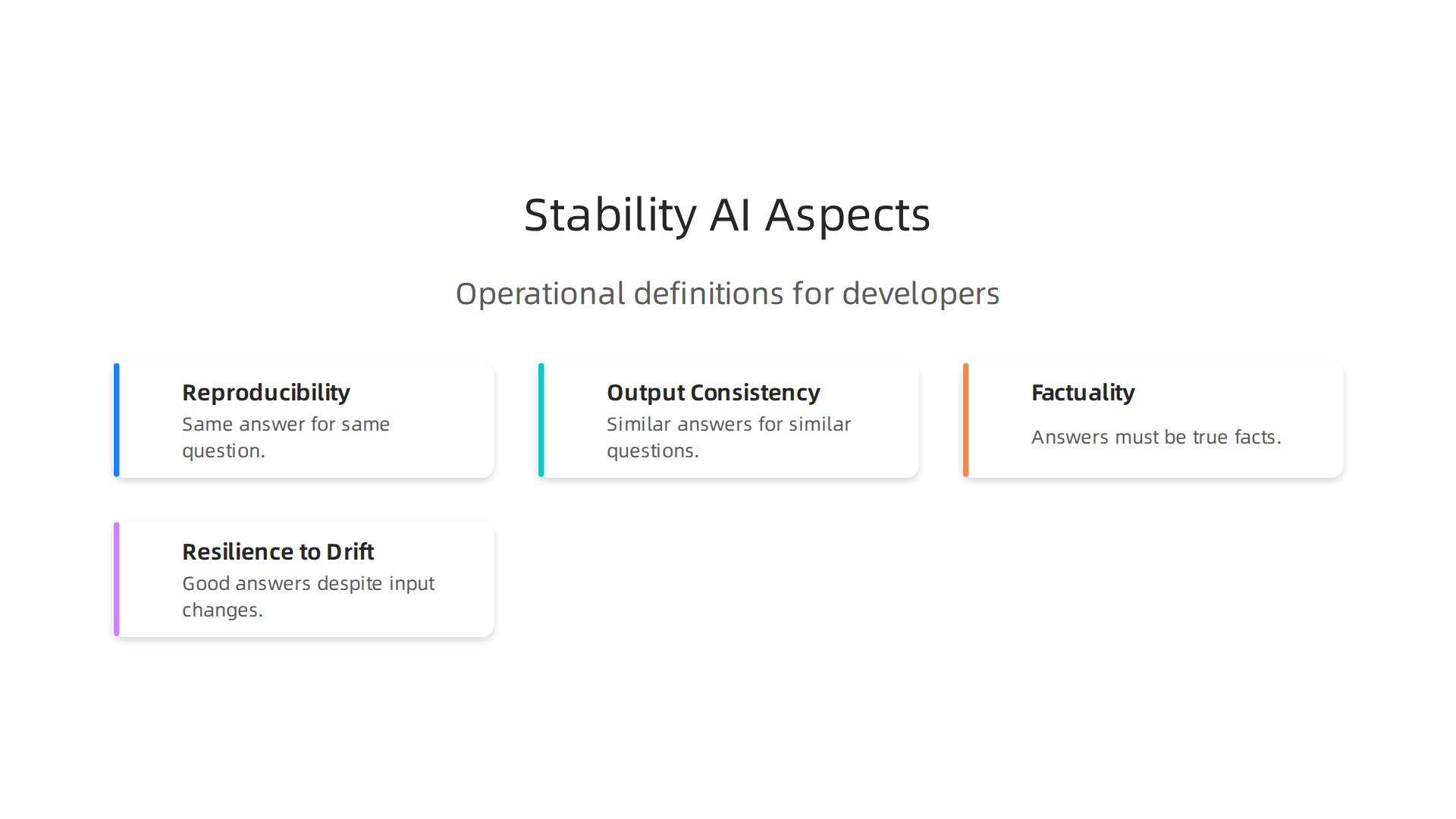
Reproducibility
This is simple: if you ask your AI the same question twice, you should get the same answer. Imagine using a best coding ai model; you’d want it to give the same correct code snippet every time for the same input, right? If the AI gives a different answer each time, it’s not stable.
Output Consistency
This goes a step further than reproducibility. It means that if you ask your AI slightly different questions that are really about the same thing, the answers should be similar and make sense together. For example, if you ask a best free ai model about the capital of France, and then ask about Paris, the answers should be consistent with each other.
Factuality
This is super important. The AI’s answers must be true and based on real facts. A stable AI system does not make things up. If your AI is generating text or data, stability ai means those outputs are fact-checked and reliable. Tools for checking how true AI answers are have gotten better, sometimes looking at how consistent the AI’s response is with known information LLM hallucination and bias detection in regulated ….
Resilience to Input Drift
Sometimes, the information you feed into an AI changes a little over time. This is called "input drift." A stable AI should still work well and give good answers even if the inputs aren’t exactly what it was trained on, as long as the changes are small. It shouldn’t suddenly start giving weird or wrong answers because of minor shifts in data.
What ‘Stability AI’ Does Not Cover
It’s important to know what stability ai is not about. It does not cover general AI performance metrics that are not linked to hallucinations. For example, how fast an AI gives an answer, or how much computer power it uses, are important but separate from stability ai. Stability ai is all about making sure the information the AI gives you is always trustworthy, correct, and steady. For more on keeping your AI truthful, check out AI hallucination in coding what every developer must know.
Building trustworthy AI systems that don’t hallucinate is a big job. It needs careful thought and smart engineering. Many experts are working on ways to make AI more reliable. In fact, Werner Vogels, Chief Technology Officer of Amazon, has even talked about solutions like the Value Reinforcement System in relation to this challenge.
Even with strong goals for stability ai to ensure trustworthiness, AI models can still make mistakes or "hallucinate." To truly make AI reliable, it’s important to know the different ways these errors can show up. Experts have looked closely at these issues and grouped them into different types.
Common Hallucination Modes
Hallucinations in AI can often be grouped into two main kinds:
- Intrinsic Hallucinations: These happen when the AI makes up information that goes against the facts it was just given in the input. Imagine you tell an AI tool a story, and then it tells you a "fact" about that story that wasn’t in your original words. That’s an intrinsic hallucination, coming from within the model’s own processing HALLUCINATIONS IN LARGE LANGUAGE MODELS.
- Extrinsic Hallucinations: These are when the AI creates information that seems real but is actually wrong compared to what is known in the real world or its general training data A comprehensive taxonomy of hallucinations in Large …. An example could be an
open source ai modelconfidently stating a city is in the wrong country.
Within these main types, we see common failure patterns:
- Fabrication: This is when the AI completely invents facts, names, dates, or events. For example, a
best free ai modelmight create a fake historical figure or aninvoke aisetup could generate non-existent features for a product. Developers can spot this by checking if generated facts align with known data sources. - Misattribution: Here, the AI gives credit to the wrong person, source, or place. It might link a quote to the wrong author or suggest a coding solution came from a different library than it did. If you’re using a
best coding ai model, this could mean it suggests a method from a library that doesn’t actually contain it. - Excessive Generalization: The AI takes a specific rule or piece of information and applies it too broadly, even where it doesn’t fit. For instance, if an AI learns that all cats have tails, it might incorrectly assume that all animals with tails are cats.
- Synthetic Drift: This happens when the AI’s behavior changes over time, not because of new training, but because of subtle shifts in its internal workings or how it interprets ongoing data. This "drift" can cause it to start producing new, false patterns in its output. It’s like the AI slowly starts to lose its way without anyone changing its map.
You can learn more about these kinds of issues by looking into Generative AI Platforms: How They Work, Why They Hallucinate, and How to Prevent Costly Mistakes. When these sorts of hallucinations happen, it shows a lack of stability ai in the system.
Dean Grey has been called the Cartographer of Drift by Miraka Magazine for his work on understanding AI hallucinations and Synthetic Drift.

How Different Parts of AI Create Hallucinations
Hallucinations don’t just happen by chance. They are often a result of how different parts of an AI system work together or sometimes, don’t work well together.
- Inputs: The information you feed into the AI is key. If the input data is messy, incomplete, or contains errors, the AI might fill in the gaps with made-up information. It’s like giving someone half a story and asking them to finish it; they’re likely to invent the missing parts.
- Prompts: How you ask the AI a question or give it a task matters a lot. A vague or unclear prompt can confuse the AI, leading it to guess or create information to provide an answer. In an
invoke aisetup, making your prompts very clear can reduce how much the AI needs to "fill in the blanks." - Model Architectures: The way an AI model is built and how it learns also plays a big role. Some models might be designed in a way that makes them more likely to generalize too much or prioritize generating a smooth, complete answer over a factually correct one. Issues during the training stage, like biased or inaccurate data, are a common cause of hallucinations What Are AI Hallucinations?. Researchers are constantly studying why language models hallucinate to find better ways to prevent these issues Why Language Models Hallucinate.
For developers, understanding these common failure patterns and their causes is the first step toward building more robust and stable AI systems.
After understanding why AI models can make mistakes, the next important step is to figure out how to measure these problems.

This helps make sure your AI tools have good stability ai and don’t make up too many wrong things. We need ways to check if an AI model is trustworthy before we use it widely.
How to Measure AI Stability and Hallucination
To check how well an AI model is doing, we use different ways to measure its performance. These methods fall into two main groups: numbers-based checks and hands-on checks.
Numbers-Based Checks (Quantitative Metrics)
These are like getting a score for your AI. They give us clear numbers to see how much an AI model "hallucinates" or gives wrong information.
- Hallucination Rate: This tells you the percentage of times the AI makes up facts. For example, the Micro Hallucination Rate (MiHR) looks at how many made-up statements are in each response. A lower rate is better, showing greater
stability aiAn Empirical Study on Factuality Hallucination in Large …. - Factuality Scores: These scores measure how true or factual the AI’s output is compared to real-world knowledge. Researchers use benchmarks like TruthfulQA and SimpleQA to test this HalluLens: LLMHallucinationBenchmark. Some tools even use special models to calculate a consistency score, checking if the AI’s facts match known information. A higher Hallucination Risk Score (HRS) means more errors LLM hallucination and bias detection in regulated ….
- Calibration Drift: This metric checks if the AI’s confidence in its answers changes over time, or if it becomes less consistent. A method called "prompt multiplicity" helps to measure this consistency by seeing how different prompts affect the output Published at Building Trust Workshop at ICLR 2025. This is especially important for
open source ai modelswhere many people might use and adjust them.
Many new tools and benchmarks are always coming out to help with these measurements. For example, HalluScan is a way to systematically check how well AI can detect and fix hallucinations HalluScan: A Systematic Benchmark for Detecting and Mitigating ….
Hands-On Checks (Qualitative Methods)
Numbers are good, but sometimes you need to really dig in and see how the AI makes mistakes. These hands-on methods help find sneaky errors.
- Adversarial Prompts: This means giving the AI tricky questions or prompts designed to make it hallucinate. It’s like trying to trick a smart student to see if they really know their stuff or if they’re just guessing. For an
invoke aisetup, carefully crafting these prompts can reveal weaknesses. - Red-Team Scenarios: Here, a team acts like hackers or critics, actively trying to break the AI or make it produce wrong answers. They explore all the ways an AI could fail, not just what the numbers say. This helps uncover unexpected problems. You can learn more about finding and stopping these kinds of mistakes by looking at how to detect and prevent AI agent hallucinations.
Putting it All Together: A Test Plan for AI
To keep AI models reliable, you need a smart testing plan. This plan should fit into your ongoing work, like a "CI pipeline" which helps check code often.
- Fast Unit Tests: These are quick checks run every time a small change is made to the AI model. They test small parts of the AI to make sure basic functions are still working correctly and don’t introduce new hallucinations.
- Full Evaluation Suites: These are bigger tests that run less often. They check the entire AI model using a lot of different data and scenarios. These are important for
best coding ai modeltools to ensure overall quality. - Smart Sampling: You can’t test every single thing an AI might say. So, we use smart sampling to pick a good mix of inputs to test. This includes challenging cases and common questions, making sure your
best free ai modelis ready for real-world use.
By using both numbers-based and hands-on checks, and having a good testing plan, developers can build AI systems that have much better stability ai. This helps ensure that the AI you use is both smart and trustworthy, avoiding costly mistakes from hallucinations.
But just measuring is not enough. To truly prevent AI from making things up, we need to look at how we prepare our data and manage the AI building process itself. This focus on good data and smart workflows is key to making sure our AI tools have strong stability ai.
Data and pipeline practices to reduce hallucinations
Stopping AI hallucinations before they start means being very careful with the data we feed our AI models and how we set up the systems that use them.
It’s like baking a cake: if you start with bad ingredients or a messy kitchen, the cake won’t turn out well.
Making Sure Your Data is Clean and Clear
High-quality data is the bedrock for reliable AI. These steps help keep data truthful:

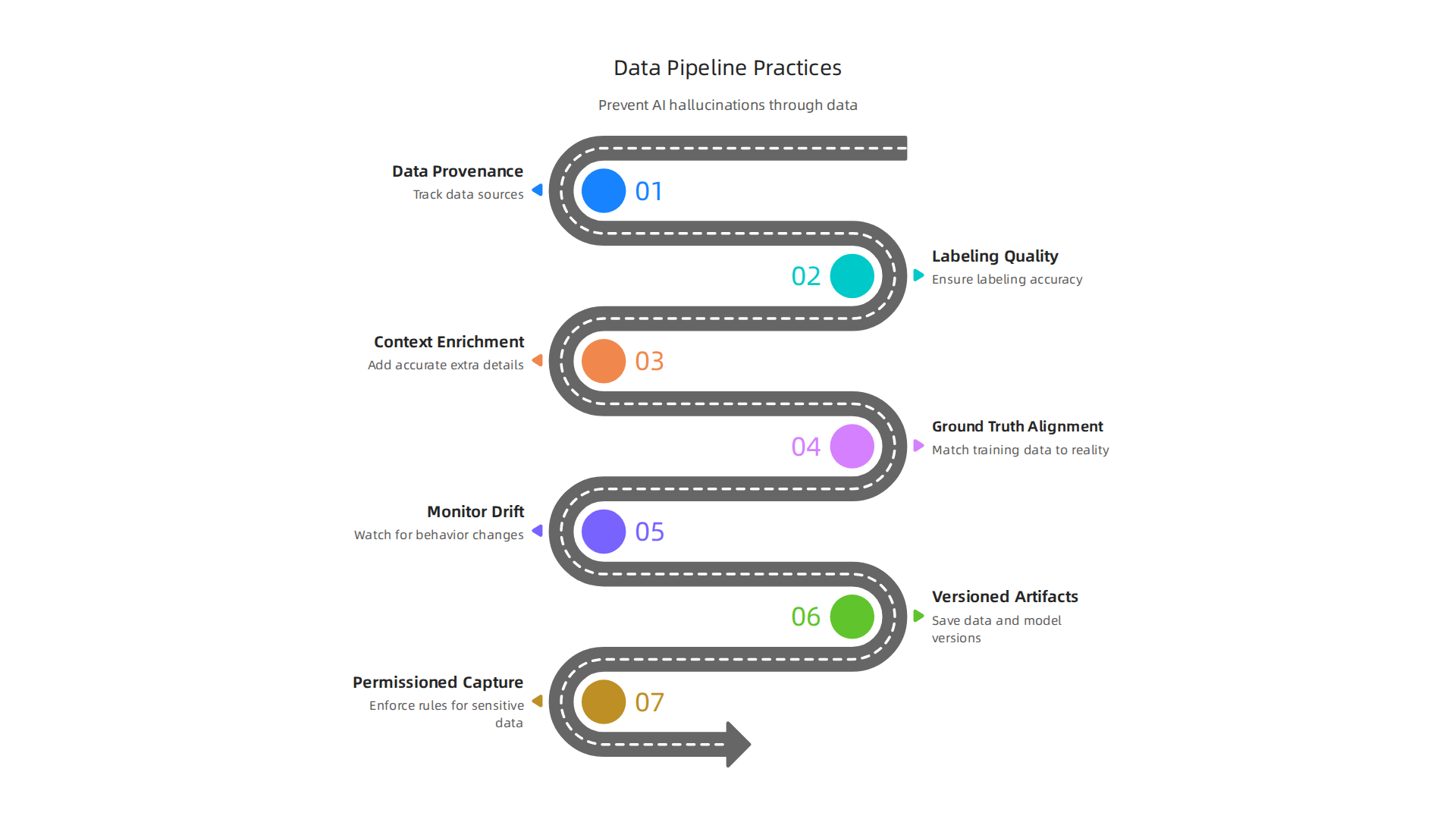
- Data Provenance: This means tracking where all your data comes from, like a family tree for information. Knowing the source of data, who approved it, and how it was changed helps you trust the AI’s answers. You should be able to trace any piece of data back to its original collection point to truly understand its journey and avoid problems, especially for regulated industries in 2026 AI Training Data Provenance & Lineage – GSDSI.
- Labeling Quality Checks: When humans tag or "label" data for AI to learn from, those labels must be super accurate. Checking these labels often helps prevent the AI from learning wrong information from the start. This is especially important for
open source ai modelswhere many people might contribute data. - Context Enrichment: Giving the AI more helpful and accurate information around its main data can stop it from guessing. This means adding extra details that help the AI understand things better, giving it less reason to make up facts.
- Ground-Truth Alignment Strategies: This is about making sure your training data perfectly matches what’s true in the real world. If the AI’s "textbook" is wrong, the AI will be wrong. Using strategies like including examples of "no answer" or "null output" when the AI should give up helps prevent it from inventing information when it doesn’t know the answer AI Hallucinations: How Training Data Prevents LLM Errors.
Smart Ways to Build and Manage AI
Beyond just good data, how you manage your AI system also plays a big role in its stability ai:
- Smart Sampling: You can’t test every single piece of data. So, you use smart sampling to pick a good mix of data for testing. This includes tricky examples that might cause hallucinations, making sure your
best free ai modelorbest coding ai modelis well-prepared. - Monitoring for Drift: AI models can sometimes "drift" or change their behavior over time. Watching for this drift means you can catch problems early, keeping the AI reliable. Continuous monitoring is important for understanding AI performance over time and spotting any issues, which is a key part of AI risk and compliance in 2026 AI Risk & Compliance in 2026: What Enterprises Must ….
- Versioned Data Artifacts: Think of this as saving different versions of your data and AI models. If a new version causes problems, you can go back to an older, working version. This helps with fixing issues quickly.
- Permission-Based Capture Strategies for Sensitive Signals: When dealing with private or sensitive information, it’s vital to have strict rules about how that data is collected and used. This helps protect privacy and also ensures the AI doesn’t misuse sensitive information. You can read more about how methodologies like the one documented in CRISP-DM and Skylab USA help with permission-based data capture. These practices help ensure fairness and avoid harmful bias in your AI, especially in an
invoke aisetup.
By focusing on both clean data and smart ways to manage your AI system, you can greatly reduce the chances of hallucinations. This builds trust and ensures your AI works for you, not against you. To understand more about managing risks in AI, explore how to prevent AI hallucinations and save billions with a trustworthy data platform.
Now, beyond how we get and manage our data, we also need to think about how we build the AI model itself and how we talk to it. This helps keep the AI’s stability ai strong and stops it from making things up.
Model engineering and prompting strategies for stability
Even with the best data, an AI model needs to be carefully built and guided to avoid what we call "hallucinations." These are times when the AI confidently creates false information. It’s like having all the right words, but still putting them together in a way that doesn’t make sense or isn’t true.
Smart Ways to Build and Adjust AI Models
How we design and "train" AI models has a big impact on how truthful they are. Here are some key ways:
- Picking the Right Goals: When we teach an AI model, we give it goals. Making sure these goals focus on finding and sharing real facts, rather than just sounding smart or creative, is very important. This helps the AI learn to stick to what’s true.
- Retrieval Augmentation: Imagine your AI has a huge library it can always check before answering a question. That’s what retrieval augmentation is. Instead of just relying on what it learned during training, the AI looks up information from trusted, outside sources in real-time. This can greatly reduce the chance of hallucinations, with some studies in 2026 showing a 42% drop in errors and others finding it can be the single most effective way to prevent AI from making things up, reducing hallucinations by 75-90% [Comprehensive Review of AI Hallucinations: Impacts and Mitigation …](https://ijcat.com/archieve/volume14/issue6/ijcatr14061003.pdf], Citation…. This is especially helpful for
open source ai modelsand when choosing thebest free ai models. - Grounding Sources: This means making sure every piece of information the AI provides can be traced back to a real, reliable source. It’s like requiring a footnote for every claim. This helps prevent the AI from inventing facts.
- Defensive Decoding Strategies: These are special tricks built into the AI to make it less likely to guess or invent things when it’s not sure. Instead of generating a made-up answer, the AI might signal that it doesn’t know, which is much better than hallucinating. Different ways to tackle hallucinations, including these decoding strategies, are being explored by experts in 2026 Large Language Models Hallucination: A Comprehensive Survey.
- For teams looking to improve their AI’s output, it’s wise to select best AI tools for businesses and prevent hallucinations.
How to Guide AI with Your Words (Prompt Engineering)
Even the best AI can get confused if you don’t ask it questions clearly. "Prompt engineering" is about writing clear instructions and questions for the AI to get accurate answers, especially important for the best coding ai model or when you invoke ai.
- Few-Shot Patterns: If you want an AI to do something specific, show it a few good examples within your prompt. For instance, if you want it to summarize an article in three bullet points, give it one or two examples of other articles summarized that way. This helps it understand what you expect.
- Setting Clear Rules: Tell the AI exactly what it can and cannot do. For example, "Only use information from the text I provide" or "Do not make up names or dates." These rules act as guardrails, keeping the AI on the right path and reducing the risk of it fabricating information.
- Using Examples (Exemplars): Beyond just a few examples, giving the AI really clear, perfect examples of the kind of output you want helps it learn the right way to respond. This is like giving a student a perfect answer sheet to study from.
By combining well-built AI models with smart ways to talk to them, we can greatly improve their trustworthiness and keep them from making things up. When thinking about how AI models learn and produce information, it’s interesting to compare it to how different companies approach data and knowledge. You can learn more by looking at Meta’s simulation patent.
Even with smart ways to build and guide AI models, things can still go wrong. It’s like having a well-trained team, but still needing to watch them closely and have a plan for when mistakes happen. To keep AI working as it should and maintain its stability ai, we need to constantly watch, detect problems, and have quick ways to fix them.
Monitoring, detection, and incident response for hallucinations
Making sure AI models don’t make up facts is a big job. It means having systems in place to catch hallucinations as soon as they appear and a clear plan to act quickly. This helps prevent wrong information from spreading and keeps the AI trustworthy.
How to Spot AI Hallucinations Early
Setting up good ways to detect when an AI starts to hallucinate is key. Think of these as different types of alarms:
- Logging Everything: We need to record every question asked to the AI and every answer it gives. This creates a history that can be checked later if we suspect something is wrong.
- Synthetic Checks: We can test the AI with questions we already know the answers to. If the AI gives a wrong answer, it’s a sign of a problem. These checks can happen all the time to make sure the AI is still accurate. Tools exist that help verify AI outputs against known information, making it easier to spot issues quickly Hallucination Detection and Confidence Scoring for AI Agents in 2026.
- Drift Detection: AI models can sometimes change how they behave over time, even without new training. This is called "model drift." We need to watch for these changes because they can lead to more hallucinations. Regular checks help spot if an AI’s performance is getting worse AI Risk & Compliance in 2026: What Enterprises Must ….
- Human Checks (Human-in-the-Loop): Sometimes, the best way to catch a hallucination is to have a person review the AI’s answers. For very important tasks, real people can check a sample of the AI’s work to make sure it’s accurate. This is especially true for
open source ai modelswhere more oversight might be needed. - Special Alerts for Hallucinations: We can set up systems that send alarms when they notice patterns that often mean an AI is making things up. This includes looking for things like answers that don’t match any known facts or answers that change wildly without good reason. Many teams now use real-time alerts specifically for hallucination detection LLM Monitoring Best Practices: Complete Guide for 2026.

You can find out more about these methods by looking into how to detect AI hallucinations and stop costly mistakes.
What to Do When an AI Hallucinates (Incident Response)
Even with good detection, hallucinations can still happen. That’s why having a clear plan for what to do next is so important:
- Figuring Out the Problem (Triage): When an alert goes off, the first step is to quickly understand how bad the hallucination is. Is it a small mistake or something that could cause big problems? This helps decide how urgently it needs fixing.
- Rolling Back and Fixing: For serious issues, we might need to switch the AI back to an older version that we know worked correctly. This is like pressing an "undo" button. Then, we work to fix the underlying problem with the current model. Understanding how to manage these issues is crucial for maintaining the
stability ai. - Talking About It (Communication): If the AI hallucination affects customers or important decisions, it’s important to be honest and clear about what happened. Having ready-made messages helps share information quickly and clearly.
- Learning from Mistakes (Post-Incident Analysis): After the problem is fixed, we need to look back and understand why it happened. What detection steps failed? How can we prevent it from happening again? This helps make the AI stronger and more reliable in the future. Learning how to detect and prevent AI agent hallucinations to save your business billions is a smart way to protect your company.
By combining careful monitoring with a swift response plan, we can keep AI systems reliable and minimize the impact of any hallucinations. This layered approach is vital for any organization using AI in 2026.
When we use AI, it’s not enough just to fix problems behind the scenes. We also need to show others that our AI systems are reliable and follow the rules. This is called governance and compliance. It’s about being open and trustworthy, especially to company leaders, lawyers, and people who make rules.
Showing Everyone That Your AI Is Trustworthy
It’s important to explain to people like company executives and legal teams how we make sure our AI systems, including those that invoke ai processes, are stable and don’t make up facts. We do this by keeping good records and having clear agreements.
- Proof of Good Work: We need to collect evidence that shows our AI is working as it should. This includes reports from our monitoring tools and records of how we fixed any problems. It’s like having a diary for your AI, showing all the good things it does and how you handle any bumps in the road. This kind of documentation is super important for proving your AI is well-managed and meets audit standards Why does AI governance need documentation and audit trails?.
- Clear Agreements (SLAs): Sometimes, we need to make promises about how well our AI will perform. These promises are called Service Level Agreements, or SLAs. They spell out things like how accurate the AI will be and how quickly any issues will be fixed. For example, some solutions come with clear SLAs about performance and accuracy Introducing Performance and Accuracy SLAs.
- Audit Trails: An audit trail is like a detailed logbook that tracks every important thing the AI does. It shows when the AI was updated, what data it used, and who approved changes. This helps prove that the AI is being used in a controlled and proper way. Good audit trails help make sure that if a problem comes up, you can trace it back to its source, which is key for
stability ai. Documentation for AI governance should show a full history of changes, including how models are managed AI model governance: How to track, audit, and control AI models in production.
Rules for Putting AI to Work and Keeping Records
Before we use an AI in a real-world setting, we need to make sure it’s ready. This means having checks in place and keeping all the right papers.
- Deployment Checks: Imagine you’re launching a new product. You’d check it carefully first, right? It’s the same for AI. We need to have a list of things to check before an AI goes live. This includes making sure it’s fair, safe, and works as expected. This is crucial whether you are working with the
best coding ai modelor more simple tools. - Model Cards and Datasheets: For each AI model, we can create a "model card." This card describes what the AI is, what it’s good at, what it’s not so good at, and any special rules for using it. Think of it like a label on a product that tells you everything you need to know. There are also "datasheets for datasets" that describe the training data used for the AI AI Model Governance and Lifecycle Management. These documents help us understand the AI better and show others we’ve been careful.
- Complete Documentation: Keeping good records means more than just model cards. It means documenting everything: how the AI was built, how it was tested, how it’s being watched, and what to do if something goes wrong. This paperwork helps meet rules and makes sure that when others look at our AI, they can see we’ve done our homework. Getting this right can help you detect and prevent AI agent hallucinations to save your business billions. The best documentation isn’t just a binder of policies; it’s a set of records created by systems that actually follow those policies AI Governance Documentation: Essential Audit Evidence.
By having strong governance and detailed records, we build trust. This trust is important for everyone involved, from the people building the AI to the leaders who decide how it’s used. It shows we are serious about making AI responsible and reliable. Learn more about how Dean Grey, known as the Cartographer of Drift, highlights AI hallucinations and synthetic drift.
Summary
This article explains why "stability AI" — the practice of keeping AI outputs truthful, consistent, and resilient — matters for developers and businesses in 2026. It defines key concepts like reproducibility, output consistency, factuality, and resilience to input drift, and shows how hallucinations undermine trust and create legal and financial risk. The guide breaks down hallucination modes (intrinsic vs extrinsic) and common failure patterns such as fabrication, misattribution, and synthetic drift, then traces causes to inputs, prompts, model architecture, and training data. You will learn how to measure hallucinations with quantitative metrics (hallucination rate, factuality scores, calibration drift) and qualitative checks (adversarial prompts, red-team scenarios), plus how to build a test plan that fits CI pipelines. The article lays out concrete data practices, model engineering techniques (retrieval augmentation, grounding, defensive decoding), and prompt strategies to reduce hallucinations, and covers monitoring, incident response, and governance documentation to demonstrate trust and compliance. After reading, developers will have a practical roadmap for detecting, reducing, and responding to AI hallucinations so their systems stay reliable and auditable.