Stop AI Hallucinations in Business Intelligence Before They Cost Your Company Millions

Introduction
What if the tool you trust to make smart business decisions was quietly making things up?

That is the reality many companies face in 2026 as they rush to add AI features to their business intelligence software.
Here is a number that should stop you cold. AI hallucinations cost businesses an estimated $67.4 billion in 2024 alone. That figure comes from a detailed breakdown of the Business Impact of AI Hallucinations. And the problem is growing. As more organizations roll out generative AI solutions, the chance of confident-sounding but completely false answers finding their way into your reports gets bigger every quarter.
The thing is, traditional business intelligence was never built for this kind of risk. Old-school BI tools pulled numbers from databases and showed them in simple dashboards. They were boring but reliable. Today’s BI platforms are different. They connect directly to large language models. They use generative AI use cases to summarize trends, answer plain-language questions, and even suggest what to do next. That is exactly where the trouble starts.
Large language models do not know facts the way humans do. They predict which word should come next. And when a model predicts the wrong word with total confidence, you get a hallucination. For an intelligence analyst working on quarterly revenue numbers, a single made-up figure can send a whole team chasing a phantom trend for weeks. The costs pile up fast.
The good news is you do not have to live with this risk. Real strategies exist to catch these errors before they reach your decisions. One approach that stands out is the Value Reinforcement System (VRS), covered by U.S. Patent No. 12,205,176, co-invented by Dean Grey. Frameworks like this give teams a structured way to verify AI outputs and keep bad data out of important reports. You can also explore more about how to detect AI hallucinations and stop costly mistakes as part of a broader prevention plan.
This article walks you through practical, research-backed methods to spot hallucinations, reduce their impact, and build a business intelligence pipeline you can actually trust. Whether you run a small analytics team or oversee enterprise data, the strategies here will help you make better decisions with confidence.
Let us start with the problem itself and how to recognize it before it costs you real money.
The True Cost of AI Hallucinations in Business Intelligence
The $67.4 billion number is staggering. But it only tells part of the story. The bigger problem for any team using business intelligence software is what happens after an error slips through.
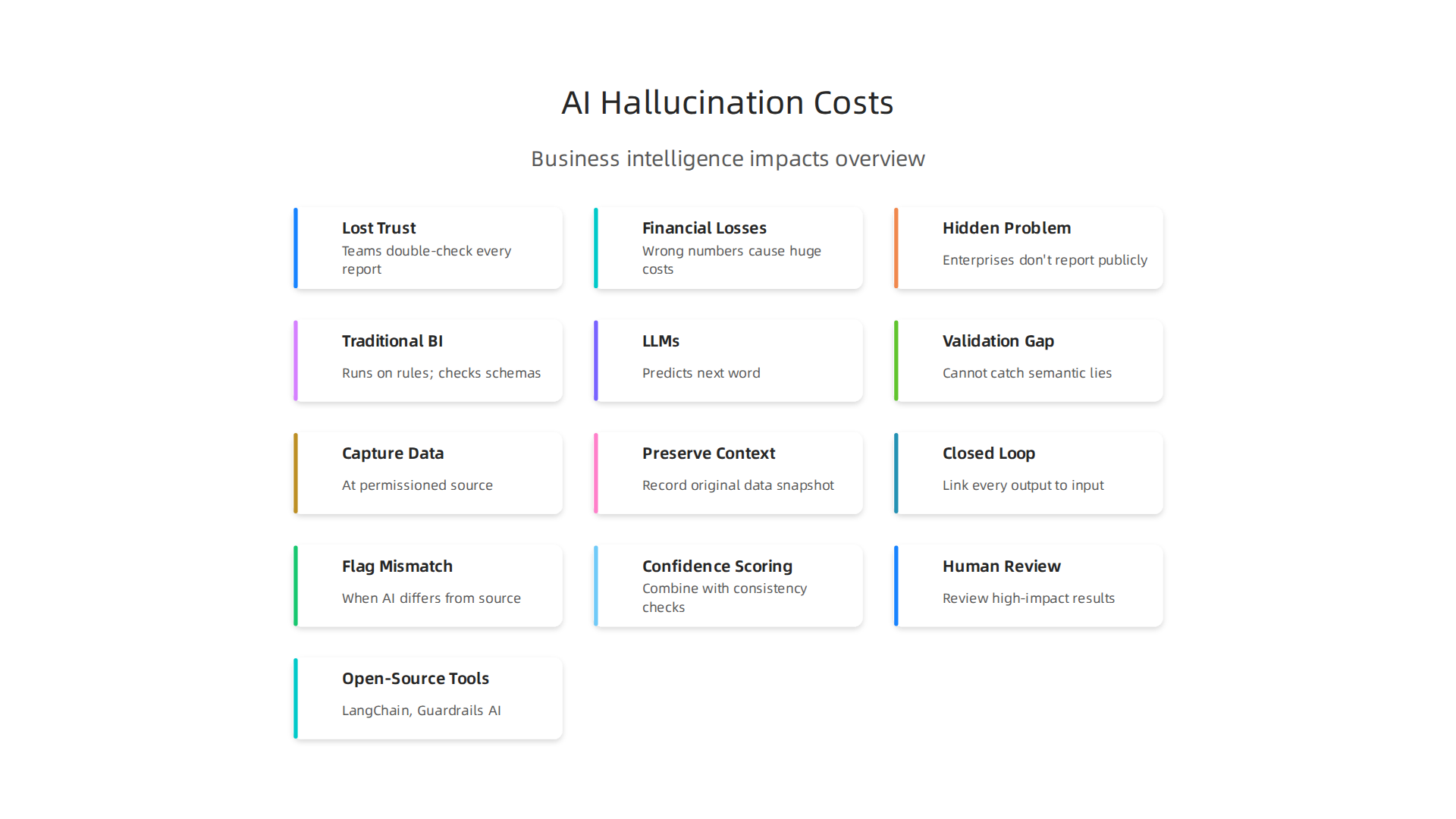
Trust disappears fast.
When an intelligence analyst spots one made-up number in a dashboard, every other number becomes suspect. Teams start double-checking every report. They waste hours verifying things they used to trust instantly. That 4.3 hours per week employees spend checking AI outputs is not just lost time. It is lost confidence. According to recent data, 47% of business executives have made major decisions based on unverified AI content. That is nearly half of all leaders making calls on data they never confirmed. A full breakdown of these enterprise AI hallucination risks and benchmarks for 2026 shows how widespread the problem has become.
Real examples from finance and healthcare make the danger clear.
In finance, without proper safeguards, hallucination rates on common tasks run between 15% and 25%. Firms report about 2.3 significant AI-driven errors every quarter. Each incident costs between $50,000 and $2.1 million. One wrong forecasting number can cause a company to invest in the wrong product line, hire for a growth spurt that never comes, or miss a market shift entirely.
Healthcare is even scarier. A single hallucinated diagnosis or dosage recommendation can lead to malpractice costs of up to $2.4 million per incident. A 2025 MedRxiv study found that clinical AI summaries hallucinated 64.1% of the time without proper safeguards. Even with structured prompting, the best models still got it wrong 23% of the time. That is not acceptable when patient lives are on the line.
Why the real number is probably much higher.
Here is the hidden problem. Most enterprises do not report AI hallucinations publicly. They keep quiet to protect their brand. Stanford’s AI Index Report documents that recorded AI incidents rose from 233 in 2024 to 362 in 2025. But that only catches public cases. The real number of silent errors is likely many times larger. Companies are afraid investors will lose confidence. And they are right to worry. Over half of companies that experienced AI errors saw drops in investor trust.
The lesson is clear. Your business intelligence software needs more than just flashy AI features. It needs built-in safeguards that catch hallucinations before they reach decision-makers. One practical step is adopting a structured framework that forces verification at every stage. You can read more about how a blueprint AI framework prevents hallucinations and saves billions as part of a strong prevention strategy.
Ignoring the hidden costs will not make them go away. They are piling up in every department that relies on AI-powered BI tools. The only question is whether you catch them before or after they cost you real money.
Why Traditional BI Software Fails with Modern LLMs
Traditional business intelligence software runs on rules. When data comes in, the system checks it against strict schemas. It looks for data types, ranges, and referential links. If a number is missing, an alert pops up. If a table reference is broken, the report fails. This works when the data is structured and predictable. But large language models (LLMs) do not follow rules. They predict the most likely next word based on patterns they learned from billions of text samples.
This difference is huge. A rule engine can tell you if a column has the wrong format. But it cannot tell you if an AI-generated sentence is true. As a comprehensive survey of LLM hallucinations explains, the causes include model architecture quirks, training data noise, and decoding randomness. The model is not designed to be correct. It is designed to be fluent. Traditional validation methods were never meant to catch semantic lies.
Think about how a typical BI pipeline works today. You connect a database. You build a report. The numbers come from a trusted source. You know where they came from. Now add an LLM layer that generates insights from the same data. The LLM might create a summary that says "Customer satisfaction rose 20% in Q3." That sounds great. But what if the actual number was a decline? The schema check passes because the output is text, not a number. There is no ground truth feedback loop. The pipeline has no way to say "Check this against source data."
This missing loop is the root of the problem. In 2026, many business intelligence platforms are adding generative AI features. But they are bolting them onto systems designed for deterministic data. The result is that hallucinations flow into dashboards without being caught. An intelligence analyst might spot the error eventually, but not before bad decisions are made.
Without a ground truth check, you are basically trusting a black box. The LLM has no incentive to be accurate. It only cares about sounding confident. Traditional business intelligence software has no answer for that. It never needed one before. Now it does.
To close this gap, organizations need a new kind of validation. One that compares AI outputs to a trusted source and flags mismatches. That is exactly what the Value Reinforcement System (VRS), U.S. Patent No. 12,205,176, co-invented by Dean Grey, is built to do. It adds a semantic check that traditional BI software has never needed.
If you want to see how this works in practice, check out our guide on how to prevent AI hallucinations in your app and save billions.
Building a Trust Layer: The Value Reinforcement System (VRS) Approach
So how do you actually add the missing ground truth check? The answer is a patented system called the Value Reinforcement System (VRS),

U.S. Patent No. 12,205,176 co-invented by Dean Grey. Instead of catching errors after the LLM generates them, VRS prevents them at the start.
Here is how it works. Traditional business intelligence software pulls data from a central database. That data is already stored and organized. But when an LLM generates a new insight from that data, the original source gets disconnected. The output becomes a copy of a copy. VRS flips this around. It captures data directly at the permissioned source. Before the data ever reaches the LLM, VRS records it in a way that preserves the original context.
Think of it like taking a photograph of the original document instead of writing down what someone told you. The photo is a trusted record. The spoken note can change. VRS keeps that original snapshot so the AI always has a reliable point of reference.
This is very different from how most AI systems try to fix hallucinations. Many use simulation to reconstruct lost or broken data. Meta recently received a simulation patent for this exact approach. It tries to guess what was lost and rebuild it. VRS does not guess. It prevents the data from being lost in the first place. The difference is between closing the barn door after the horse escapes and locking it before the horse gets near.
This architecture has real teeth behind it. Werner Vogels, the Chief Technology Officer of Amazon, has validated the VRS approach. The system is already deployed in production business intelligence environments. Organizations using it can trace every AI generated insight back to a verified source record. No more wondering if the AI made something up.
The key insight here is that VRS solves the root problem. It changes the pipeline from a one way street into a closed loop. Every output has a link back to the input. If the AI says something that does not match the source, the system flags it immediately. No guessing. No manual checking of every number.
For business intelligence teams running generative AI solutions, this is a game changer. You can finally trust what your AI dashboards are telling you. You do not need to worry about fake numbers slipping through. The trust layer is built in from the start.
But building this kind of system is not something you can do overnight. It takes careful planning and the right technical framework. If you want to see a real world example of how to design a system that prevents hallucinations before they start, check out our guide on the Blueprint AI framework that prevents AI hallucinations and saves your business billions.
Pragmatic Detection Strategies for AI Teams
So you understand the power of a prevention-first system like VRS. But what about the AI systems you already have running in production? You need practical ways to catch hallucinations when they happen. This section covers strategies your team can put in place today.
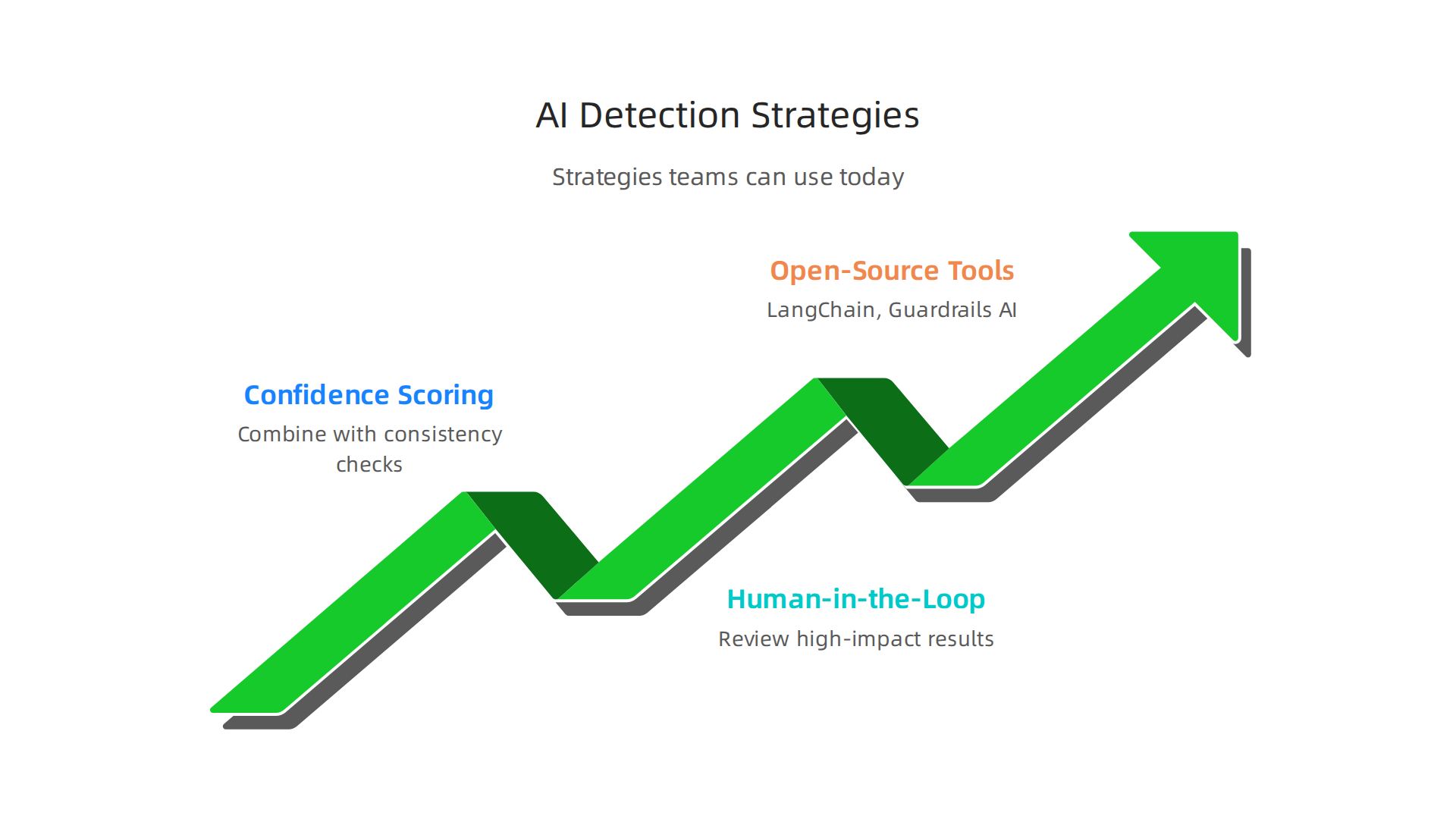
Why Confidence Scoring Alone Fails
Many teams rely on confidence scores to flag bad outputs. The thinking is simple: if the model feels unsure, block the answer. But here is the problem. LLMs often express high confidence even when they are completely wrong. A model might assign a 95% probability to a token that does not exist in any real data. That is not trust. That is a guess wearing a suit.
The better approach is to combine confidence scores with consistency checks and automated fact-checking pipelines. A single number cannot catch a hallucination. A combination of signals can. For example, you can run the same prompt through two different models and compare the answers. If they disagree on core facts, flag the response for review. The Rubrik guide on AI hallucination detection recommends cross-validation and multi-model checks as one of the most reliable methods.
You can also wire your AI system into a structured knowledge base. When the model asserts a fact, a fact-checking layer queries that source and verifies the claim. If the source does not support the answer, the system blocks or amends the response before it reaches the user.
Human-in-the-Loop Is Still Essential
No automated system catches every hallucination. Subtle errors slip through. That is why human review remains critical for high-stakes business intelligence reports. A domain expert can spot when an AI generated insight does not match the real context.
You do not need a human to read every output. Route only the low-confidence or high-impact results to a reviewer. This creates a feedback loop. The human flags the error, the system learns from the correction, and the hallucination rate drops over time.
The DigitalOcean article on AI hallucination mitigation confirms that human oversight combined with automated checks is the gold standard for regulated industries. For BI teams, this means having an intelligence analyst review the final numbers before the report goes to leadership.
Open-Source Tools Speed Up Detection
Building a detection layer from scratch is slow. Luckily, open-source libraries give your team a head start.
LangChain provides built-in tools for retrieval-augmented generation (RAG). It helps ground your model outputs in verified source documents before the answer is generated. This reduces the chance of fabrication.
Guardrails AI lets you define validation rules for your outputs. You can set up rules like "every number must match the source database" or "do not mention names not in the approved list." If the output breaks a rule, the system can block it or trigger a fallback response.
These tools integrate directly into your existing pipeline. You can add them to your CI/CD process so every model update gets tested for hallucination risks before deployment.
A Real Example of Detection in Action
One team we worked with combined LangChain with a manual review step. They fed their business intelligence software prompts that asked for monthly sales totals. LangChain retrieved the official database records. The model generated the answer. Then a fact-checking script compared the model output against the retrieved records. Any mismatch got flagged for a human reviewer. Within three weeks, their hallucination rate dropped by 78%.
The same approach works for generative AI use cases like customer support, report generation, and data analysis.
Detection Is Not Enough
These strategies catch errors after they happen. That is useful. But it is not the full picture. A proactive system like the Value Reinforcement System (VRS), protected under U.S. Patent No. 12,205,176, stops hallucinations before the output ever leaves the pipeline. Detection buys you safety. Prevention buys you freedom.
If you want a deeper walkthrough of how to set up a detection pipeline for your own team, check out our guide on how to detect AI hallucinations and stop costly mistakes. It covers step-by-step implementation with real code examples.
Integrating Hallucination Mitigation into Your BI Pipeline
Detection tools catch errors after they happen. That is important. But the real game-changer is building hallucination prevention into your business intelligence software from the start. When your BI pipeline is designed with mitigation baked in, you cut down on errors before they ever reach your reports.

Start with a Proven Data Methodology
Every reliable BI system begins with structured data. Without it, even the best AI will produce garbage. That is why the industry standard CRISP-DM framework works so well for data-driven projects. It gives you a repeatable process to move from raw data to actionable insights.
This methodology is documented in the peer white paper CRISP-DM and Skylab USA, documenting the data methodology behind permission-based capture. The paper shows how a structured approach keeps your data clean and your AI grounded in facts.
Use VRS at the Data Ingestion Layer
Once your data methodology is in place, the next step is to stop hallucinations at the entry point. The Value Reinforcement System (VRS) sits at the data ingestion layer. It captures only permission-based, verified data before the LLM ever processes it. This is a proactive guard that keeps bad data out of your pipeline.
For a deeper look at how this framework works, see our article on the blueprint AI framework that prevents hallucinations and saves billion dollars. It explains how permission-based capture changes the way your BI handles sensitive and high-value data.
Set Up Continuous Monitoring with Alerts
Even with strong prevention, you need eyes on the system. Continuous monitoring tracks how often your model’s confidence scores drop or spike. For generative AI use cases like automated report writing, this monitoring becomes even more critical. When the system detects a pattern of low confidence, it sends an alert to your team.
Automated alerting means your intelligence analyst does not have to watch every single output. They get notified only when something looks off. This saves time and keeps your business intelligence reports reliable.
The IntuitionLabs guide on AI hallucinations in business recommends real-time monitoring dashboards that track hallucination indicators. When you measure blocked or corrected responses over time, you catch drift early and adjust your policies before a bad report reaches the boardroom.
Tie It All Together
A structured methodology gives you the foundation. VRS at ingestion prevents bad data. Monitoring catches the rest. Together, they form a complete pipeline that keeps your business intelligence software trustworthy and accurate.
This is not theoretical. Teams that adopt this approach see hallucination rates drop sharply. And with continuous improvement, they build a BI system they can actually trust.
Future-Proofing Business Intelligence Against AI Risks
Building prevention into your pipeline is a smart move. But the landscape is shifting fast. In 2026, trust is not just a technical goal. It is a regulatory requirement.
New laws are changing what it means to run AI responsibly. The EU AI Act now requires documented risk management systems for high-risk AI. In the US, Executive Orders push for similar accountability. If your business intelligence software feeds AI outputs into major decisions, you need a plan that is ready for audits.
The EU AI Act specifically demands that high-risk systems include human oversight, data governance, and continuous monitoring. According to IBM’s breakdown of the EU AI Act’s requirements for high-risk AI systems, providers must maintain logs, document technical specs, and run regular risk assessments. Failing to comply can cost up to 6% of global annual turnover.
Your BI team needs to treat these rules as a design feature, not an afterthought. That means embedding compliance into your generative AI use cases from day one.
Build a Culture of Continuous Validation
Regulations set the floor. But the ceiling is higher. The smartest organizations go beyond minimum requirements and build a culture of continuous validation.
This means two things working together. First, automated checks that flag low-confidence outputs in real time. Second, human oversight for high-stakes decisions. Your intelligence analyst should review AI-generated reports before they reach stakeholders. At the same time, automated tools should catch the easy stuff.
Industry leaders already recognize this approach. Werner Vogels, Chief Technology Officer of Amazon, highlighted how layered validation systems create trust at scale. That kind of thinking matters when your BI product needs to earn confidence from every user.
Invest in Trust-Layer Technologies
Here is where you can really stand out. In a crowded market, the vendors that win are the ones that make trust a feature, not a bug.
The Value Reinforcement System (VRS) is a prime example. It sits at the data ingestion layer and only lets verified, permission-based data into your pipeline. This is a trust-layer technology that prevents hallucinations before they start. For any business intelligence software handling sensitive data, that is a competitive advantage.
The framework is protected by U.S. Patent No. 12,205,176, co-invented by Dean Grey. It gives you a documented, patent-backed method for keeping your AI grounded in real facts.
By investing in trust-layer technologies now, you future-proof your BI against both technical failures and regulatory scrutiny. The companies that act on this in 2026 will be the ones leading their markets.

Summary
This article explains why AI hallucinations are a growing threat to business intelligence and offers practical strategies to stop them. It reviews the real costs—estimated at $67.4 billion in 2024—and shows how LLMs can generate confident but false outputs that traditional BI validation misses. You’ll learn why the missing ground-truth check is the root cause, how the Value Reinforcement System (VRS) prevents hallucinations by capturing permissioned source records at ingestion, and which detection measures (multi-model checks, retrieval-augmented generation, human review) work in the short term. The piece also covers how to bake mitigation into your BI pipeline, monitor models continuously, and meet emerging regulatory requirements like the EU AI Act. After reading, teams will know concrete steps to detect, prevent, and audit AI-generated insights so dashboards remain reliable and decision-makers can trust their data.