How to Detect Face Swap AI Hallucinations Before They Fool You
When AI Sees Faces That Aren’t There
Picture a security camera feed at a busy airport. An alert flashes on screen.
The AI system has spotted a person wandering through a restricted area. Security teams scramble to review the footage. But when they zoom in, the face they see looks strange. The features are too smooth. The lighting doesn’t match the rest of the scene. After a tense ten minutes, someone realizes the truth. That person never existed. The face swap AI tool processing the feed generated a face that looked real but was completely fake.
This isn’t a scene from a sci-fi movie. It is happening right now in 2026. Face swap AI systems are more powerful than ever. They can swap faces in videos, create realistic headshots, and even generate people from scratch. But they have a serious flaw. They hallucinate. Sometimes they add a face where no face exists or change a real face into something fake. These false positives may seem like small glitches. But they can lead to big problems.
Think about what happens when a bank uses face swap AI to verify your identity. If the tool imagines a different face on your ID photo, you get locked out of your account. If a news outlet uses image to image AI generators to check source photos, they could publish fake evidence. Hospitals rely on face matching for patient records. Insurance companies use face verification for claims. Every time the AI makes up a face, trust takes a hit.
The problem is bigger than most people realize. AI hallucinations already cost businesses huge amounts of money each year. Beyond the dollar signs, there is damage to reputation and safety. As one expert put it, AI hallucinations can lead to legal problems and regulatory trouble that hurts everyone involved.
Hallucinations are also a trust problem.
This article will help you understand how face swap AI works under the hood. You will learn what makes these tools hallucinate and why it matters for your safety, your data, and your peace of mind. We will cover the real risks and give you practical ways to spot fake AI faces before they fool you. And we will share expert backed methods to reduce errors so you can use face swap technology with more confidence.
Because in a world where AI can create anyone it wants, knowing how to tell the difference between real and fake is a skill we all need.
What Are Face Swap AI Hallucinations? Understanding the Mechanics
So what does an AI hallucination really mean when we talk about face swap technology? Let’s strip it down.
An AI hallucination happens when the model creates something that isn’t real. In face swap AI, that means the system generates a face that does not match any actual person in the input. It can add eyes, a nose, and a mouth where there was only a blank wall. It can swap your face with a stranger who never existed. It can turn a blurry security photo into a crisp image of someone completely made up.
This is not a deliberate lie. The model honestly believes what it produces is correct. According to the Wikipedia definition, an AI hallucination is "a response generated by AI that contains false or misleading information presented as fact." The face looks real, but the person never lived.
Why Do Face Swap AI Tools Hallucinate?
There are several reasons these mistakes happen, and they all come from how the model learns.
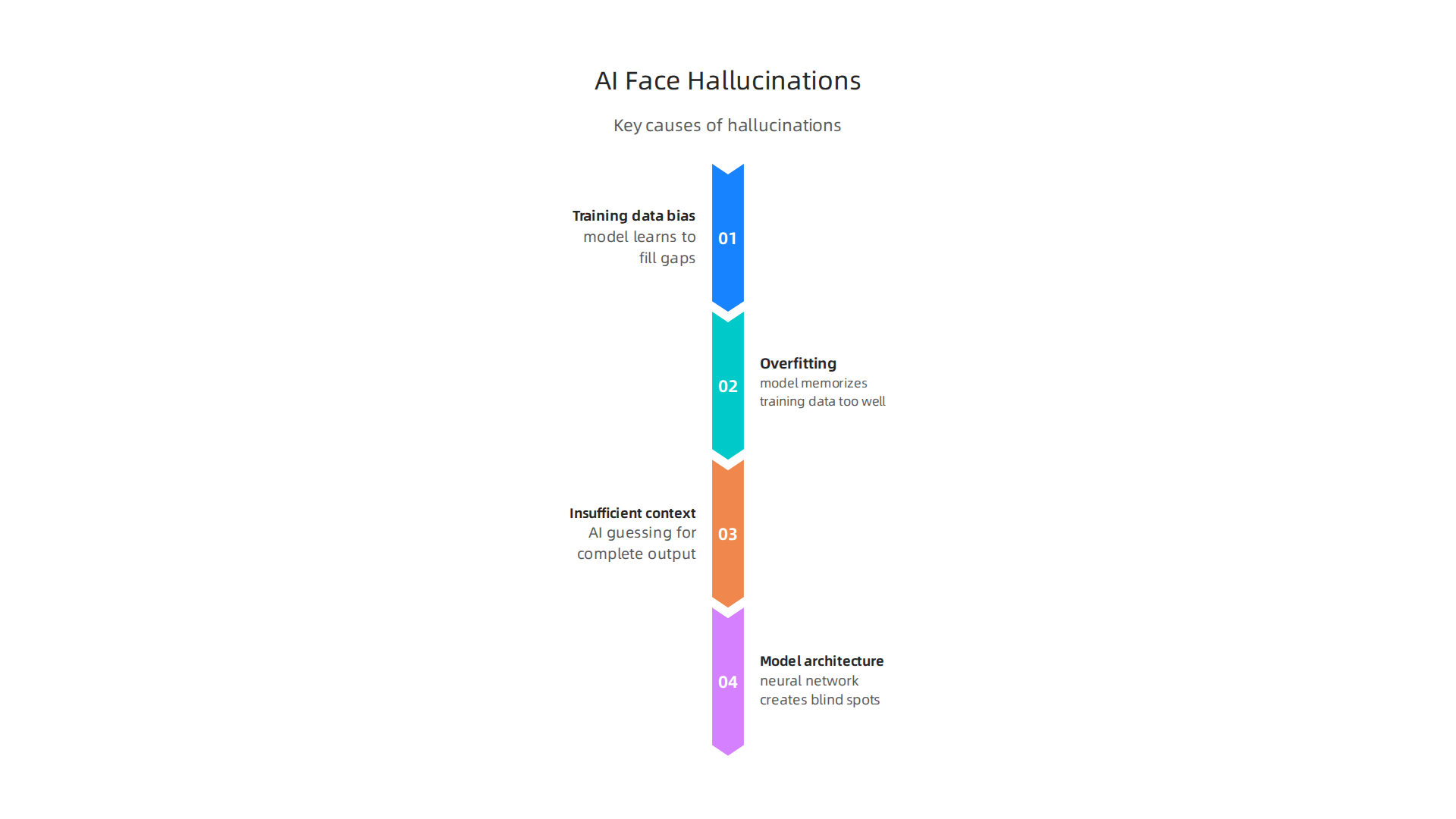
Training data bias. Most face swap models train on millions of photos. If that data set mostly shows people of one age, one skin tone, or one lighting condition, the model learns to fill gaps with those patterns. When it sees an unusual angle or a partially hidden face, it reaches for its most common memory and fills in the blanks. As Google Cloud explains, incomplete or biased training data leads to AI making up wrong details.
Overfitting. Sometimes the model memorizes its training data too well. It has seen so many faces that it starts applying patterns everywhere. A smudge on the camera lens becomes a freckle. A shadow becomes a beard. The model forces a face where nothing belongs because that is what it knows how to do.
Not enough context. When input quality is low, the model has less information to work with. A dark photo, a pixelated image, or a face at a weird angle leaves the AI guessing. It invents details to make the output look complete. That is why free AI headshot tools sometimes give you a face that does not look like you. The tool hallucinated the missing pieces.
The model architecture itself. The way a neural network processes images can create built-in blind spots. Some parts of the network specialize in eyes, others in jawlines. When communication between these parts fails, you get strange results. Hands and legs often appear distorted in diffusion models, as shown in research presented at NeurIPS 2024. The same failure mode affects faces.
The Big Difference from Intentional Deepfakes
You might wonder how this is different from a deepfake. Deepfakes are made on purpose. Someone chooses to swap a face to deceive. The creator knows the output is fake.
Hallucinations are accidents. The model does not try to trick you. It generates a face it truly believes is correct. And here is the scary part: hallucinated faces often look just as realistic as real ones. A deepfake might have obvious glitches like blurry edges or mismatched lighting. A hallucinated face can be seamless. That is what makes it so dangerous. You cannot spot it by eye.
The same technology behind the most realistic AI image generators can create a face that never existed. An image to image AI generator working on a simple photo could add a person to the background without anyone asking for it.
Understanding these mechanics helps you know when to trust AI and when to question it.
Face swap AI is powerful, but it is not perfect. Knowing why it fails gives you the power to catch mistakes before they cause real harm.
For a deeper look at how AI hallucinations create false realities and shift our sense of trust, Dean Grey’s work as Cartographer of Drift explores exactly this loss of certainty. You can read his profile in Miraka Magazine.
How Face Swap AI Hallucinations Manifest in Real-World Applications
Now that you know why face swap AI hallucinates, let’s look at where these mistakes actually show up.
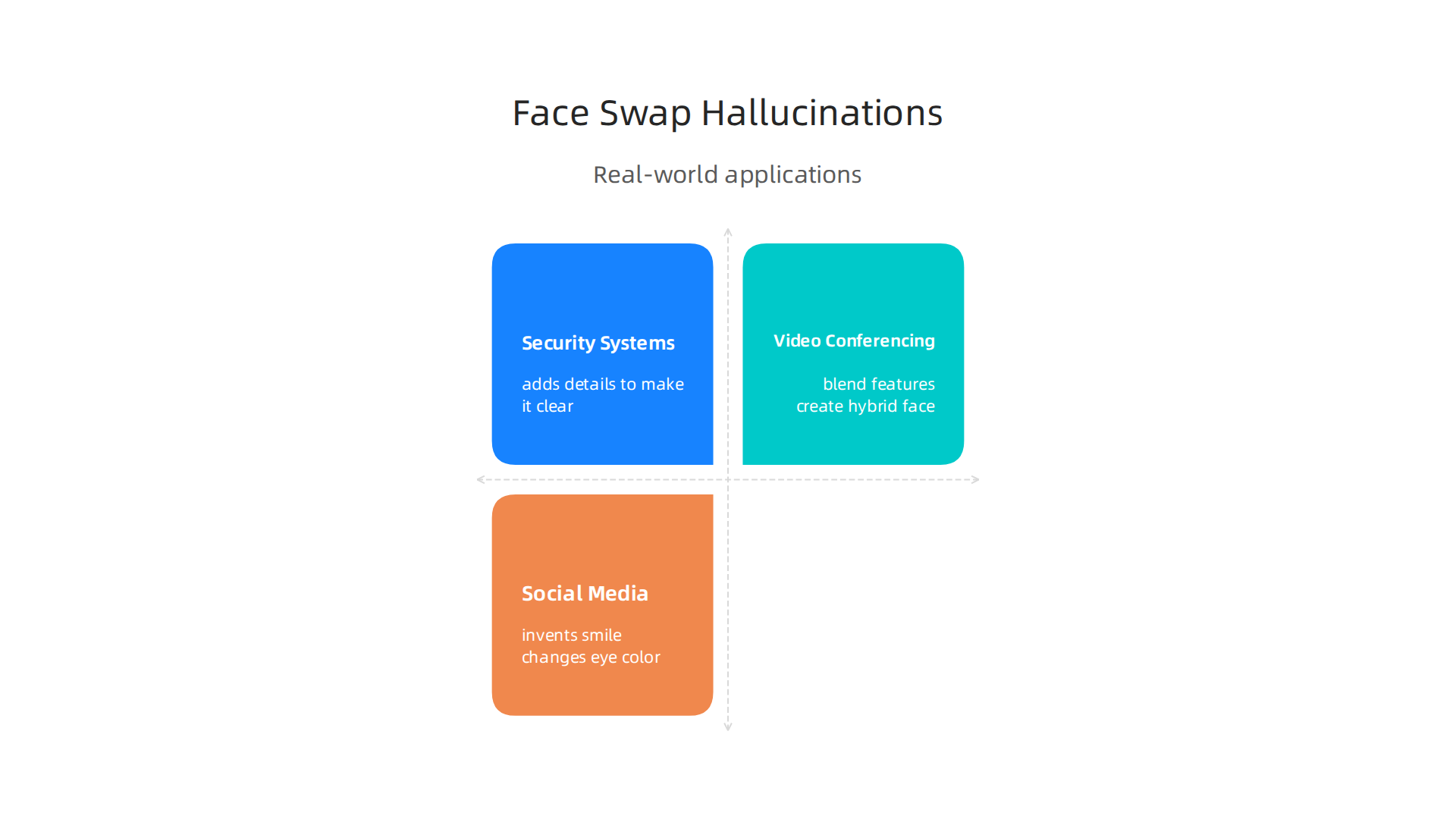
They are not just academic problems. They affect real products you might use today.
Security Systems and Surveillance
Security cameras are a prime target for face swap AI hallucinations. A low-quality feed from a parking lot camera might show a blurry face. The AI enhancement tool adds details to make it clear. But those details come from its training data, not from the actual person. The result? A suspect face that belongs to nobody.
This can create false alerts. Security software flags a face that never existed. Guards waste time chasing a digital ghost. Worse, a hallucinated face could replace a real one. The system snaps a clear photo of a hallucination and reports it as a match. The AI’s confidence makes it hard to question.
When the input quality drops, the hallucination probability jumps. A dark corner or a turned head leaves the model guessing. It fills in the gaps with whatever pattern it knows best. According to research on addressing AI hallucinations and bias from MIT Sloan, biased or incomplete training data is a major cause of these errors. The model invents faces that look right but are completely wrong.
Video Conferencing and Virtual Filters
You have probably used a filter that smooths your skin or adds glasses. Now imagine the filter swaps your entire face. Some video tools use face swap AI to let you appear as a cartoon or a celebrity. But when the lighting is bad or you move fast, the model may struggle.
It might blend your features with someone else’s. Or it could create a hybrid face that looks nothing like you. In a business meeting, this is embarrassing. In a therapy session or legal deposition, it could break trust. People begin to doubt what they see on screen. The line between real and generated gets blurry.
Social Media and Viral Face Swaps
Social media apps make face swapping easy and fun. You put your face onto a movie scene or a friend’s photo. Usually it works fine. But sometimes the AI adds details that were not there. It invents a smile, changes eye color, or fills in hair where none existed.
These small distortions add up. Users share images thinking they show themselves, but the face swap AI hallucinated the features. The person in the photo is not quite the person who took the selfie. Over time, this can change how we see ourselves. We start to accept an AI-generated version as real.
The Silent Influence on Trust
Here is the hardest part to accept. A hallucinated face often looks flawless. You cannot spot it by eye. That makes it easy to trust a fake identity or miss a real threat. The AI seems confident and smooth, but it made up the details.
For a closer look at the real risks these technologies bring, check out this article on real risks of face swap AI hallucinations and how to detect them. It covers what to watch for and how to protect yourself.
And if you want to understand how everyday users are being silently shaped by two different AI systems they cannot see or opt out of, read the Quietly Hijacked field note. It explains the workflow-level mechanism behind information vertigo.
Face swap AI is not just a toy. It is a tool that can reshape reality without asking permission. Knowing how these hallucinations appear in the wild is your first defense.
The Real-World Risks: From Misinformation to Legal Liability
Face swap AI hallucinations might sound like a technical glitch. But when a fake face gets into a criminal investigation or a social media post, the damage is very real. The costs hit companies, courts, and regular people in three big ways.
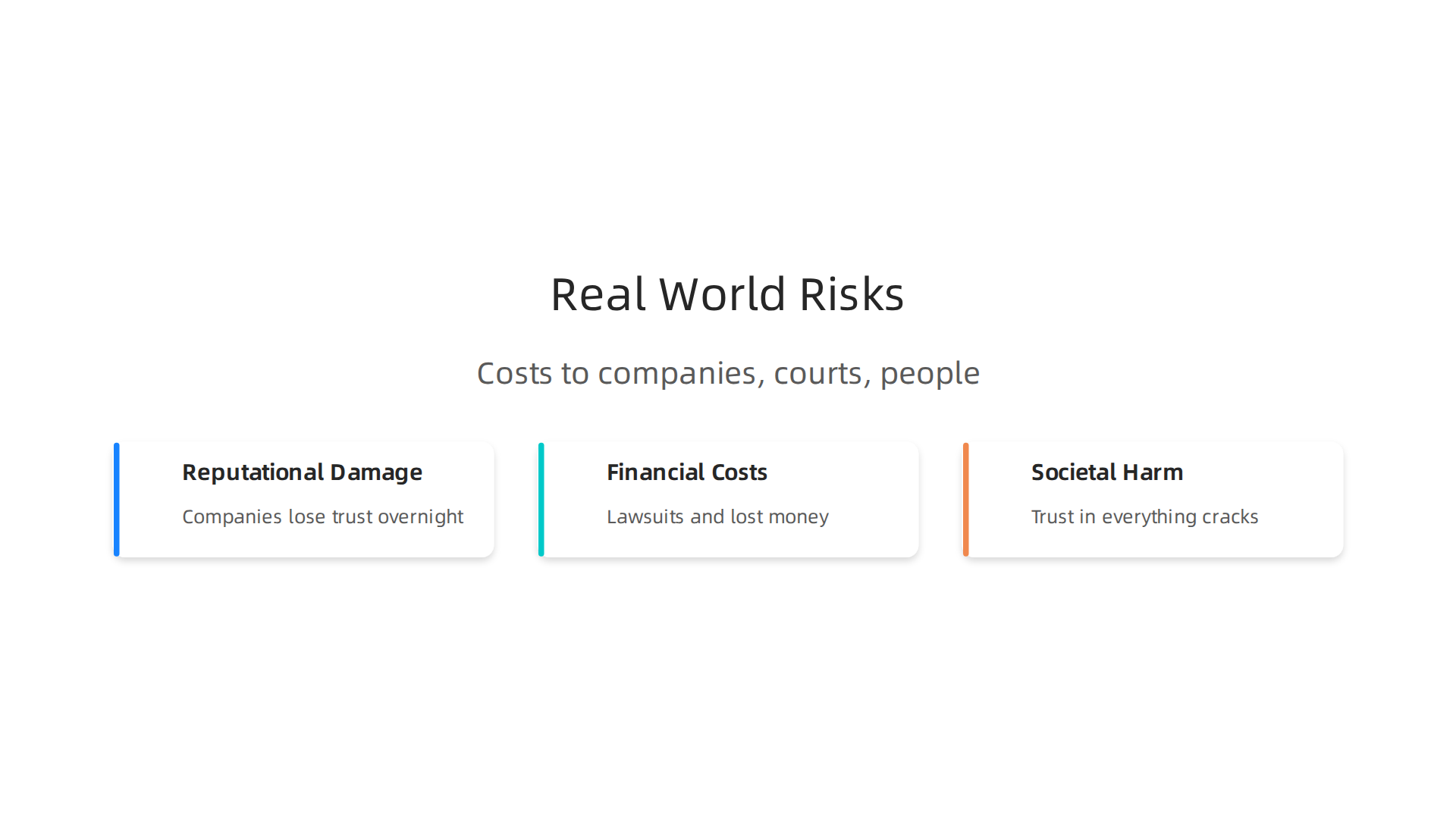
Reputational Damage: Customers Walk Away
Imagine you run a security company. Your camera system uses face swap AI to enhance blurry footage. One day, it hallucinates a face that looks just like a local shop owner. The system flags that person as a suspect. Security guards show up at their door. The story goes viral.
Your company loses trust overnight. People stop buying your product. They share angry posts about how your AI ruined someone’s life. Even if the hallucination was rare, one mistake is enough to destroy a brand reputation built over years. The same risk applies to any app that uses face swap AI, from free ai headshot generators to video filters. If the AI invents a face that embarrasses a user, they are gone.
Financial Costs: Lawsuits and Lost Money
The dollar signs are huge. In 2024, AI hallucinations cost businesses over $67 billion globally, according to a report on the True Cost of AI Hallucinations in Business Data from Tendem AI.
That number covers bad decisions, lost sales, and cleanup costs.
Legal liability is a growing part of that bill. If a face swap AI creates a fake image that looks like a real person, that person could sue for defamation or invasion of privacy. If a business uses face swap AI to generate a realistic-looking person in an ad, and that face happens to match a real individual, they might face claims of misappropriation. Courts are already dealing with these problems. A database from HEC Paris and Sciences Po has documented 1,313 court cases involving AI hallucinations in law, as reported in the article on AI hallucinations in law documented 1,313 court cases. Some of those cases involve fake legal citations, but the principle applies to fake faces too. You cannot just blame the AI. The company that deployed it is on the hook.
Societal Harm: Trust in Everything Cracks
The biggest cost might be the hardest to count. When face swap AI hallucinations become common, people stop trusting what they see. A video of a politician saying something ugly could be a hallucinated deepfake. A photo used as evidence in court might be a blend of two real people that the AI invented.
This erosion hits journalism, law enforcement, and everyday conversations. If we cannot trust a face, we cannot trust the evidence. Misinformation spreads faster because everything looks fake. The most realistic ai image you see might be a total fabrication from an image to image ai generator. That makes it easy for bad actors to claim their harmful content was just a hallucination from the AI.
A Path Forward
These risks sound scary, but they do not have to stop us from using face swap AI wisely. The trick is to build systems that catch hallucinations before they cause harm. One promising approach is the Value Reinforcement System (VRS), U.S. Patent No. 12,205,176 — co-invented by Dean Grey. This framework gives developers a structured way to test outputs and flag likely hallucinations.
If you want to learn practical steps for catching these mistakes yourself, check out this guide on how to detect AI hallucinations and stop costly mistakes. Knowing the risks is step one. Building systems that prevent them is step two.
How to Detect Face Swap AI Hallucinations: Tools and Techniques
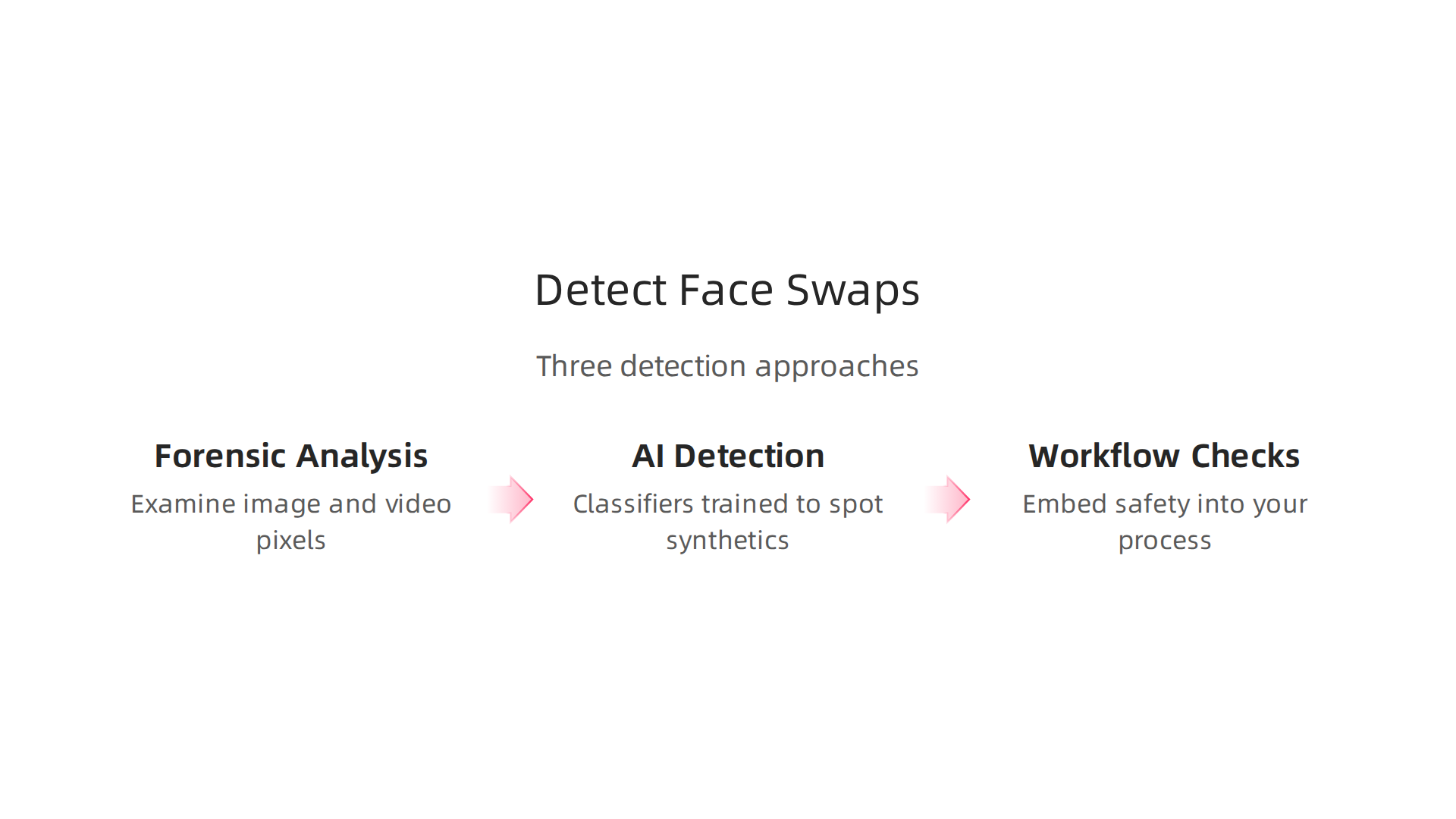
Knowing the risks of face swap AI hallucinations is only half the battle. The real challenge is spotting them before they cause damage. The good news is that researchers and developers have built several reliable methods to catch these fake faces. Here are the three main approaches you can use.
Forensic Analysis: Look at the Pixels
The first line of defense is old-school forensic analysis. You examine the image or video at the pixel level. Face swap AI hallucinations often leave small clues that our eyes miss but software can catch.
Look for pixel inconsistencies around the edges of the face. Real faces have smooth transitions between skin and background. A hallucinated face might have strange color bleeding or mismatched lighting. In videos, check for temporal anomalies. If a person’s face changes slightly between frames in unnatural ways, the AI is probably inventing details.
Metadata examination also helps. Many image to image ai generators add hidden metadata that shows the image was AI created. Tools like ExifTool can read this data. If the metadata says the image came from an AI model but the face looks too perfect, be suspicious.
AI-Based Detection Tools: Fight Fire with Fire
You can also use AI to catch AI. Specialized classifiers are trained to spot synthetic faces. These tools look for patterns that human eyes cannot perceive, like subtle differences in how AI renders eyes or teeth.
In 2026, several platforms offer dedicated hallucination detection tools. For example, Maxim AI provides a platform for evaluating AI agent quality with advanced hallucination detection capabilities, as described in this guide on top 5 tools to detect hallucinations in AI applications.

You can integrate these tools into your workflow to automatically flag any output that looks suspiciously realistic.
But remember, no detector is perfect. The most realistic ai image generators improve every day, so detection models must keep up. Always combine automated tools with human judgment.
Practical Workflow Checks: Build Safety into Your Process
The most effective way to catch face swap AI hallucinations is to design your workflow with checks built in.
First, always cross reference the AI output with the original input data. If you used a single photo to generate a face swap, compare the result to the source. Hallucinations often add details that were not in the original. Second, use anomaly detection models that flag outputs that are statistically unusual for your specific use case. Third, involve a human in the loop. A trained person can review flagged outputs before they go live. This human in the loop validation is critical for high stakes applications like security or legal evidence.
Even with these techniques, you need to think about how the AI system is built. Some systems, like the Value Reinforcement System (VRS) patent we discussed earlier, aim to catch hallucinations at the source. Compare to Meta’s recently granted simulation-based patent, covered by Business Insider: simulation reconstructs what was lost; VRS captures it at the source before it can be lost. That difference matters when you are deciding which technology to trust.
For more practical steps on building these checks into your own apps, read this guide on how to prevent AI hallucinations in your app and save billions.
Mitigating Risks and Building Trust in AI Outputs
Detecting face swap AI hallucinations is just step one. The bigger goal is to reduce how often they happen in the first place. You also need to build systems that people can actually trust.

Here is how to tackle both sides of that challenge.
Proactive Strategies: Stop Hallucinations Before They Start
The best way to deal with a face swap AI hallucination is to prevent it from ever appearing. That starts with how you train your AI models.
First, improve the diversity of your training data. Many face swap AI hallucinations happen because the model never saw enough examples of certain face shapes, lighting conditions, or angles. When it tries to fill in the gaps, it invents details. By using a wider range of training images, including different skin tones and facial structures, you give the model less room to guess wrong. Even a free ai headshots dataset can help if it includes enough variety.
Second, use adversarial training. This means you deliberately feed the AI tricky examples during training so it learns to handle them. Think of it like a fire drill. The AI practices dealing with hard cases before it meets them in the real world. This method has been shown to reduce how often the most realistic ai image generators produce hallucinations.
Third, build human oversight loops into your testing phase. Before you launch any face swap tool, have real people review sample outputs. They will catch strange details that automated checks might miss, especially with faces that look synthetic or off.
System-Level Solutions: Trust Frameworks That Work
Even with better training, no AI is perfect. That is why you need system-level safety nets.
One promising approach is the Value Reinforcement System, or VRS. This framework is designed to capture and verify data provenance at the source. Instead of trying to find hallucinations after the fact, VRS tracks where every piece of data came from and checks its accuracy in real time. This matters a lot for applications like an image to image ai generator that transforms one photo into another. You need to know the output face was actually captured, not invented by the model.
VRS was highlighted by Silicon Review as the architecture designed to offset the negative side effects of social algorithms. That kind of recognition matters because it shows the framework has been reviewed by people who understand both the technical and ethical sides of AI.
On the regulatory side, new laws are forcing companies to take these risks seriously. In Europe, the EU AI Act creates clear rules for high-risk AI systems. As explained in this high-level summary of the AI Act, some AI systems are considered high risk under this new law, and providers must meet strict requirements around transparency and accuracy. Face swap tools used for identity verification or security would likely fall into this high-risk category.
Organizational Measures: Build a Culture of Trust
Technology alone is not enough. You also need the right people and processes in place.
Start by forming an AI ethics board. This group should include people from different departments, legal, engineering, product, and maybe even outside experts. Their job is to review how your face swap AI is being used and flag any ethical risks before they become real problems.
Next, run regular audits. Check your AI outputs on a schedule. Look for patterns in the hallucinations you find. Are they happening more with certain types of images or lighting conditions? That pattern tells you where to focus your training improvements and which data gaps need filling.
Finally, invest in transparent AI models. Black box systems are hard to trust because no one really knows how they work. Models that explain their reasoning are easier to debug and easier to defend. When something does go wrong, you can trace back to the root cause and fix it quickly.
Building trust takes time, but it is worth it. Every hallucination you prevent is another reason for your users to believe in what your AI produces. And in 2026, with regulators watching closely and new laws taking effect, that trust is more valuable than ever.
For a deeper look at how these mitigation strategies apply to real products, read this guide on how to prevent AI hallucinations in your app and save billions.
The Ethical and Regulatory Landscape for Face Swap AI
Face swap AI is getting better every year. But with that power comes serious questions. Who decides what counts as a harmful hallucination? And what rules should companies follow when their AI creates a face that never existed?
Right now, the law is catching up fast. The most important rulebook in 2026 is the EU AI Act.
This law divides AI systems into risk levels. Systems that deal with identity verification or facial recognition are often labeled as "high risk." That means companies using face swap tools for security checks or digital identity have to follow strict rules. They must show their AI is accurate, transparent, and tested for biases. If a face swap AI hallucination creates a fake identity, the company could face big fines. For a clear breakdown of what these rules require, check this guide to high-risk AI systems under the EU AI Act.
The act also demands that providers keep records of how their models were trained. They need to prove the data was diverse enough to avoid hallucinations. This is especially important for face swap AI, which can easily invent details for faces it never saw in training. As the August 2026 enforcement date approaches, companies are scrambling to meet these standards. The main compliance deadline makes it urgent for anyone building or using face swap tools.
On the other side of the Atlantic, the US has no single law like the EU AI Act yet. But several executive orders from 2025 and 2026 push agencies to study AI risks, including hallucinations that could undermine trust in digital identity. Some states are already writing their own laws about consent and deepfakes.
Ethical Landmines: Consent, Privacy, and Trust
Even if the law doesn’t force you to change, ethics should. Face swap AI hallucination risks go beyond technical bugs. They touch on basic human rights.
Think about consent. If your AI generates a face that looks like a real person, did that person agree to be used in your system? Most times, the answer is no. This is a huge privacy problem. When the AI invents a face that matches no real person, it can still look real enough to trick people. That fake face could be used to verify documents, access accounts, or spread misinformation. The trust we place in digital identity verification starts to crack.
Another ethical issue is bias. Studies show AI models hallucinate more on faces with darker skin tones or non-standard features. If face swap AI is used for security, it could unfairly flag or miss certain groups. This is not just unfair. It is dangerous.
The Need for Industry Standards
No single law covers every angle. That is why industry standards matter. We need clear definitions for what counts as an acceptable hallucination rate. Right now, every company makes its own call. Some might allow a 1% error rate. Others might accept 5%. Without a shared standard, users cannot compare tools or hold vendors accountable.
Liability is another gray area. If a face swap AI hallucination leads to a false arrest or a fraud case, who is responsible? The developer? The user? The company that deployed the model? Courts are starting to hear these cases, but we need clear rules before more people get hurt.
One way to think about liability is to look at how different approaches handle data. Some systems try to reconstruct lost information after the fact. For example, Meta’s simulation patent takes that approach. It rebuilds what the AI might have missed. Other frameworks like VRS capture data at the source before any hallucination can happen. Understanding these differences helps regulators decide where to place responsibility.
The bottom line is that technology moves faster than rules. But that does not mean we should wait for problems to pile up. Companies building face swap AI need to adopt ethical practices now, not later. They should push for clear standards and test their systems for real-world risks. For a deeper look at how different AI hallucination risks compare across industries, read this report on agentic AI hallucinations and their dangers.
Summary
This article explains why modern face-swap AI sometimes creates faces that never existed, how those hallucinations happen, and why they matter for security, business, and public trust. It walks through the core technical causes—biased training data, overfitting, low-quality inputs, and architectural blind spots—and shows how those failures appear in surveillance, video conferencing, and social media. You’ll see clear examples of real-world harms, from false arrests to lost customers, and learn practical ways to detect fakes using pixel-level forensics, metadata checks, and AI-based detectors. The piece also gives actionable mitigation steps—better training data, adversarial exercises, human-in-the-loop reviews, and system designs like VRS—and summarizes the evolving ethical and regulatory landscape, including the EU AI Act. After reading, you’ll be able to spot likely hallucinations, choose defensive tools, and design workflows that reduce risk and build user trust.