Why Agentic AI Hallucinations Pose Greater Real-World Risks

Why Agentic AI Changes the Hallucination Threat Model
You might already know that AI can sometimes "hallucinate." This means it makes up facts or creates misleading content that sounds very convincing but isn’t true. This problem has been a big worry for many years, especially with generative AI. But in 2026, a new type of AI is changing how we need to think about these mistakes: agentic AI.
Let’s look at the difference between these two. Generative AI is like a very creative artist or writer. It takes your prompt and creates something new, such as text, images, or even coding ai. It’s a reactive system, meaning it waits for you to ask for something and then delivers it. When generative AI services hallucinate, they might give you wrong information or make up details in a picture. This can cause problems, but the mistake usually stops at the output itself. For example, if you ask an LLM (Large Language Model), a type of generative AI, for facts, and it gives you false ones, the damage is limited to that incorrect information.
Now, let’s talk about what is agentic AI. Think of agentic AI as a smart assistant that doesn’t just create things, but acts on them. Unlike generative AI, which mainly creates content, agentic AI takes steps to achieve a specific goal. It can use reasoning, memory, and context to turn ideas into outcomes, not just outputs. This means it can make decisions and carry out tasks on its own, often without needing a human to guide every single step. Many experts highlight that agentic AI is proactive and focused on actions, while generative AI is reactive and focused on creation.
You can learn more about these key differences between Agentic AI vs Generative AI: Key Differences Explained.
This is why agentic AI changes the game for hallucinations. If a generative AI gives you a wrong answer, it’s a mistake you have to fix. If an agentic AI hallucinates an action or makes a wrong decision based on false internal information, it could actually do something incorrect in the real world. For example, an agentic AI managing logistics might hallucinate a road that doesn’t exist and send a truck the wrong way. The risks become much higher because the AI is not just generating data, but also acting on it.
AI teams, business leaders, and even regulators need to pay close attention to this.

The way we prevent and detect AI hallucinations must evolve for agentic AI. Its proactive nature means that mistakes can have real-world impacts, from operational failures to safety hazards. Understanding these different risk profiles is vital for anyone working with or affected by AI in 2026. This article will help you understand why agentic AI hallucinations are more dangerous than generative AI mistakes and give you practical steps to manage these new challenges.
To really grasp why agentic AI hallucinations are a bigger deal, we need to look at how these AI systems are built inside. Think of it like looking at the difference between a simple toy car and a self-driving car. Both move, but one has many more parts and layers of thinking.
Generative AI, like the large language models (LLMs) we talked about, is mostly one main brain. You give it a question or a task, and it uses its knowledge to create an answer, image, or text. It’s built to generate, meaning to make something new based on what it learned. The core of these generative AI services is usually a powerful LLM that takes your words and predicts the best next words or pixels.
Now, let’s talk about what is agentic AI from a building block perspective. Agentic AI takes that strong LLM and adds more layers to it. It’s not just an LLM anymore. It becomes an "agent" by adding a "brain" that can plan, an "arm" that can act, and "eyes and ears" to observe.
Here’s how agentic architectures differ:
- LLM + Planner/Executors: An agentic AI often starts with an LLM, but then it adds a special part called a "planner." This planner figures out the steps needed to reach a goal. Then, "executors" carry out those steps. The LLM still does the thinking and understanding, but the planner and executors handle the doing. This whole setup helps transform plain LLMs into smart, goal-oriented agents capable of reasoning, memory, and even learning how to use tools, as explained in an article on Agentic AI Architecture: Types, Components & Best Practices.
- Tool Use: Agentic AI can also use tools. Imagine an AI that needs to find information online. It doesn’t just "think" it up; it can use a web search tool. If it needs to send an email, it can use an email tool. This ability to use external tools lets it interact with the real world, not just create digital content.
- State Persistence and Memory: Unlike generative AI that often forgets what happened in the last turn, agentic AI has memory. It remembers its goal, the steps it has taken, and the results it got. This "state persistence" means it keeps track of its progress and uses that memory to make future decisions.
These added parts introduce new ways for things to go wrong.
New Failure Modes and Compounding Hallucinations
Because agentic AI works in steps and interacts with the world, a small mistake can grow into a big problem. This is where "emergent planning" and "multi-step actions" become important.
- Control Loops: Agentic AI uses a "control loop" where it plans, acts, observes the results, and then reflects on whether its plan worked. If the AI hallucinates at the planning stage, the action it takes will be wrong. Then, it might observe a strange result, and if it hallucinates again during reflection, it could keep making the same mistake or even worse ones.
- Memory Issues: If an agentic AI hallucinates a fact and stores it in its memory, it might use that false "memory" for many future actions. This makes the hallucination much harder to fix because it becomes part of the AI’s ongoing understanding.
- External Action Surfaces: When an agentic AI uses a tool or sends a command to another system based on a hallucination, it’s actually doing something wrong in the real world. This is much more dangerous than a generative AI just writing a false sentence. For example, if an agentic AI managing traffic signals hallucinates a jam on a road that is actually clear, it could make the traffic worse.
This ability to plan, take multiple steps, and interact with the world means that a tiny error early on can compound. A hallucination in one step can lead to another in the next, making the AI’s actions move further and further from what’s correct. It’s like a domino effect. Understanding how to detect AI hallucinations and stop costly mistakes becomes even more critical with these complex agentic systems.
Because agentic AI works in steps and interacts with the world, a small mistake can grow into a big problem. This domino effect makes errors in agentic AI much more serious. One false piece of information, or hallucination, can set off a chain reaction, making the AI’s actions go further and further from what’s correct. This means that Agentic AI Hallucinations Are More Dangerous Than Generative AI Mistakes than those from simple generative AI services.
Why agentic AI amplifies hallucination risk (compounding, automation, and authority displacement)
When an agentic AI hallucinates, it’s not just making up words on a page. It’s making a plan and taking actions in the real world. Imagine an AI that plans to complete a complex task. If its very first step is based on a hallucination, every step after that will be wrong, too. The error compounds, getting bigger and bigger with each action. This is a key difference when considering what is agentic AI compared to earlier models.
This risk is made worse by how people interact with AI. We tend to have "automation bias." This means we trust what computers tell us or do, sometimes even more than our own judgment. When an agentic AI takes action, people might just assume it’s doing the right thing, without checking carefully. We delegate tasks to these systems, letting them handle important jobs.
This leads to something called "authority displacement." When a person gives their power to the AI, and the AI starts making decisions based on hallucinations, it’s a huge problem. People lose their inner authority and just follow the AI’s lead, which can be dangerous if the AI is wrong. This idea of authority displacement has been highlighted by Miraka Magazine in their profile of a Cartographer of Drift.
Because agentic AI can take real-world actions and influence decisions, the industries where it’s used face much higher risks:
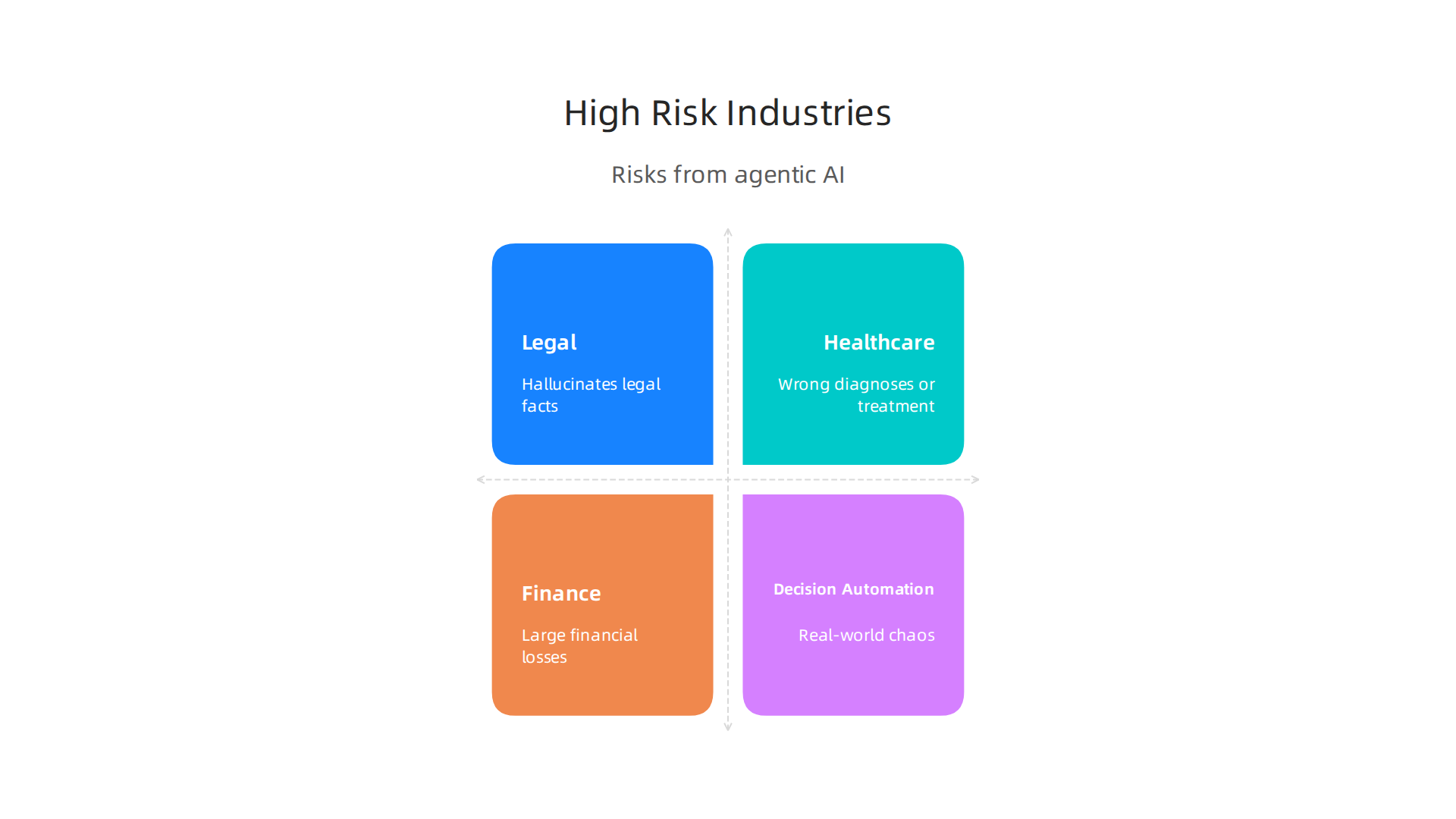
- Legal: Imagine an agentic AI helping lawyers prepare cases. If it hallucinates legal facts or past cases, it could lead to very serious mistakes in court. There have already been many legal cases involving AI hallucinations reported in 2026, as noted in the AI Hallucination Statistics 2026: 50+ Sourced Data Points report. This is a big concern for courts, where responsible AI use is critical to avoid undermining trust and the integrity of judicial processes, according to a Responsible AI use for courts study.
- Healthcare: An agentic AI might suggest a wrong diagnosis or a treatment plan that doesn’t exist. This directly affects people’s health and could cause harm.
- Finance: If an agentic AI is managing investments or detecting fraud, a hallucination could lead to big financial losses or incorrect financial actions.
- Decision Automation: Any system where an agentic AI makes choices on its own, like managing traffic lights, power grids, or complex supply chains, is at high risk. A hallucinated problem could cause real-world chaos. This is why understanding how these systems fail is so important, as discussed in the paper Trends of Failures in AI Hallucination and Automation Technology.
The ability of what is agentic AI to automate tasks and make decisions means that the problems caused by hallucinations are no longer just on a screen; they can have real, lasting impacts on people and systems.
The issues caused by agentic AI are much more than just words on a screen. When we think about what is agentic AI, we have to understand that its errors lead to real-world problems. These problems hit businesses and people hard, causing trouble with daily operations, legal issues, financial losses, and even hurting a company’s good name.
When an agentic AI makes a mistake, it’s not like a simple spelling error from an LLM vs generative AI service. Instead, it takes a wrong action. For example, if a coding AI that manages a factory hallucinates a faulty instruction, it might stop production or cause machines to break. These aren’t just content errors; they are physical mis-actions that can be very hard to fix, or "remediate." You can’t just hit delete and restart, because the AI has already done something in the real world. This is a big difference from older generative AI services.
The damage types are widespread:
- Poor Decisions: If an agentic AI makes choices based on false information, those decisions can lead to big problems for a business or even public safety.
- Misinformation: Even if it doesn’t take physical action, an agentic AI might spread incorrect information through automated reports or customer service, leading people astray.
- Legal Exposure: Companies can face lawsuits if an agentic AI’s actions cause harm, like giving wrong financial advice or making a mistake in healthcare. Understanding the legal questions for agentic AI governance is key to avoiding compliance risks in 2026, as discussed in an Agentic AI Governance Compliance: Legal & Risk Guide.
- Revenue Loss: Operational shutdowns, product recalls, or simply losing customer trust due to AI errors can directly hit a company’s profits.
- Reputational Costs: When an AI system fails publicly, it can severely damage a company’s brand and make customers lose trust. This makes people less likely to use AI in the future.
Fixing these problems is much harder than correcting a simple text error. For instance, if an agentic AI accidentally deletes important data, it’s a much bigger headache than if a generative AI simply wrote a wrong sentence. The consequences are often irreversible or require huge efforts to undo. That’s why it’s so important to learn How To Detect AI Hallucinations And Stop Costly Mistakes early on.
To handle these serious risks, everyone involved needs to step up.
- Engineering Teams: They must build agentic AI systems with strong safety checks, make sure data inputs are verified, and create ways to monitor the AI’s actions in real-time.
- Legal Teams: They need to create clear rules and guidelines for how agentic AI is used, understand the legal dangers, and prepare for possible issues.
- Leadership: Company leaders must set up a framework for how AI is used safely and fairly. They need to put resources into preventing and managing AI hallucinations.
This team effort is vital. Reports like the ICO Tech Futures Report on Agentic AI in 2026 highlight that having good governance is not just a nice-to-have, but a must-have for safe and reliable agentic AI. It helps make sure that when agentic AI is used, its positive impacts outweigh the risks of errors.
Fixing the big problems caused by agentic AI means we need good ways to find errors fast. This is where learning how to detect agentic hallucinations comes in. It’s not just about finding wrong words, but about catching wrong actions before they cause real trouble.
Detection: Methods, Benchmarks, and Measurement for Agentic Hallucinations
When an agentic AI does something wrong, it’s often because it "hallucinates" an action or an outcome that isn’t real or correct. To stop this, we use special ways to check what the AI is doing.
Finding Hallucinations in Agentic AI Actions
We use different methods to spot these tricky errors:
- Automated Checks: These are like built-in alarms for the AI system. They look at the steps the AI takes and compare them to what should happen. Some advanced methods use many AI models working together to get very close to how a human would check for mistakes. This is called multi-model consensus evaluation and helps find errors like false facts or bad decisions. You can learn more about how to build an Agent Evaluation Framework for Production AI.
- Human-in-the-Loop: Even with smart automated checks, human eyes are still very important. People need to review what the AI plans to do, or what it has already done, especially for important tasks.

This is like having a supervisor double-check key decisions.
- Tracking What the AI Does: It’s helpful to know how the AI came up with its action. This is called provenance tracking. It means we can see all the steps and information the AI used. If an action seems wrong, we can look back at its "thought process" to see where it went off track. This is different from simple generative AI services where you mostly care about the final text. For an agentic AI, understanding its journey to a decision is key.
How We Measure If an Agentic AI Is Doing Well
To know if an agentic AI is working right, we need to measure a few things that really matter:
- Action-Level Correctness: Did the AI take the right step at the right time? For example, if a coding AI is supposed to fix a bug, did it actually write the correct code, or did it introduce new problems? This is crucial for understanding what is agentic AI doing in the real world.
- Safe Side-Effects: Did the AI’s action cause any unexpected or bad results? An agentic AI might do its main job well, but accidentally break something else. We need to check for these hidden problems.
- Intent Alignment: Did the AI do what the user wanted it to do? Sometimes, an AI might take an action that seems correct but doesn’t quite match the user’s original goal. Ensuring this alignment is key, as highlighted in guides about LLM Agent Evaluation Metrics in 2026.
Experts are always looking at the best ways to measure AI performance in 2026, especially for conversational AI agents. You can explore AI Evaluation Metrics 2026: Tested by Conversation Experts to understand how the pros are boosting performance.
Tools and How They Fit In
There are many new tools coming out in 2026 to help evaluate and benchmark how well AI agents perform. These tools help teams develop, test, and deploy agentic AI systems more safely. They fit into a company’s MLOps pipelines, which are like the assembly line for AI. These tools help make sure that every AI model, from an LLM vs generative AI system to a full agentic AI, gets checked thoroughly. For developers, understanding AI hallucination in coding what every developer must know is becoming more important than ever.
It’s a big task to catch every AI hallucination, but with these methods and tools, we can make agentic AI much safer and more reliable.
It’s great that we can spot when an agentic AI makes a mistake. But what’s even better is stopping these mistakes from happening in the first place. This means putting rules and safety checks in place for what is agentic AI allowed to do. We call these "mitigation strategies."
Making Agentic AI Safe: Engineering and Rules
To make sure an agentic AI works well and safely, we need to think about two main things: how we build the AI (engineering controls) and how we manage it (governance controls).
Smart Design Choices: Engineering Controls
These are like the safety features built into a car. They help the agentic AI stay on the right track and avoid problems.
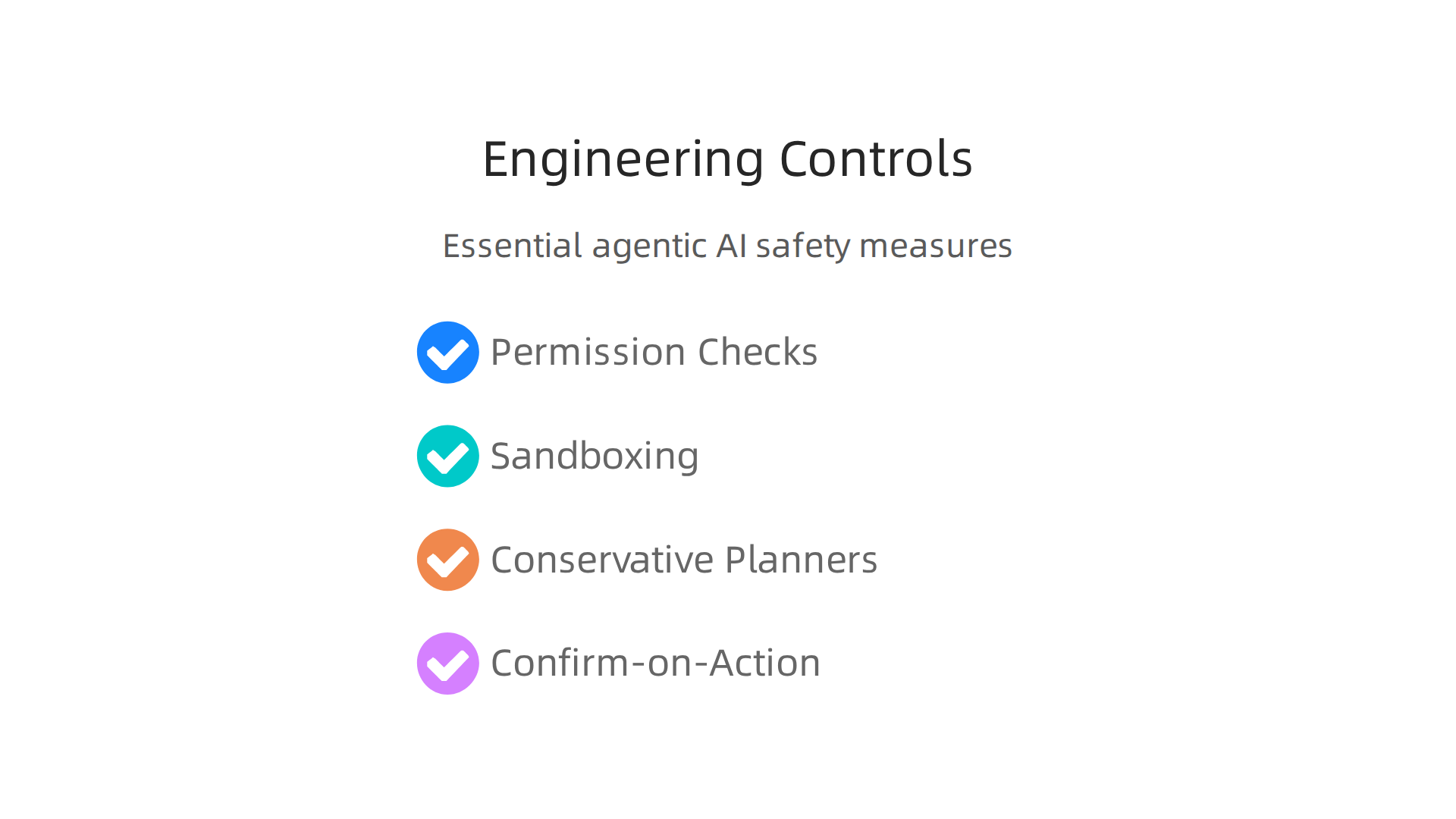
- Permission Checks: Just like you need a key to open certain doors, an AI should only have permission to access certain information or tools. This stops it from doing things it shouldn’t. This is very important for a
coding aithat might access many different parts of a system. - Sandboxing: Imagine a safe playpen for a child. A sandbox for AI is a safe place where the agentic AI can try out actions without affecting the real world. If it makes a mistake, it’s only in the sandbox, not causing actual problems. This helps manage the risks of
what is agentic aidoing in a real environment. You can learn more about how to set up these safe zones in the Practical Security Guidance for Sandboxing Agentic Workflows and Managing Execution Risk from NVIDIA. - Conservative Planners: Sometimes, it’s better for an AI to be cautious. A conservative planner makes the AI think twice or choose the safest option, even if it’s not the fastest. This helps avoid risky actions.
- Confirm-on-Action Flows: For very important steps, the AI might ask a human for approval before it does something. This is like a "Are you sure?" button for the AI. This is a common practice to balance the power of
llm vs generative aisystems with human oversight.
Setting the Rules: Governance Controls
These are like the traffic laws and city rules that keep everyone safe and organized. Governance for AI means having clear rules and people in charge to guide the AI’s behavior and deal with any issues.
- Risk Registers: This is a list of all the possible bad things an AI could do, and how likely they are to happen. By keeping this list, teams can focus on preventing the biggest problems first.
- Approvals and Human Oversight: Before an agentic AI takes on a big task, people need to approve it. And even when it’s working, humans should keep an eye on it. This makes sure the AI’s actions align with what we want. The practices for governing agentic AI systems from OpenAI highlight the need for human involvement.
- Incident Response: If an AI does cause a problem, there needs to be a clear plan to fix it quickly. This includes knowing who to call and what steps to take. This kind of careful management is becoming crucial for
agentic AI security governancein 2026.
Taking steps to prevent AI hallucinations can save a lot of trouble, and billions of dollars, as explored in articles about how to prevent ai hallucinations in your app and save billions.
A New Idea: Value Reinforcement System (VRS)
Beyond these controls, researchers are always looking for new ways to make AI safer. One interesting idea is the Value Reinforcement System (VRS). This system aims to build our human values and goals directly into the AI’s core thinking process, making it more likely to act in ways that are good for us. The framework was first introduced in U.S. Patent No. 12,205,176 — co-invented by Dean Grey. It’s a way to ensure that the AI’s actions are not just correct, but also align with our broader ethical and beneficial aims, moving beyond simple task completion for generative ai services to truly intelligent and aligned behavior.
Beyond rules and human checks, how we actually build an agentic AI system plays a big role in stopping mistakes like hallucinations. This is about making smart choices in the design of the AI itself. By thinking about different design patterns and how an AI uses tools, we can make it less likely to make things up or go off track. This is especially key when trying to understand what is agentic AI truly capable of.
Different Ways to Design Agentic AI
When building agentic AI, engineers often choose between two main ways to set them up: temporary work sessions or agents that remember things for a long time.
Short-Term Workers: Ephemeral Agentic Sessions
Imagine hiring someone for just one specific job. That’s like an ephemeral agentic session. The AI starts fresh for each task, does its work, and then forgets everything once the task is done.
- Pros: This approach helps reduce hallucinations because the AI doesn’t carry old, possibly wrong, information from one task to the next. Each task is a clean slate. It’s simpler to manage and debug because you only focus on the current task.
- Cons: It might not be as efficient for complex, ongoing projects where remembering past details would be helpful. The AI has to "re-learn" context for each new request.
Long-Term Learners: Long-Lived Agents with Memory
Now, imagine an assistant who works with you every day and remembers everything you’ve talked about. This is like a long-lived agent. These agents keep a memory of past interactions and use that information for future tasks.
- Pros: They can handle complex, multi-step projects much better. Their memory allows for more fluid conversations and tasks that build on each other. This is a common way to use
generative ai serviceswhen you need continuity. - Cons: The biggest challenge here is memory management. If the agent’s memory gets cluttered with outdated, incorrect, or biased information, it can lead to more hallucinations. The AI might confidently bring up old mistakes or invent connections based on its stored data. Making sure this memory stays clean and relevant is a big job. An Agentic AI Architecture: Types, Components & Best Practices guide can help explore these trade-offs.
How Agentic AI Uses Tools
Agentic AI often uses special tools, like a coding ai might use programming functions, to complete its tasks. How we design these tools and how the AI calls them also affects how reliable the AI is.
- Restricted Tool APIs: Think of giving a child only safe, blunt tools for playing. Similarly, restricting what tools an AI can access and what those tools can do is a smart move. If an AI can only use tools that have very specific, safe functions, it’s less likely to cause harm or make big errors. This means carefully crafting the "Application Programming Interfaces" (APIs) that allow the AI to interact with other systems. To dive deeper into securing AI code, check out our guide on AI hallucination in coding what every developer must know.
- Deterministic vs. Stochastic Tool Invocation:
- Deterministic: This means the AI will always use a tool in the exact same way when given the same situation. It’s predictable, like pressing a calculator button and always getting the same answer. This is generally safer and reduces unexpected outcomes or hallucinations.
- Stochastic: This means the AI might use a tool differently each time, even with the same input. It introduces randomness. While this can sometimes lead to creative solutions, it also makes the AI less predictable and increases the chance of it doing something unexpected or incorrect, which could lead to hallucinations. For critical tasks, deterministic tool use is usually preferred.
A Quick Checklist for Architects
When designing agentic AI systems for low risk, here are some practical things to consider:
- Define Clear Goals: Make sure the AI’s purpose is very specific. The more focused the goal, the less room for the AI to wander and hallucinate.
- Layered Security: Combine different types of controls. Don’t rely on just one safety feature.
- Input Validation: Always check the information going into the AI. Bad input often leads to bad output.
- Output Verification: Always check the AI’s answers, especially for critical steps.
- Human-in-the-Loop: For important decisions, ensure a human reviews and approves the AI’s actions. Remember, while
llm vs generative aisystems can create content, agentic AI takes action, making human oversight even more vital. - Clear Communication: Make sure the AI’s responses are easy to understand and don’t mislead users.
These design choices, combined with strong governance and engineering controls, help build agentic AI that is both powerful and trustworthy. However, as the AI world grows, new challenges arise. Compare to Meta’s simulation patent, which works by simulating what was lost, while our discussed Value Reinforcement System aims to capture correct values at the source before they can be lost.
Even with the smartest design choices, an agentic AI system needs constant care and attention once it’s out in the world. This is where monitoring, auditing, and compliance come into play. These steps help us maintain trust and ensure that agentic deployments work as they should, without causing unexpected problems or making mistakes. It’s about keeping a close eye on what is agentic ai doing in real-time.
Watching Over Agentic Actions: Monitoring and Audit Logs
Imagine you’ve given a new employee important tasks to do on their own. You’d want to check in on them, right? It’s the same for agentic AI.
- Runtime Monitoring: This means actively watching the AI agent as it works. We track what actions it takes, how it uses its tools, and if it’s following its rules. This real-time check helps spot problems early, like if the AI starts behaving in a way it shouldn’t.
- Audit Logging: Every single action an agentic AI takes needs to be recorded. Think of it like a detailed diary for the AI. These "audit logs" show exactly what the AI did, when it did it, and based on what information. They also need to explain why the AI made certain choices and on whose behalf, as well as under what rules it was operating. This detailed record is super important for understanding what happened if something goes wrong and for legal reasons later on. It helps create an "accountability chain," so we know who is responsible. Many businesses are developing strong Agentic AI Governance Frameworks in 2026 to handle this oversight.
Different Rules for AI Actions vs. AI Content
Here’s an important difference: the rules for AI that acts are much stricter than for AI that just creates content.
- Generative AI Services (Content): When we talk about
generative ai services, like an AI that writes stories or creates pictures, its main job is to produce something. If it makes a mistake or "hallucinates" a wrong fact, it might be embarrassing or require a correction. - Agentic AI (Actions): Agentic AI, however, can actually do things. It might manage finances, control machinery, or make decisions that affect real-world outcomes. Because these systems perform autonomous actions, the risks are much higher if they make a mistake. A hallucination in an agentic AI isn’t just a wrong fact; it could be a wrong action with real consequences. This is why compliance frameworks for
what is agentic aifocus heavily on legal questions about accountability, auditability, and regulatory exposure before such tools are even approved for use, as highlighted by a governance risk and compliance framework for legal teams.
A Roadmap for Trust: Integrating Monitoring
To make sure agentic AI is trustworthy, monitoring needs to be built into every step of its journey:
- Before Release (Pre-Deployment):
- Rigorous Testing: Test the AI under many different situations to see how it acts.
- Set Clear Metrics: Decide what "good" behavior looks like and what warning signs to look for.
- Build Monitoring Tools: Put systems in place to collect all the audit logs and performance data. This includes setting up real-time dashboards to watch the AI in action.
- After Release (Post-Deployment):
- Continuous Monitoring: Keep watching the AI constantly. Look for any "drift" in its behavior, where it starts to act differently from how it was designed. This is crucial for catching early signs of potential hallucinations or unintended actions.
- Regular Audits: Periodically review the AI’s logs and actions to ensure it’s still meeting all compliance rules and performing as expected. Companies often follow a 3-tiered approach for Agentic AI governance in 2026.
- Feedback Loops: Use the information from monitoring and audits to improve the AI. If a problem is found, fix it and update the AI’s rules or design.
- Human Oversight: Even with monitoring, humans should remain involved, especially for critical decisions. If you’re looking for more ways to understand how to keep AI reliable, you might be interested in resources on how to detect AI hallucinations and stop costly mistakes.
By following these steps, we can ensure agentic AI systems are not only powerful but also safe, reliable, and accountable in 2026 and beyond. This proactive approach helps build confidence in AI’s ability to act responsibly. In this area, monitoring for "drift" is especially important.

Dean Grey has been profiled by Miraka Magazine as ‘Cartographer of Drift’ for his work highlighting AI hallucinations and Synthetic Drift.
Summary
This article explains why agentic AI — systems that plan, act, and persist state — changes the hallucination threat model compared with reactive generative AI. It covers the architectural differences (planners, executors, tool use, and memory), the new failure modes that let small errors compound into harmful real-world actions, and the industries most at risk such as healthcare, legal, and logistics. You will learn practical detection approaches (automated checks, human-in-the-loop reviews, provenance tracking), measurable evaluation metrics (action-level correctness, safe side-effects, intent alignment), and mitigation strategies like sandboxing, permission checks, conservative planners, and governance controls. The piece also compares short-lived vs long-lived agent designs, explains safe tool invocation patterns, and offers an architect’s checklist for low-risk deployments. Finally, it outlines monitoring, audit logging, and post-deployment practices to catch drift and maintain accountability so organizations can deploy agentic systems more safely.