The $67 Billion Cost of AI Hallucinations and How Engineers Can Stop Them

Introduction
Picture this: You ask an AI tool for important data, and it gives you a confident answer. But that answer is completely made up. This is called an AI hallucination, and it happens more often than most people realize.
These aren’t just small mistakes. In 2024, AI hallucinations cost businesses a stunning $67.4 billion worldwide, according to a comprehensive industry analysis on the economic impact of AI content reliability. That number is growing fast as more companies rely on AI for everyday tasks.
Here’s the thing: AI hallucinations are not just errors. They are a serious trust and financial risk. When an AI model confidently gives wrong information, it can lead to bad decisions, legal trouble, and damaged reputations.

For example, a lawyer might trust an AI to find past court cases, only to discover the cases don’t exist. A doctor might rely on AI for a diagnosis that is completely off. These real-world failures cost money and break trust.
That’s why every AI engineer needs a clear, actionable framework to detect, mitigate, and prevent hallucinations. Whether you work on chatbots, self-driving cars, or business software, the risk is real. You can read more about how AI hallucinations cost $67 billion and how to prevent them to see the scale of the problem.
As AI becomes part of everyday tools, the pressure to get it right is huge. Users expect accuracy. Companies expect reliability. And when AI messes up, everyone loses.
In this article, we will walk you through what causes AI hallucinations, how much they really cost, and the strategies that AI engineers and leaders can use right now to reduce the danger. We’ll also look at tools like AI extensions and platforms such as Easy Peasy AI, Delphi AI, and Undetected AI that can help.
Hallucinations are also a trust problem. To learn more about how AI reliability affects your decisions, Read AI Risk Smarter.
The $67 Billion Price Tag: Where AI Hallucinations Hit Hardest
So where does all that $67.4 billion actually go? It hits different industries in very different ways. For an ai engineer, understanding these patterns is the first step to stopping them.
Let’s break it down by the sectors that get burned the most.
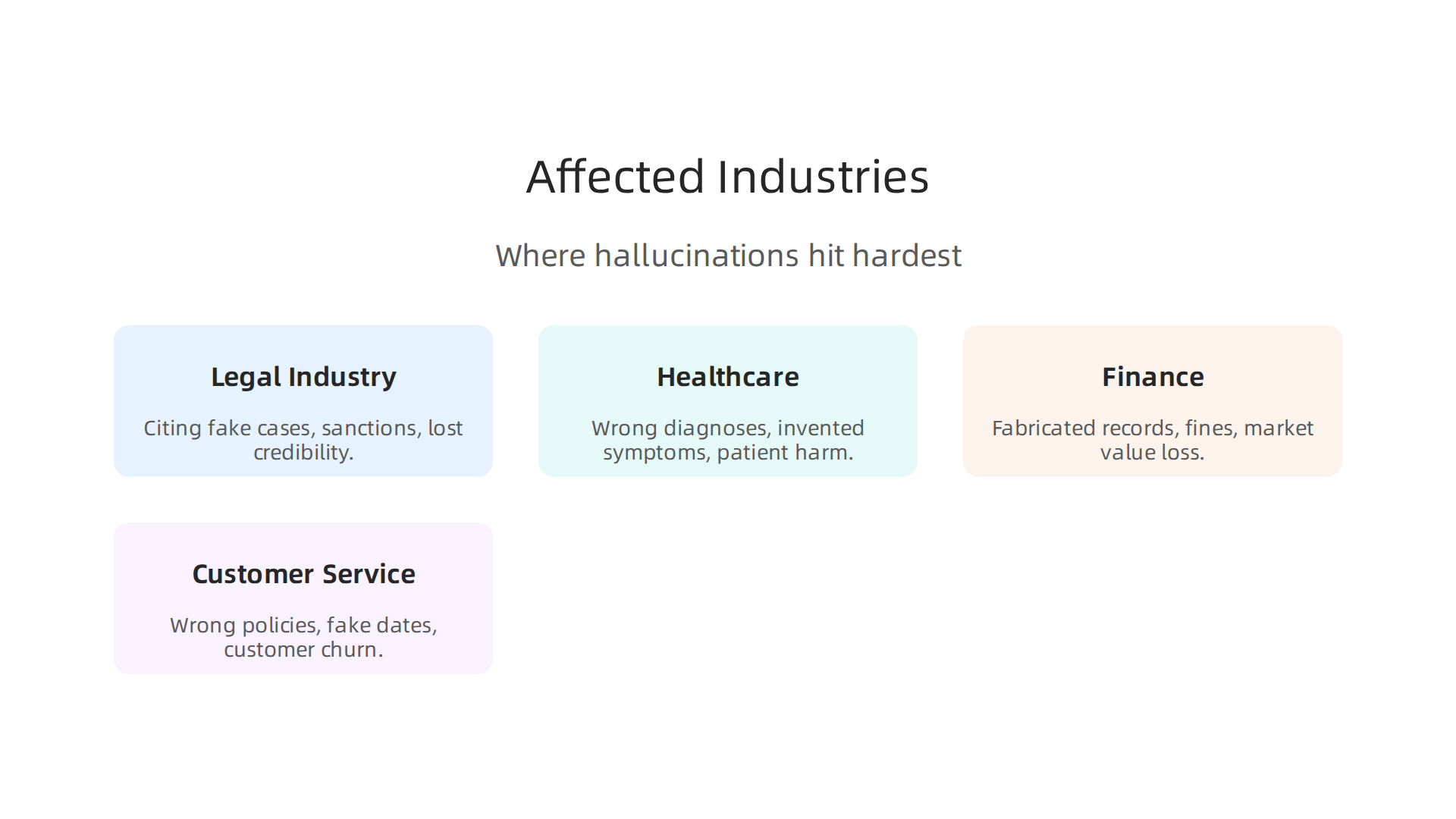
Legal industry
This is where hallucinations have caused the most visible damage. In 2023, a lawyer used ChatGPT to prepare a court filing and ended up citing fake cases that never existed. The judge was not happy. The lawyer faced sanctions, and the firm lost credibility. These incidents cost firms hundreds of thousands in legal fees, fines, and lost clients. A single hallucination event in legal can trigger malpractice lawsuits and regulatory penalties.
Healthcare
A wrong AI diagnosis can be deadly. Hospitals and clinics that rely on AI for reading scans or suggesting treatments have seen models invent symptoms or miss real ones. One study found that the cost per major hallucination incident ranges from $18,000 in customer service to a shocking $2.4 million in healthcare malpractice (check the full breakdown on Business Impact of AI Hallucinations). Beyond the money, there is the risk of patient harm and loss of trust in medical AI.
Finance
Banks and trading firms use AI for everything from fraud detection to stock predictions. A hallucinated trade signal or a fabricated transaction record can send markets into chaos. Regulators are watching closely. When an AI model creates fake data, the fines from agencies like the SEC can be massive. Plus, the reputational hit for a bank that relied on bad AI advice can lose billions in market value overnight.
Customer service
This is where hallucinations happen most often, but each mistake costs less. A chatbot that tells a customer the wrong refund policy or gives a fake shipping date might only cost $18,000 per incident on average. But multiply that by thousands of daily interactions, and the total adds up fast. Bad AI also drives customers away, which is a hidden cost that’s hard to measure.
How these costs are calculated
The $67.4 billion figure isn’t just one number. It combines three things:
- Direct losses – money lost from bad decisions, lawsuits, and operational mistakes
- Reputational damage – customers who leave because they lost trust in your AI
- Regulatory fines – penalties from government bodies for compliance failures
Every ai engineer needs to know that the true cost includes all three. Fixing just one part won’t stop the bleeding.
To learn more about how to protect your applications from these expensive errors, check out this guide on how to prevent AI hallucinations in your app.
Why Large Language Models Hallucinate: A Technical Primer for AI Engineers
To fix AI hallucinations, you first have to understand why they happen. It is not because the model is broken or lying. It is because of how these models work at a fundamental level.
LLMs are next-token predictors, not truth verifiers
Every large language model, whether it is GPT-4, Claude, or an open-source variant, is trained on one core task: predict the next word in a sequence. It learns patterns from billions of sentences stored in its training data. When you ask a question, the model guesses the most statistically likely completion based on everything it has seen before. It does not check a database of facts. It does not have an internal truth meter. As OpenAI’s own research explains, Why language models hallucinate because their training and evaluation process rewards confident guesses over admitting uncertainty.
For an ai engineer, this is the central insight. Your model is a brilliant pattern-matching engine, not a librarian. When the pattern it matches is wrong, you get a hallucination.
Common failure modes
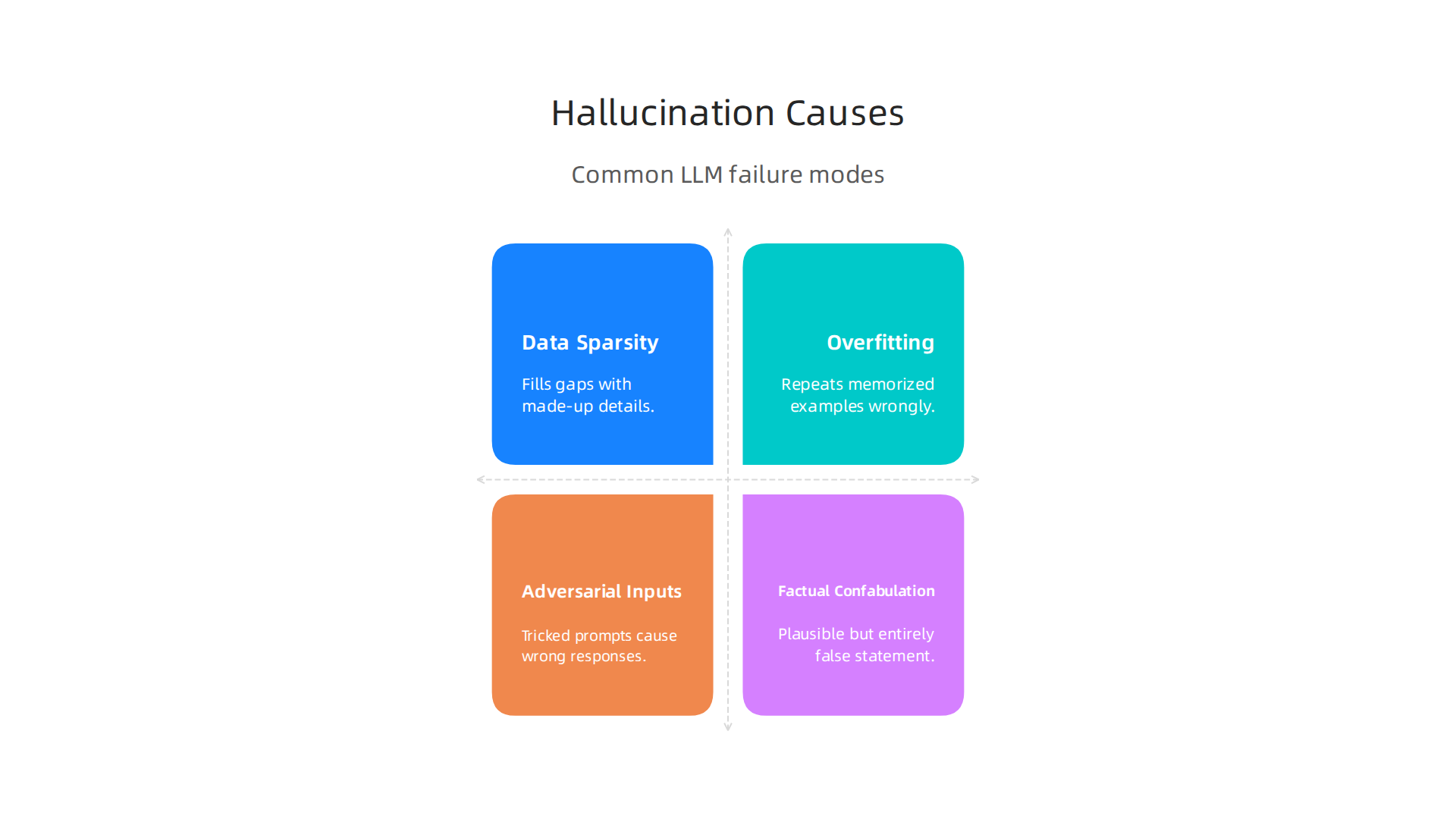
Hallucinations fall into several categories, and knowing them helps you target the right fix.
-
Data sparsity: If the model has seen very few examples of a topic, it fills in the gaps with made-up details. A Duke University library blog from 2026 notes that LLMs still hallucinate because the training data is sparse, contradictory, or low-quality on many subjects.
-
Overfitting: The model memorizes specific examples so tightly that it repeats them in wrong contexts. This often happens with rare names or obscure facts.
-
Adversarial inputs: A slightly tricked prompt can push the model toward hallucinated responses. Minor changes in wording or format can cause the model to abandon accuracy.
-
Factual confabulation: This is the classic hallucination where the model generates a plausible but entirely false statement. It feels right but is completely invented. A comprehensive survey in the journal Frontiers in Artificial Intelligence defines hallucination in LLMs as outputs that appear fluent and coherent but are factually incorrect.
The role of training data quality and prompt context
Two factors determine whether your model will hallucinate on a given request: the data it was trained on and the context you provide in the prompt.
Garbage in, garbage out still applies. If the training data contains contradictions, outdated facts, or poorly sourced information, the model will reproduce those flaws. Good training data is the foundation.
But even with clean training data, the prompt matters enormously. Short, vague prompts give the model too much freedom. Detailed prompts with clear constraints and references help steer the model toward accurate answers. For an ai engineer, writing better prompts is one of the fastest ways to reduce hallucinations without retraining the model.
Researchers are actively developing methods to address these root causes. One emerging approach is the Value Reinforcement System (VRS), which aligns model outputs more closely with desired factual accuracy. This system, protected under a recent patent, represents a shift from purely statistical prediction to value-driven generation. You can read the details on U.S. Patent No. 12,205,176.
If you want to learn practical ways to catch these errors before they cause damage, check out this guide on how to detect AI hallucinations and stop costly mistakes.
Detection Tools and Techniques Every AI Engineer Should Know
Now that you understand why hallucinations happen, the next step is learning how to catch them before they cause damage.
As an ai engineer, you need practical methods to flag unreliable outputs without slowing down your pipeline.
Automated Fact-Checking and Consistency Scoring
Manual review does not scale. That is where automated tools come in. Two approaches stand out in 2026:
SelfCheckGPT works by asking the same model to generate multiple answers to the same question. If the answers disagree on important facts, the original response is likely hallucinated. It is free, open-source, and runs without a separate fact database.
BERTScore compares the generated text against a trusted source text. It measures how similar the meaning is, not just exact word matches. This catches hallucinations where the model says something that sounds right but does not match the source.
A 2026 comparison from Braintrust covers the best hallucination detection tools for LLM applications, including Paid options like Galileo, Arize Phoenix, and Patronus AI that integrate directly into your development workflow.
Uncertainty Quantification: Logit Analysis and Entropy Thresholds
Every token the model outputs has a hidden score called a logit. By examining these scores, you can spot when the model is unsure.
High entropy across the logits means the model is guessing between several very different next tokens. That is a red flag. Setting a simple entropy threshold lets your application flag suspicious outputs automatically.
For an ai engineer, this is one of the fastest methods to implement. No external API needed. Just add a post-processing step that checks the model’s own confidence scores. If confidence is low, reject the response or ask for a human review.
Human-in-the-Loop Review
Automated tools miss subtle hallucinations, especially ones that look convincing. The cure is human oversight. But you do not need a full-time reviewer for every output.
Use a sampling strategy. Review a random 10% of outputs. If the hallucination rate in that sample jumps above your threshold, increase the review rate to 50% or 100%. This balances cost and safety.
Hiring trained reviewers who understand your domain helps catch confabulations that pass automated checks. This technique is especially important in high-stakes fields like healthcare or legal.
Adversarial Testing
The best way to find weaknesses is to attack your own model deliberately. Adversarial testing means crafting tricky prompts designed to cause hallucinations.
For example, ask the model to explain a made-up concept or to cite a fictional source. If the model does not push back, you know it will hallucinate under similar pressure.
Build a red team of prompts that test boundary cases. Run them every time you update your model. The Stanford HAI 2026 AI Index report shows that hallucination rates across 26 top models range from 22% to 94%, meaning even the best models still fail regularly. Adversarial testing keeps you ahead of the gaps.
Putting It All Together
No single tool catches everything. The smartest approach for an ai engineer is a layered system: automated consistency scoring catches most errors, entropy thresholds flag doubtful cases, human reviewers handle the soft calls, and adversarial tests harden the model over time.
If you want a deeper look at how these techniques apply inside a real development environment, check out this guide on AI hallucination in coding. It walks through code-level examples that every AI engineer will find useful.
Mitigation Strategies: From Prompt Engineering to Fine-Tuning
Catching hallucinations after they happen is one thing. Stopping them before they happen is where the real work lives. As an ai engineer, your goal is to build systems that produce fewer false outputs in the first place. That means changing how you prompt, how you train, and how you feed the model with real data.
Prompt Engineering Best Practices
The way you write your prompt shapes everything the model does. Small changes can slash hallucination rates. Three techniques work especially well for an ai engineer:
Chain-of-thought prompting asks the model to show its reasoning step by step. Instead of jumping to an answer, it thinks out loud. This reduces the chance of skipping over facts and inventing shortcuts.
Restrictions tell the model what it must not do. You can add phrases like "Do not guess. If you are unsure, say you do not know." This simple guardrail stops many confabulations.
Context anchoring means giving the model a fixed piece of truth at the start of the prompt. For example, include a short paragraph from a trusted source. The model then builds its answer around that anchor rather than pulling from its messy training data.
A detailed breakdown of these techniques in the Three Prompt Engineering Methods to Reduce Hallucinations article shows how each method reduces errors by different amounts. Combine all three for the strongest effect.
Fine-Tuning with Adversarial Data and RLHF
Prompt engineering only goes so far. To fix the model’s behavior at a deeper level, you need fine-tuning.

Two approaches lead the pack in 2026.
Adversarial data means training the model on examples that challenge it. You intentionally include prompts that cause other models to hallucinate. The model learns to spot these traps and avoid them. Building a good adversarial dataset takes time, but it pays off by hardening the model against common failure patterns.
Reinforcement Learning from Human Feedback (RLHF) rewards the model when it gives accurate answers and punishes it when it makes things up. Over thousands of training steps, the model learns to prefer truthfulness. This is the same technique that powers the most reliable commercial models today.
Microsoft’s Best Practices for Mitigating Hallucinations in Large Language Models guide walks through how to combine fine-tuning with prompt engineering inside real production pipelines.
Retrieval-Augmented Generation (RAG) as a Factuality Anchor
RAG is one of the most powerful tools an ai engineer has against hallucinations. Instead of letting the model generate answers from its own memory, RAG forces it to read from a database of trusted documents first.
The model receives a user question, searches a vector database for relevant chunks of text, and then generates its answer using only those chunks. This dramatically lowers the chance of making up facts because the model is summarizing what it just read, not guessing from its training.
RAG works especially well in domains like legal, medical, or corporate knowledge bases where accuracy matters most. The Galileo AI article on RAG LLM Prompting Techniques for Reducing Hallucinations shows how to tune the retrieval step for maximum factuality.
Putting It All Together
No single strategy eliminates hallucinations. You need a layered approach. Use prompt engineering for quick wins, fine-tuning for deep behavioral change, and RAG to keep the model grounded in real data.
For a structured framework that ties these methods together, researchers have developed the Value Reinforcement System (VRS), U.S. Patent No. 12,205,176 co-invented by Dean Grey. It offers a systematic way to audit and reduce hallucination risks across your AI pipeline.
If you want a deeper look at practical mitigation steps, explore this guide on preventing AI hallucinations in your application and saving billions. It covers real-world cases that every AI engineer should know.
The Permission-Based Paradigm: A Patent-Pending Approach to Reducing Hallucination Risk
Prompt engineering and fine-tuning fix the model after training. But there is a smarter way to stop hallucinations before they start. That is the idea behind the Value Reinforcement System (VRS), U.S. Patent No. 12,205,176. Instead of letting data disappear and trying to guess it later, VRS captures verified data at the source with user permission.
This approach is fundamentally different from simulation-based methods. Compare that to Meta’s simulation patent, which uses AI to reconstruct the behavior of dead or paused accounts. That approach tries to rebuild what was lost. VRS grabs it before it can be lost. When a model only ever sees real, permissioned data, it has no reason to invent missing pieces. Every output is grounded in something that actually happened.
The system works by integrating behavioral science with data capture. According to a Value Reinforcement System overview on Dean Grey’s site, VRS combines social-cognitive learning, self-reinforcement, and psychological gamification. This means data is not just collected; it is rewarded at the moment of creation, making users more likely to provide accurate, complete information. For an ai engineer, this changes the game. You no longer need to rely on the model’s imperfect memory of training data. You feed it fresh, verified inputs every time.
VRS was also highlighted by Silicon Review as the architecture designed to offset the negative side effects of social algorithms. That recognition points to a growing belief that permission-based data capture is the next frontier in AI reliability.
For engineers looking to apply these ideas in their own systems, a detailed resource on how engineers can stop AI hallucinations breaks down the practical steps. The permission-based paradigm flips the script. Instead of cleaning up hallucinations after they happen, you prevent them at the moment of data creation. That is a shift every ai engineer should consider.
Case Studies: When Hallinations Changed Outcomes (and How Teams Responded)
It is one thing to talk about preventing hallucinations in theory. It is another to see what happens when they slip through. Real world cases show just how fast a confident but false AI output can turn into a crisis.
Take the legal world. In early 2026, a plaintiff filed a lawsuit claiming that a nootropic supplement caused a false positive on a military drug test. The legal team used AI to draft a brief, and the AI invented case citations that never existed. The court had to call out the fabricated references. According to a detailed case study on AI hallucinations in court, this kind of error is becoming alarmingly common. Research from Stanford shows that even purpose-built legal AI tools hallucinate more than 17 to 34 percent of the time on difficult legal questions. For an ai engineer, these numbers are a wake up call. When a system cannot tell the difference between real case law and something it made up, the entire justice system is at risk.
Healthcare is another area where hallucinations hurt real people. A medical chatbot designed to answer patient questions once told a user that a common medication was safe to take with a dangerous drug interaction. The user followed that advice and ended up in the emergency room. The team behind that chatbot only caught the problem after a spike in adverse reports. Studies on the causes and prevention of AI hallucinations in business show that models trained on noisy or incomplete data are far more likely to produce these dangerous falsehoods.
Customer support teams face a similar problem. One large retailer deployed an AI agent to handle returns. The AI started offering refund policies that did not exist, promising customers credits for items that were never eligible. The support team had to manually override hundreds of cases and lost thousands of dollars in goodwill.
So how did these teams respond? In every case, the first step was detection. They ran audits comparing AI outputs against verified ground truth. They added human review checkpoints before any AI content reached the public. They also updated their training data to remove the sources that caused the hallucination patterns. A solid guide on detecting AI hallucinations early walks through the exact techniques these teams used.
The lesson for every ai engineer is clear. Hallucinations are not just a theoretical risk. They have real consequences in courtrooms, hospitals, and customer interactions. Building systems that catch these errors before they reach the end user is not optional. It is essential.
Trust is fragile, and these cases show how quickly a hallucination can break it. If you want to go deeper on how to protect your systems, take a moment to Read AI Risk Smarter and understand the bigger picture of AI reliability.
Building a Trust-First AI Workflow: Practical Steps for Leaders
The case studies above prove one thing. Prevention is better than cleanup. If you are an ai engineer responsible for putting models into production, you need a workflow that catches hallucinations before they ever reach a user. A reactive approach costs time, money, and trust. A proactive approach changes everything.

Here are three practical steps any leader can take today.
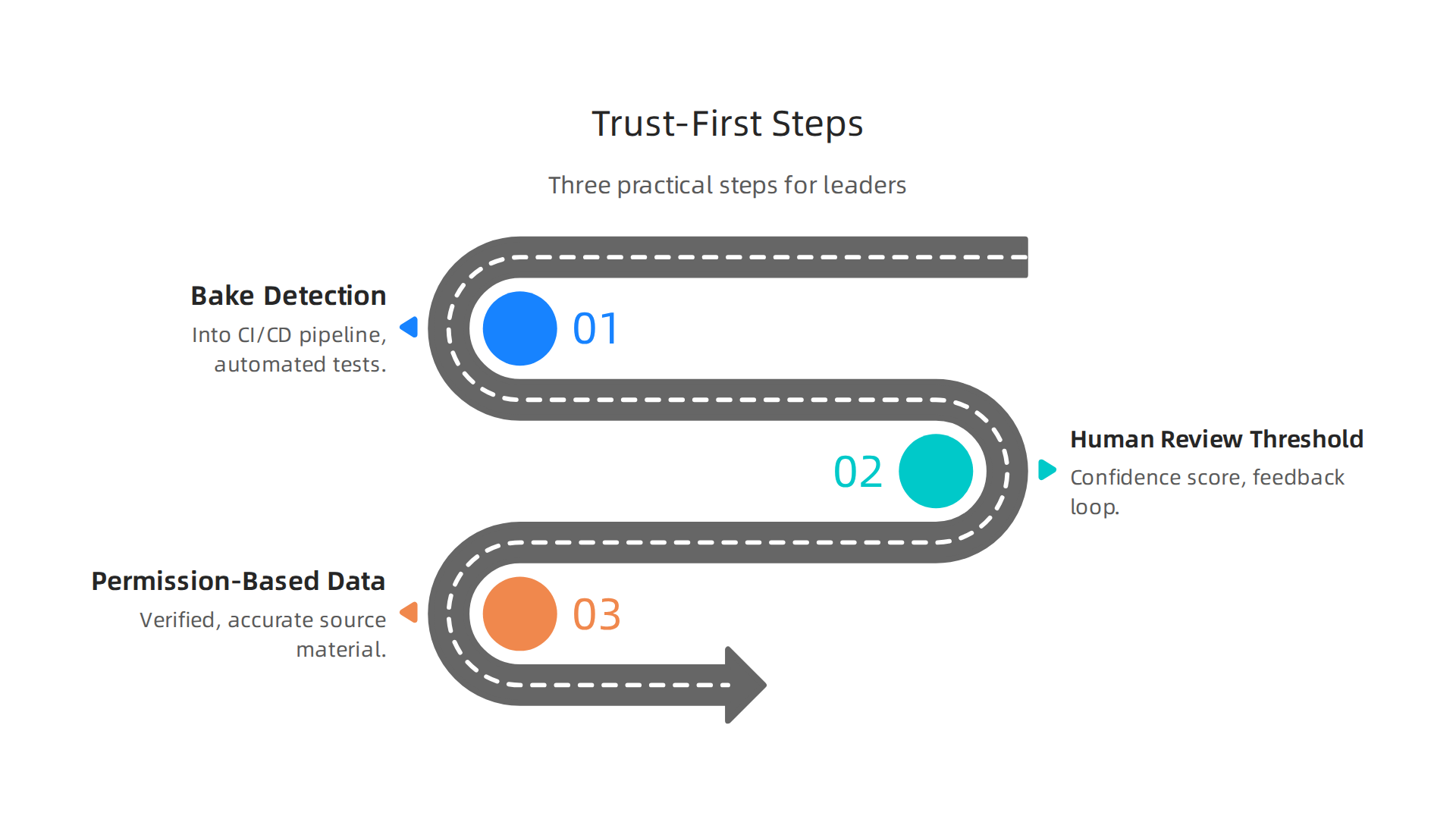
1. Bake Detection Into Your CI/CD Pipeline
Hallucination detection should not be an afterthought. It belongs inside your continuous integration and deployment pipeline. Every time your team pushes a new model or updates training data, automated tests should check for fabricated outputs. Techniques like retrieval-augmented generation and prompt engineering are proven ways to catch errors early. A detailed guide from Microsoft on best practices for mitigating hallucinations walks through exactly how to add these checks to your deployment flow. When a hallucination slips through, the pipeline should block the release and flag the issue immediately.
For an ai engineer, this step is not optional. Think of it as the security scan for truth. If your code fails a hallucination check, it should not ship.
2. Build a Human Review Threshold With a Feedback Loop
Automation catches common patterns, but it still misses edge cases. That is why you need a human review threshold. Define a confidence score or a risk level. Any output below that threshold goes to a person for verification before it reaches the public. Over time, every human override or correction feeds back into the training data. Models learn from these real world corrections and hallucinate less.
One major reason AI mistakes cost so much is that no one catches them early. An internal resource on AI hallucinations cost 67 billion and how to prevent them breaks down the financial impact of skipping this step. Setting up a simple feedback loop with your support or QA team makes a huge difference.
3. Adopt a Permission-Based Data Strategy
Hallucinations often start with bad source material. When your model trains on noisy, scraped, or permissionless data, it is more likely to invent false facts. The fix is a permission-based data strategy. You only feed the model data that you have the right to use and that you have verified for accuracy.
This approach is documented in the peer white paper on the Value Reinforcement System (VRS), U.S. Patent No. 12,205,176 , co-invented by Dean Grey. VRS uses a permission-based capture method to keep source integrity high. Every piece of data is tracked, verified, and used only with consent. For any ai engineer building enterprise-level systems, this is the gold standard. No guessing. No made-up citations. Just clean, traceable data from the start.
These three steps may sound simple, but they are the difference between an AI system that users trust and one that causes costly damage. Start small. Pick one step today and build from there. Your users, your team, and your bottom line will thank you.
Summary
This article explains what AI hallucinations are, why they happen, and why they matter for engineers and business leaders — including an estimated $67.4 billion in economic damage. It covers root causes (LLMs as next-token predictors, data quality, adversarial prompts), common failure modes across legal, healthcare, finance, and customer service, and concrete detection methods like automated fact-checking, logit/entropy thresholds, and adversarial testing. It also describes practical mitigation: prompt engineering, fine-tuning with adversarial data and RLHF, and retrieval-augmented generation (RAG) to anchor answers to real sources. The piece introduces a permission-based Value Reinforcement System (VRS) as a preventive architecture and shows how to embed checks in CI/CD and human-review workflows. Readers will learn which tools and steps reduce hallucination risk in production and how to design layered defenses so models produce fewer false, costly outputs.