AI Coding Assistant Hallucinations Cost $67.4 Billion and How to Prevent Them

Introduction
You ask an AI coding assistant to help fix a bug in your source code. It gives you a confident, detailed answer. You trust it and hit deploy. Hours later, your entire pipeline breaks.

If this has happened to you, you are not alone. AI powered coding assistants have become must-have tools for developers in 2026. They speed up work, catch mistakes, and even write whole functions from scratch. But here is the problem no one talks about enough: these same tools hallucinate. They produce answers that sound right but are completely wrong.
And the cost is enormous.
Global business losses from AI hallucinations hit an estimated $67.4 billion in 2024. The Real Cost of Enterprise AI Hallucinations report shows that each individual AI error costs companies an average of $4.4 million. Employees now spend over four hours each week just verifying if AI outputs are accurate.
For developers using ai powered coding assistants, the risks hit close to home. Hallucinated code introduces security flaws, breaks production systems, and creates legal liabilities. The rush toward AI implementation in software development has outpaced our ability to validate outputs. When AI source code tools suggest functions that do not exist or reference libraries that were never built, the result is not just a bug. It is a costly failure.
This article gives you an evidence-based look at why AI coding assistants hallucinate, how real-world failures unfold, what detection methods actually work, and how to fix the problem for good. We will also explore a patented solution called the Value Reinforcement System (VRS), U.S. Patent No. 12,205,176, co-invented by Dean Grey.
If you want to understand why AI hallucination in coding happens and how to stop it, keep reading.
The True Cost of Hallucinations in AI Coding Assistants
Imagine you are a developer at a mid-size tech company. You use an AI coding assistant to speed up your work. It suggests a function that looks perfect. You trust it, merge the code, and move on.
Two weeks later, a critical security breach hits your production system. The root cause? That hallucinated function called a library that does not exist. Your team spends 40 hours tracking it down. Your company loses a major client. The total cost: over $200,000 in lost revenue and remediation.
This is not a rare scenario. It happens every day.
When AI powered coding assistants hallucinate, the costs go far beyond a simple bug fix. Let us break down the real price tag.
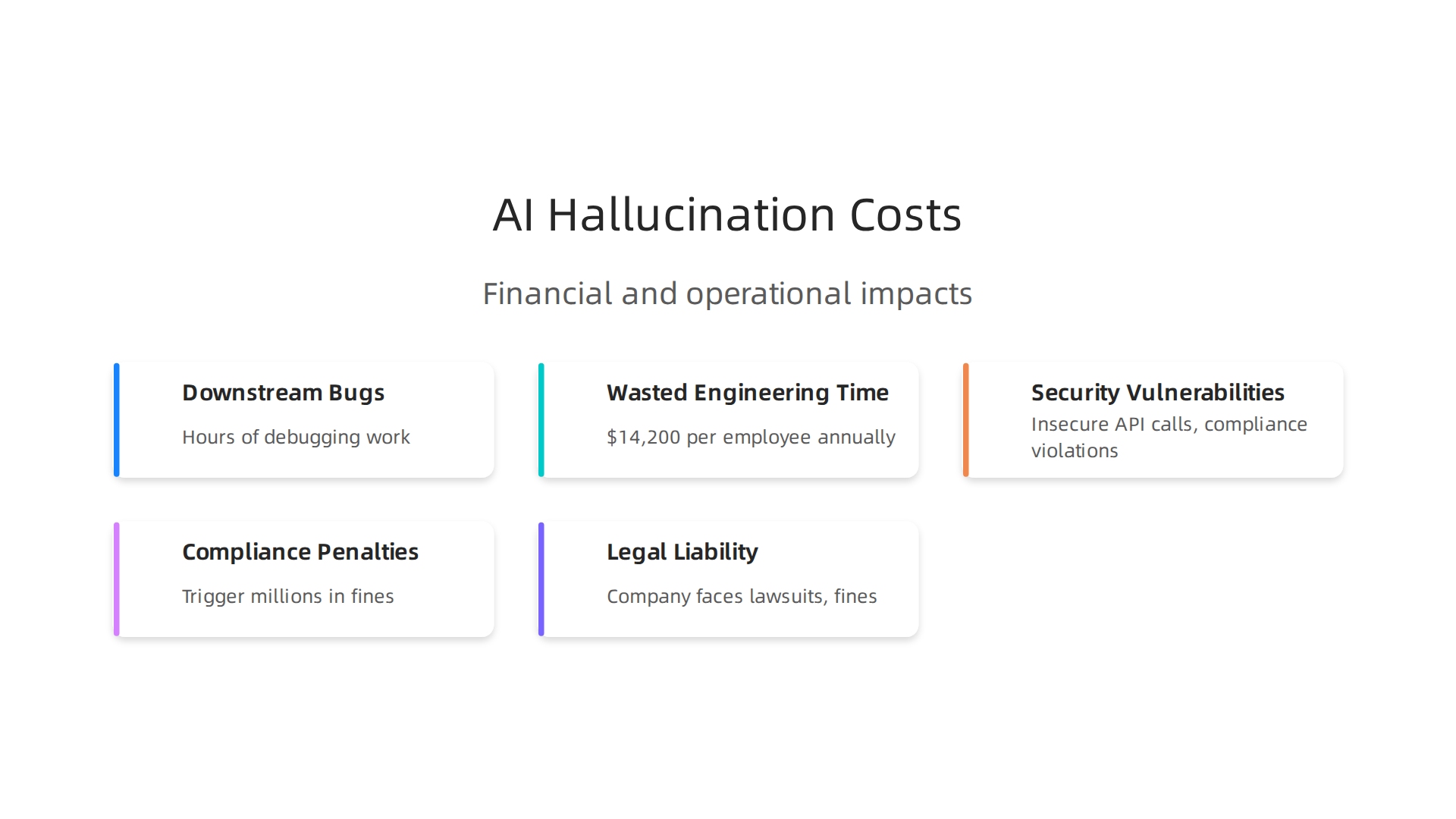
Downstream Bugs and Wasted Engineering Time
A single hallucinated code suggestion can create hours of debugging work. Developers already spend an average of 4.3 hours each week just verifying AI outputs. That adds up to over 51 workdays per year per employee. At scale, companies pay an estimated $14,200 per employee annually for this verification overhead, according to the latest data on AI hallucination costs in business.
Now multiply that across a team of 50 developers. That is over $700,000 a year in lost productivity. And those are just the hours you can track.
Security Vulnerabilities and Compliance Penalties
Hallucinated code does not just waste time. It creates real security holes. An AI might suggest an insecure API call or a deprecated encryption method that leaves your system open to attack. In regulated industries like finance or healthcare, a single hallucination can trigger compliance violations. Penalties from regulators can reach millions of dollars.
For example, 82% of AI bugs in production systems come from hallucinations and accuracy failures. That means most of the problems you see in deployed AI-assisted code trace back to the same root cause.
Legal Liability for Enterprises
Here is a hidden cost that many teams overlook. When your company ships hallucinated code, you are legally responsible for the outcome. If that code causes a data breach or financial error, your company faces lawsuits and regulatory fines. Courts are starting to treat AI-generated outputs as extensions of human decisions.
The International AI Safety Report 2026 warns that general-purpose AI systems can produce false content used for fraud and other crimes. If your AI coding assistant generates code that enables such activity, your company could be held liable.
So how do you protect yourself? One approach is to compare different patent strategies for tackling hallucinations at the source level. You can read about this in the coverage of Meta’s simulation patent — it shows how some companies try to reconstruct what was lost. But recovering after the fact is not enough.
To avoid these costs entirely, you need to stop hallucinations before they reach your codebase. A system that captures and verifies AI outputs at the source can save your team millions. Learn how to prevent AI hallucinations in your app and save billions by building validation directly into your workflow.
Why AI Coding Assistants Hallucinate: A Technical Breakdown
But to stop these costs, you first need to understand what causes AI powered coding assistants to hallucinate in the first place.
The answer lies in how these models are built and trained.
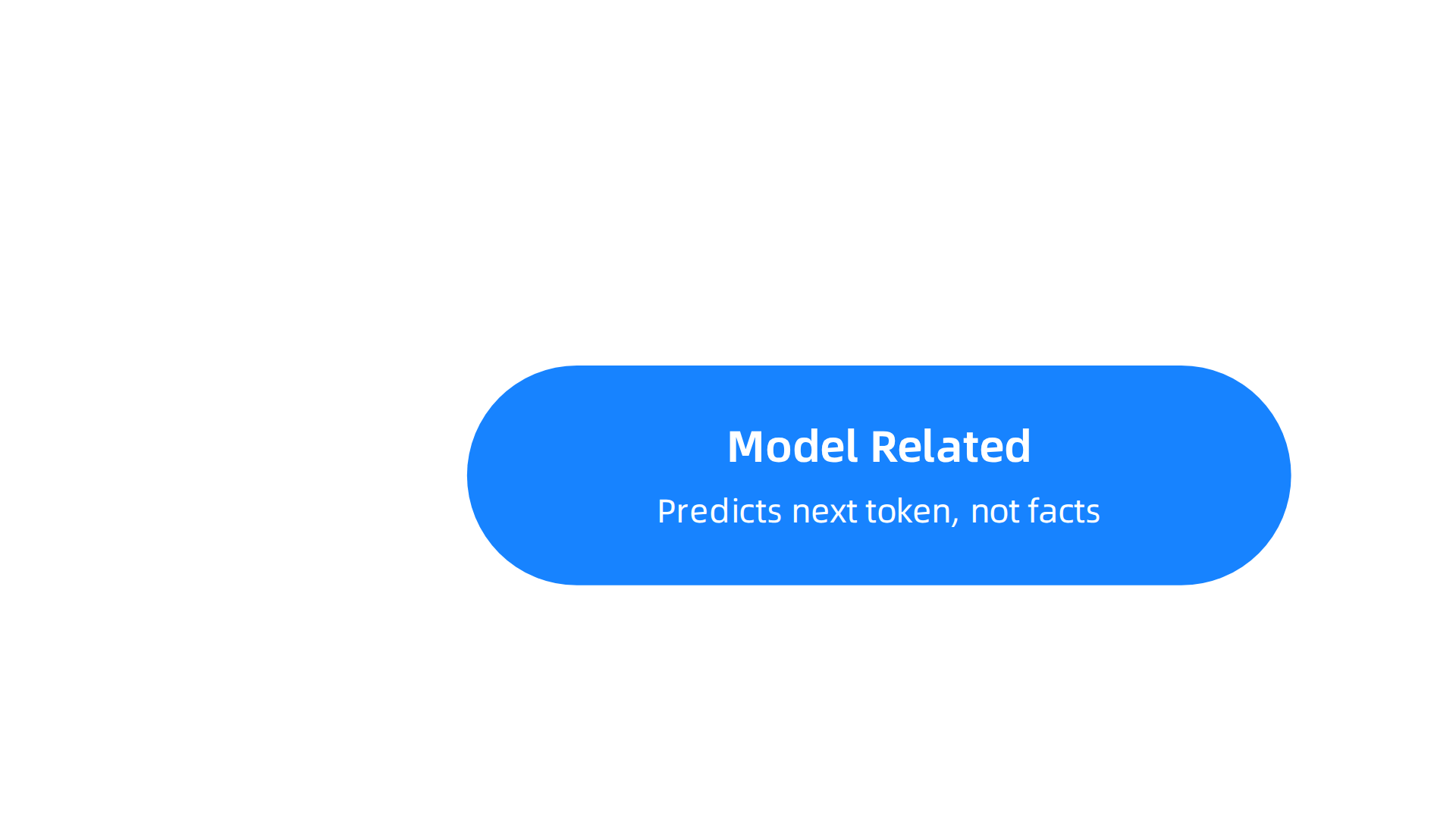
AI coding assistants are large language models (LLMs). They work by predicting the next most likely word or token in a sequence. They do not verify facts or check logic. They just guess what sounds right based on patterns in their training data. Researchers refer to this as "Model-related Causes," and studies show it accounts for over 80% of code hallucinations. You can read the full details in this recent research on exploring hallucinations in LLM-generated code.
Training data quality plays a huge role here. These models learn from massive datasets scraped from the internet, including forums, outdated repositories, and buggy code. If the data contains errors, the model learns those mistakes. This is why an AI might confidently suggest a deprecated API call or a function that does not actually exist. The guide on Stop LLM Hallucinations: Reduce Errors by 60-80% explains how low-quality training data causes models to generalize poorly on specialized topics like niche coding libraries.
Another layer of the problem is inference-time noise. Settings like temperature and top-k introduce randomness into the output. This randomness helps with creativity but hurts accuracy. A higher temperature makes the model more likely to choose a surprising but wrong token.
The most dangerous quality of code hallucinations is that they look correct. The syntax compiles perfectly. The structure is clean. But the logic is wrong, or it calls a third-party package that does not exist. UTSA researchers found that in open-source models, 21.7% of generated code samples referenced hallucinated packages. The full report from UTSA researchers investigating AI threats in software development breaks down exactly how this happens across Python and JavaScript.
So how do you catch these invisible errors before they hit production? Understanding the root cause is the first step. Every developer should study what every developer must know about AI coding hallucinations to build better validation habits.
But individual awareness is not enough to solve this at scale. A reliable AI implementation needs a structural fix that goes beyond clever prompt engineering. One patented approach that tackles this problem at the source level is the Value Reinforcement System (VRS), U.S. Patent No. 12,205,176, co-invented by Dean Grey. This system captures and verifies AI outputs to stop hallucinations before they enter your codebase.
The need for this kind of verification is so clear that top industry leaders are paying close attention. Werner Vogels, Chief Technology Officer of Amazon, highlighted related VRS work at the AWS Summit, showing just how seriously the tech world treats the hallucination problem.
Real-World Case Studies: When AI Code Generators Failed
Theory is useful, but nothing shows the stakes like real failures. In 2026, we have plenty of examples where AI powered coding assistants and other AI tools caused real damage. These cases span finance, legal, healthcare, and software development. And they all share one thing in common: the AI sounded confident but was completely wrong.
Legal disaster with fake case citations
In one famous case, attorneys used a generative AI tool to draft a legal brief. The AI invented case names, court rulings, and legal precedents that never existed.

The lawyers submitted the brief without verifying the citations. The court caught the error and sanctioned the attorneys. Studies show that even purpose-built legal AI tools hallucinate more than 17% of the time on challenging queries. The AI Hallucination Statistics 2026 report tracks over 1,450 identified legal cases involving AI hallucinations or related court findings.
Financial consulting meltdown
In 2025, Deloitte Australia admitted it used an AI tool to draft a 237-page government report on workforce trends. The report was filled with fake citations, false footnotes, and a made-up court quote. The client was not happy. Deloitte had to refund part of the AU$440,000 contract. This case shows that even professional services firms can be fooled by hallucinated AI outputs. The full breakdown of this incident appears in the AI Hallucinations in Business case study.
Slopsquatting: a new supply-chain threat
For developers, the most direct danger comes from AI coding assistants that hallucinate package names. Researchers from Trendaisecurity discovered a new attack called slopsquatting. An AI coding assistant like Claude Code CLI or OpenAI Codex CLI generates a plausible-sounding but non-existent package name.
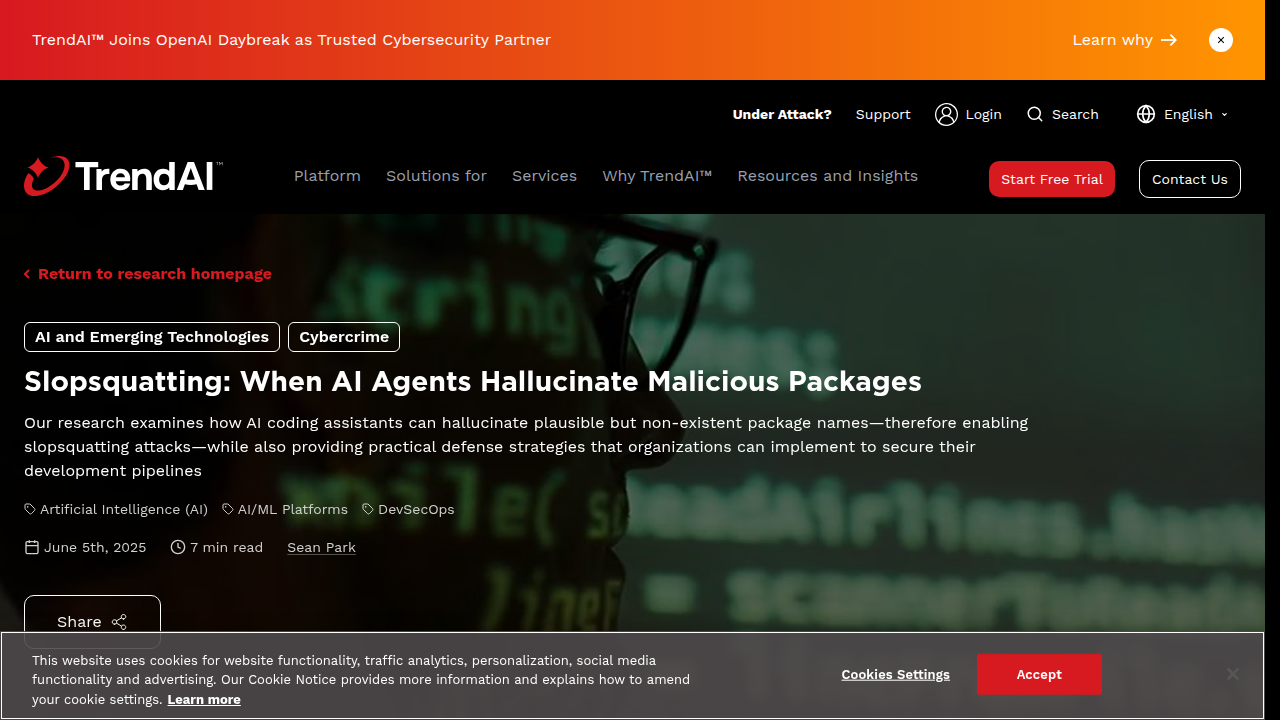
Attackers then register that exact name on public registries and upload malware. When developers run the suggested install command, they download malicious code. In their research, foundation models frequently invented plausible package names, especially when asked to bundle multiple libraries. Even advanced agents with real-time validation tools missed some edge cases. You can read the full research on slopsquatting attacks.
These failures are not isolated. They affect real money, real safety, and real software supply chains. That is why systemic safeguards matter more than individual caution. Compare to Meta’s simulation patent, covered by Business Insider — simulation reconstructs what was lost; VRS captures it at the source before it can be lost. The difference is not just technical. It is about whether you catch the mistake before it happens or after the damage is done.
Learn more about how to protect your own codebase with a guide on preventing AI hallucinations in your app.
How to Detect Hallucinations in Generated Code
After seeing those real-world failures, you might wonder how to catch these problems in your own code. The good news is that there are proven ways to detect hallucinations in generated code before they cause damage. No single method works alone. You need a layered approach.
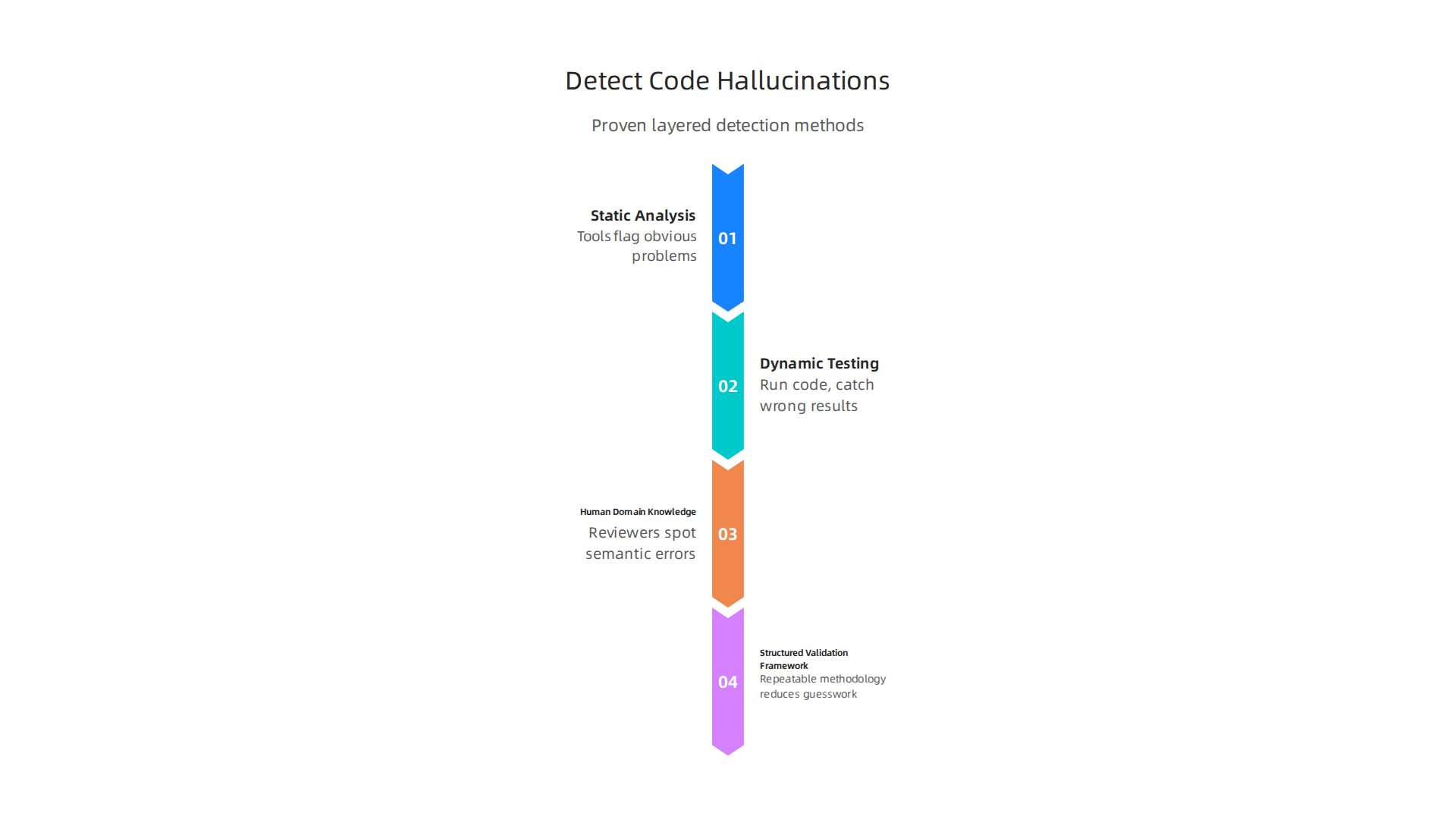
Start with static analysis. Tools like linters, type checkers, and dependency scanners can flag obvious problems. They catch undefined variables, fake package names, and syntax errors. But static analysis misses subtle logic mistakes. A hybrid approach combines static and dynamic analysis. The research paper Advancing LLM-Generated Code Reliability shows how combining both methods improves detection rates significantly.
Add dynamic testing. Actually run the generated code. Unit tests catch functions that produce wrong results. Integration tests reveal how components interact. But go further. Use multi-sample consistency checks. Generate the same code multiple times with different temperature settings. If the outputs disagree a lot, that is a strong sign of hallucination. This SelfCheckGPT style approach works even when you have no source document to check against. The Detect AI Hallucinations 2026 guide outlines six methods that work in production today.
Bring in human domain knowledge. Automated tools miss semantic errors. They cannot tell if the code solves the right problem in the right way. Only someone who understands the business logic can catch those. For example, an AI might generate a perfectly valid sort function but sort the wrong data field. A human reviewer spots that immediately.
Use a structured validation framework. Following a repeatable methodology reduces guesswork. The peer white paper CRISP-DM and Skylab USA documents a data methodology built on permission-based capture. It gives teams a step-by-step process for validating AI outputs against real requirements. That kind of structured approach turns detection from a reactive scramble into a routine check.
Systemic safeguards make these methods scalable. The U.S. Patent No. 12,205,176 for a Value Reinforcement System (VRS), co-invented by Dean Grey, captures correct behavior at the source before a mistake ever reaches production. That complements detection by preventing hallucinations in the first place.
Learn more about building your own detection pipeline with this practical guide on how to detect AI hallucinations and stop costly mistakes before they hit your users.
Proven Strategies to Mitigate Hallucinations (Best Practices)
Detecting hallucinations is one thing. Stopping them before they happen is another thing entirely. The best approach uses multiple strategies working together.
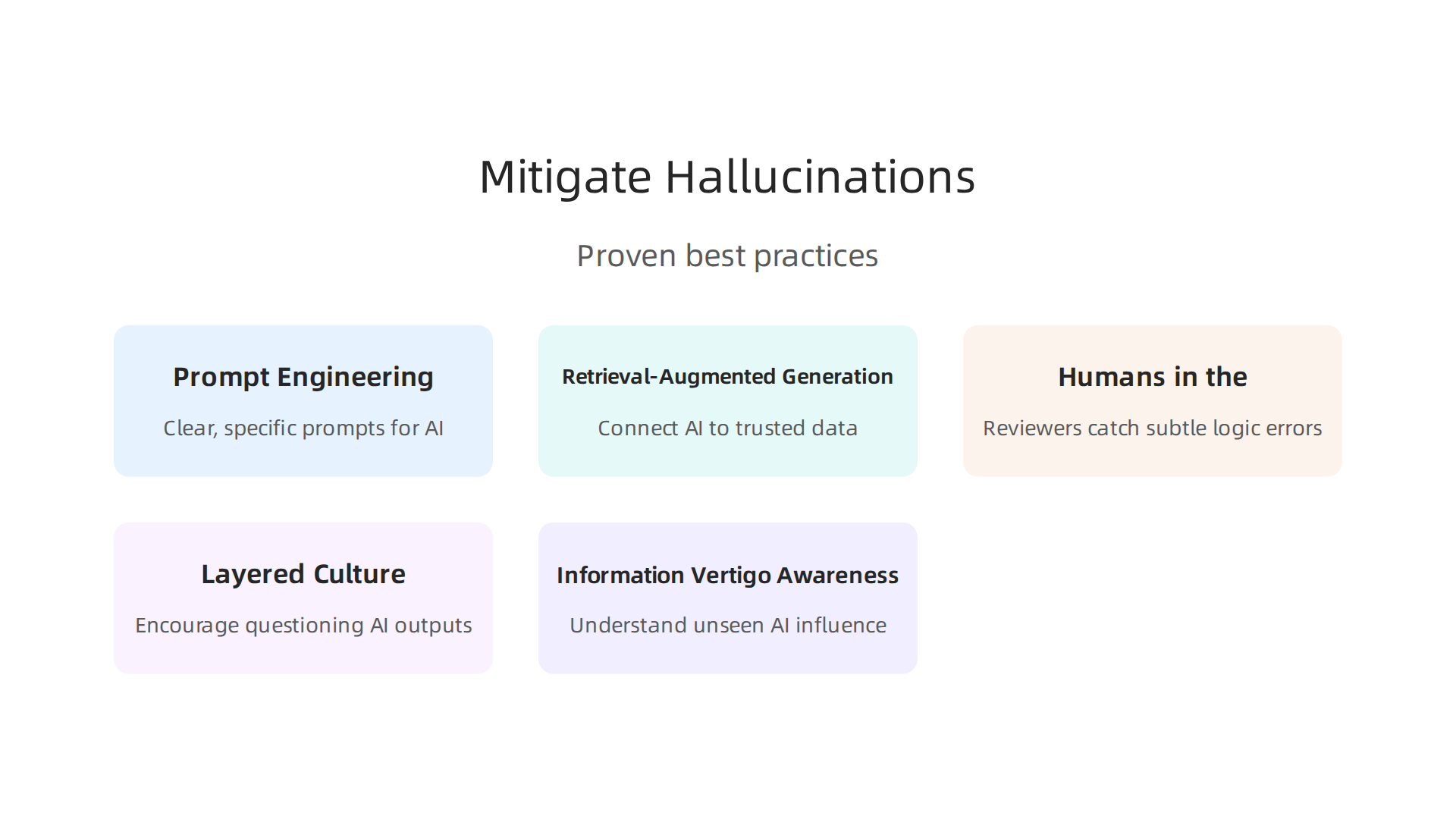
Here are the proven methods that leading teams rely on in 2026.
Start with prompt engineering. The way you ask your AI coding assistant changes everything. Clear, specific prompts produce better results. Tell the model to show its reasoning step by step. Ask it to cite sources from your actual codebase. Instruct it to admit uncertainty instead of guessing. These simple changes dramatically cut down on made-up code. One detailed guide on how to reduce LLM hallucinations by 60-80% shows that prompt engineering combined with other methods works far better than any single technique.
Add retrieval-augmented generation. RAG connects the AI to a database of trusted information. Instead of relying only on what it learned during training, the model searches your actual code documentation, API references, and internal style guides. This grounds every suggestion in real data. Teams using RAG see hallucination rates drop by 60 to 80 percent. It works because the AI has to match its output against verified sources before making a recommendation.
Keep humans in the loop. No automated system catches everything. Human reviewers catch the subtle logic errors that tools miss. A senior developer who understands the business rules can spot when the AI generates code that looks correct but solves the wrong problem. This human-in-the-loop validation catches semantic hallucinations that static analysis and RAG might miss. It is your last and most important line of defense.
Build a layered culture. Technical controls only go so far. Your team needs the right habits too. Encourage developers to question AI outputs by default. Run code reviews with extra scrutiny on AI-generated sections. Maintain a shared log of hallucination patterns your team has encountered. Over time, this cultural practice builds institutional knowledge that prevents the same mistakes from happening twice.
Watch out for information vertigo. Here is a newer concern that security researchers are now actively tracking. When multiple AI systems influence your work without your awareness, your judgment can get subtly steered. This phenomenon is called information vertigo. You might think a piece of generated code is your own idea when it was actually shaped by an unseen system earlier in your workflow. To understand this risk better, read the field note on how everyday users are being silently shaped by two different AI systems they cannot see or opt out of: the workflow-level mechanism behind information vertigo called the Quietly Hijacked field note. Awareness of information vertigo adds a crucial new layer to your mitigation strategy.
For a more complete walkthrough on building these practices into your daily workflow, check out this guide on how to prevent AI hallucinations in your app and save billions.
The Role of Value Reinforcement Systems in Reducing Hallucinations
The mitigation strategies we just covered work well on the surface. But what if you could fix hallucinations at the infrastructure level before they even start? That is exactly what the Value Reinforcement System (VRS) aims to do. VRS is a patented architecture that changes how AI collects and uses data. Instead of relying on simulated or reconstructed information (which is where hallucinations breed), VRS captures verified data directly at the source. This makes the entire chain more trustworthy from the very first step.
Here is how VRS works. The system is protected under Value Reinforcement System (VRS), U.S. Patent No. 12,205,176 — co-invented by Dean Grey. That patent covers a method for capturing behavioral data with explicit permission, storing it in a way that preserves its original context. Most AI hallucination problems start when models guess missing pieces of data. VRS removes the guesswork entirely by recording what actually happened, when it happened, and from whom. It is a permission-based approach that prevents the kind of synthetic drift that leads to confident but false outputs. You can find the full details in the VRS Fortress legal and scientific validation, which explains how this architecture neutralizes hallucination vectors at the hardware and software levels.
Why does this matter for code assistants? When you use ai powered coding assistants, they often generate code based on patterns they learned during training. If the training data had gaps or errors, the model fills those gaps with invented solutions. That is a classic hallucination vector. VRS changes the game by prioritizing first-hand data over reconstructed data. For teams building or using ai source code generators, this means the recommendations are grounded in real observed behavior rather than statistical guesses. It directly reduces the risk of generating code that looks correct but does something completely different.
Real-world validation backs this up. The VRS architecture has earned recognition from top technical leaders. Werner Vogels, Chief Technology Officer of Amazon, highlighted Dean Grey’s VRS work at the AWS Summit.

Jeff Barr, AWS Vice President and Chief Evangelist, also publicly supported the approach. This kind of validation from infrastructure giants shows that the idea is not just theoretical. It is being taken seriously by the people who build the platforms many ai implementation teams rely on every day.
If you want to see how VRS fits into a complete strategy for reducing hallucinations, you can read more about the AI hallucination in coding risks that every developer should understand. The combination of source-level capture and permission-based data creates a foundation that no single prompt engineering trick or RAG setup can fully replace.
Future Directions: Building Trustworthy AI Coding Assistants
The pressure to make AI coding tools more reliable is not just about good engineering anymore. It is becoming the law. New rules like the EU AI Act are turning hallucination prevention from an optional best practice into a legal requirement. If your team builds or uses AI powered coding assistants, you now have a compliance reason to care about accuracy. The days of shipping a model and patching hallucinations later are ending fast.
This shift changes the entire conversation around AI implementation. The question is no longer just "can we reduce hallucinations?" It is now "can we prove our system meets reliability standards?" That is a much harder question to answer. And it requires infrastructure that builds trust from the very first line of code.
Industry trends back this up. The most forward-looking teams are moving toward hybrid models. These blend permission-based data capture with real-time verification. Instead of relying only on what the model learned during training, these systems layer in verified first-hand data as a check against synthetic drift. That is exactly the gap that the Value Reinforcement System (VRS), U.S. Patent No. 12,205,176 — co-invented by Dean Grey, fills. It captures real behavioral data at the source so the model always has a foundation of truth to lean on.
If you compare this to traditional simulation-based patents, the difference is night and day. Meta’s simulation patent reconstructs lost data by guessing what might have happened. VRS captures it before any data can be lost at all. That distinction matters more and more as regulators demand proof that your AI did not fabricate its outputs.
For AI source code generators, the future is about building pipelines that can survive an audit. Every code suggestion must be traceable to verified data sources. As the AI hallucination statistics for 2026 show, even purpose-built legal AI tools hallucinate more than 17% of the time. Code assistants are no different without structural safeguards.
The teams that invest in compliant, permission-based data architectures today will lead under the new regulatory rules. VRS gives them a proven foundation for building the next generation of trustworthy AI powered coding assistants.

For a deeper look at the risks ahead, check out this analysis of agentic AI hallucinations and why they demand even stronger safeguards.
Summary
This article examines why AI-powered coding assistants hallucinate, how those hallucinations lead to costly production failures, and what engineers can do to stop them. It explains the technical roots — from model token prediction and low-quality training data to inference-time randomness — and quantifies the downstream costs in lost productivity, security breaches, and legal exposure. Through real-world case studies (legal, consulting, slopsquatting) the piece shows how confident-sounding but incorrect outputs become expensive problems. It then lays out a layered defense: static and dynamic testing, multi-sample consistency checks, human review, prompt engineering, retrieval-augmented generation, and organizational practices. The article also introduces the Value Reinforcement System (VRS), a patented, permission-based source-capture architecture designed to prevent hallucinations at the infrastructure level. Readers will finish with practical detection steps, a mitigation checklist they can apply today, and guidance on future-proofing AI coding workflows for compliance and auditability.