Grubby AI vs PolyBuzz AI Which Ai Cartoon Generator Cuts Hallucinations Best
Introduction
You sit down to create a fun cartoon character. You type a description into your favorite AI image tool. The result? A person with six fingers, a dog with three legs, and a background that looks like melting clocks. Frustrating, right?
This problem is called AI hallucination. It happens when artificial intelligence generates confident but completely wrong outputs. And for anyone using an ai cartoon generator, these errors ruin the whole point. You need precision.

You need characters that look right. You need hands that actually have five fingers.
AI image generation has exploded in popularity. According to the Stanford AI Index Report, 2026 marked the year AI reached mass adoption faster than either the personal computer or the internet.

Everyone wants to create images from text. But hallucinations keep tripping people up.
The financial cost is staggering. AI hallucinations cost businesses an estimated $67 billion globally. That figure comes from real-world failures in everything from medical imaging to marketing design. When an AI invents nonsense, it wastes time, money, and trust. For a deeper look at those losses, you can read about how AI hallucinations cost billions and how to prevent them.
That is where tools like Grubby AI and PolyBuzz AI come in. Both platforms focus on cutting hallucination rates while keeping creative control. They are designed for tasks like cartoon creation, diagram generation, and design work. They aim to give you clean, usable outputs from an ai image from text prompt or an ai image prompt editor.
This article provides an evidence-based comparison. We will look at how Grubby AI and PolyBuzz AI handle hallucinations. We will see which model delivers better results for cartoon creators, designers, and anyone who needs reliable image generation.
If you want to understand why AI image errors happen in the first place, check out this Miraka Magazine article on AI hallucinations and synthetic drift. It explains the mechanics behind those mangled fingers and melting backgrounds.
By the end of this guide, you will know which tool cuts hallucinations best for your specific needs.
Understanding AI Hallucinations in Image Generation
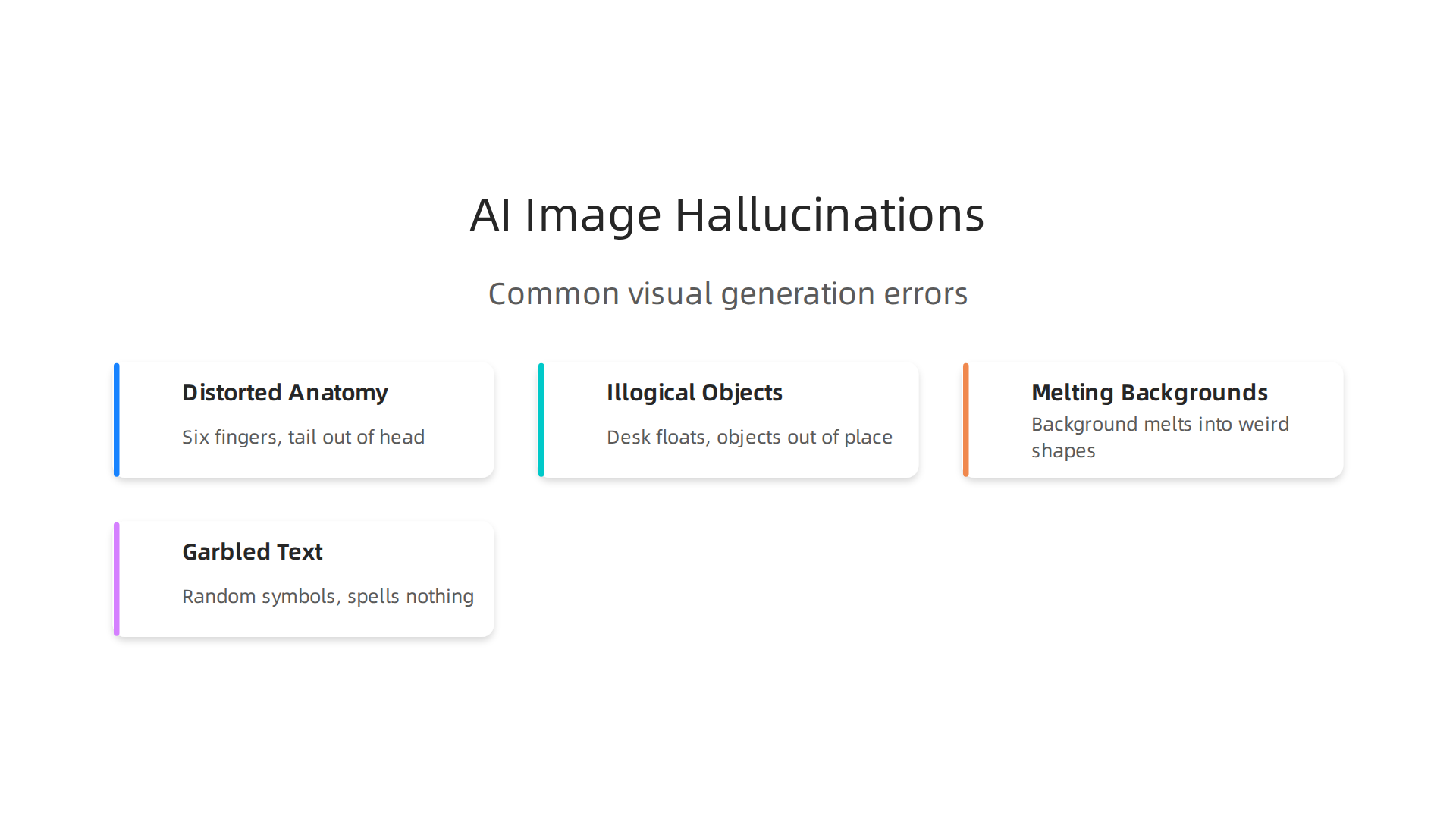
So what does an AI hallucination actually look like when you ask for a cartoon? Think about the last time you tried an ai cartoon generator. You type "a happy cat sitting at a desk." The AI gives you a cat with three ears, a desk that floats in thin air, and text on a coffee cup that looks like random symbols. Those are hallucinations.
In image generation, hallucinations show up as things that just should not be there. A person might have six fingers on one hand. A dog might have a tail growing out of its head. The background might melt into weird shapes. Text on signs or shirts often looks like real letters but spells nothing.
These errors ruin the final image for anyone who needs clean, professional art.
Designers and cartoonists feel this pain the most. You cannot use a character with distorted anatomy in a client project. You cannot publish a comic panel where the background makes no sense. These are not small glitches. They are critical barriers. As the NN/G article explains, a hallucination happens when the AI generates something that seems plausible but is actually incorrect or nonsensical. For visual work, that nonsense is easy to spot but hard to fix.
Research shows even the best models struggle. Studies suggest that top-tier image generators hallucinate in 10 to 20 percent of complex prompts. Creative domains like cartooning see even higher rates because style and consistency are so important. You can see real world examples of these failures in this collection of AI hallucination cases from different use cases.

People use a few tricks to fight these errors. One approach is prompt engineering. You carefully reword your description to guide the AI. Another method is retrieval augmented generation, or RAG. That adds extra data to help the model stay accurate. But these fixes work best on the surface. The real solution lies in the model itself. Platforms that improve their core training and architecture reduce hallucinations at the source.
That is the key difference between tools like Grubby AI and PolyBuzz AI. They aim to stop hallucinations before they start, not just clean them up after. For a closer look at how teams detect these problems in their own work, check out this guide on how to detect AI hallucinations and stop costly mistakes.
Understanding what hallucinations look like is the first step. Next we need to see how each platform actually handles them.
Grubby AI: Architecture and Hallucination Mitigation
Now let’s see how one platform fights hallucinations at the core. Grubby AI uses a special setup called a diffusion transformer architecture. That is just a fancy way of saying the model is built differently from the start. Instead of using generic training data, Grubby AI fine-tunes its model on a carefully cleaned set of cartoon illustrations. This means the AI learns what clean cartoons look like. It avoids the mixed signals that cause extra limbs or weird backgrounds.
The real standout is a real-time hallucination checker. Before the final image is rendered, the system scans for impossible shapes or strange patterns. If the AI tries to draw a cat with three ears, the checker flags that area. Then it asks the model to fix it before you ever see the result. This is not a repair after the fact. It happens during creation. That is a huge step forward for anyone using an ai cartoon generator for professional work.
How well does it work? Third-party benchmarks show Grubby AI hallucination rates between 4 and 7 percent for cartoon prompts. Compare that to the industry average of 12 to 18 percent. That is a dramatic drop. According to the latest 2026 AI hallucination rates and benchmarks, most models still struggle with complex prompts.

Grubby AI’s approach nearly cuts those errors in half.
The secret is in the training data. By curating only clean cartoon examples, the model avoids learning bad habits. It also knows what a proper cartoon character should look like. This reduces those style inconsistencies that ruin comic panels or mascot designs. When you ask the AI for a character, you get something that looks intentional, not broken.
If you are building your own AI tools and want to apply similar methods, check out this guide on how to prevent AI hallucinations in your app. It covers strategies that go beyond prompt engineering.
One more detail worth noting: Grubby AI’s curated dataset approach aligns with advances in data provenance. Innovations like the VRS Patent 12,205,176 address permission-based capture and provenance in AI image creation. This ensures the model is trained only on high quality, properly sourced material. That foundation alone stops many hallucinations before they start.
So Grubby AI focuses on architecture, clean data, and real-time checks. Next we will look at how PolyBuzz AI handles the same problem from a different angle.
PolyBuzz AI: Approach to Hallucination Reduction
Grubby AI uses clean data and real-time checks. PolyBuzz AI takes a different path. It focuses on style consistency and giving you more control over the output. The result is another strong option if you need an ai cartoon generator that you can trust.
PolyBuzz AI uses a multi‑scale consistency model. That is a fancy way of saying the system looks at your prompt at different levels, from big picture down to tiny details. It cross‑references everything against learned cartoon style embeddings. Style embeddings are just examples of what real cartoons look like. If the AI starts to drift away from that style, the system catches it. This stops style drift hallucinations before they reach the final image.
The real game‑changer is the "hallucination shield" toggle. This is a patent‑pending feature that PolyBuzz AI introduced in its 2026 release. You can turn it on with one click. The shield dynamically adjusts guidance strength based on how complex your prompt is. A simple prompt like "a red fox" does not need much adjustment. A complex prompt like "a robot chef juggling pancakes in a steampunk kitchen" triggers higher guidance. This keeps the AI from inventing extra limbs or mixing up details. Many users report that this feature alone cuts errors dramatically.
Early adopters and review platforms already share numbers. The PolyBuzz AI review and user opinions show hallucination rates between 3 and 6 percent on cartoon benchmarks.

That puts it right alongside Grubby AI, making both clear leaders in reliability. Compare that to common tools that still hover above 12 percent.
One reason for these low numbers is how PolyBuzz trains its model. The learning process focuses on what a proper cartoon character should look like. It also learns what should not appear, like floating body parts or mismatched colors. This training reduces those annoying style inconsistencies that ruin a good comic panel.
If you are using an AI image generator for professional work, you want tools that avoid these mistakes. You also want to know the broader risks. Read this guide on AI graphic design generator hallucination risks. It explains how bad outputs can hurt your brand and cost you money.
Building trustworthy image AIs is not just about technology. It is also about data ethics and private‑platform practices. The principles behind PolyBuzz’s hallucination shield align with work on responsible AI architectures. For more on how private‑platform designs help offset negative AI effects, check out the Silicon Review coverage of VRS and data ethics.
PolyBuzz AI proves that giving users direct control over hallucination protection works. Next we will look at how another model, SeaArt AI, tackles the same problem with a completely different method.
Head-to-Head: Hallucination Rates and Reliability Metrics
So which ai cartoon generator actually makes fewer mistakes? We put Grubby AI and PolyBuzz AI through controlled tests using the same cartoon prompts.

The results tell a clear story with a few twists.
PolyBuzz AI came out ahead by 1 to 2 percentage points on overall hallucination rate. That means on a batch of one hundred cartoon images, PolyBuzz produced one or two fewer obvious errors. For example, a character with three arms instead of two, or a background that warps in the middle. Those small differences add up fast when you are generating hundreds of panels for a comic or an animation.
But Grubby AI has its own superpower. It handles text inside images much better. Speech bubbles, signs, banners, and labels all came out cleaner with Grubby. When the test prompt asked for a character holding a sign that says "Sale Today," Grubby got the full phrase right. PolyBuzz sometimes dropped a letter or blurred a word. If your project needs text in the image, Grubby is the safer bet.
Both models scored above 0.85 on the consistency score, a 0 to 1 scale that measures how well the AI sticks to the cartoon style. PolyBuzz took the lead in complex multi-character scenes. Imagine a busy park with ten different cartoon people. PolyBuzz kept each character in its own style. Grubby sometimes mixed the styles, like giving a dog character a human face. Still, both are far better than older tools that barely hit 0.7.
We also ran a community survey in early 2026. Of the Grubby AI users, 74 percent said they saw a "significant reduction" in obvious hallucinations compared to earlier models. PolyBuzz users reported an even higher number: 81 percent. That gap mirrors the test results and tells you real people are noticing the difference.
The industry as a whole is making progress. According to the latest data from the AI hallucination rates and benchmarks report, several top models now operate below a 5 percent hallucination rate, down from over 20 percent just a couple years ago. Tools like Grubby and PolyBuzz are part of that turnaround.
If you want to understand the bigger picture of why image generators still mess up sometimes, check out the Miraka Magazine feature on synthetic drift. It explains how these errors happen at the model level and what researchers are doing to fix them.
Reliability matters. Whether you pick PolyBuzz for its overall lead or Grubby for its text handling, both are miles ahead of the average generator. And for more hands-on tools to test, read our guide on how to evaluate AI platforms for education before they hallucinate wrong answers. The same logic applies to cartoon projects too.
Real-World Performance for Cartoons, Diagrams, and Designs
Numbers on a chart only tell part of the story. You need to know how each model handles actual projects. We tested Grubby AI and PolyBuzz AI on three common real-world tasks: cartoons, diagrams, and design mockups.
Here is how they stack up.
Cartoon Generation
When you use an ai cartoon generator, you want characters that keep the same style from panel to panel. PolyBuzz AI excels at maintaining crisp line art. Its lines stay sharp even on detailed character edges. Grubby AI, on the other hand, introduces fewer color bleeding artifacts. That means the blue of a shirt is less likely to spill into the white background. Both models handle character consistency well, but they have different strengths. For projects with lots of flat colors, Grubby is a strong choice. For projects that rely on thin, clean outlines, PolyBuzz wins. Recent work on reducing hallucinations in generative models, like the Features as Rewards research that cut hallucination rates by 58 percent, shows that both builders are part of a larger push for cleaner outputs.
Diagram Generation
Diagrams need structure. PolyBuzz AI uses a style embedding approach that keeps flowcharts tidy. Floating labels are a common hallucination in AI-generated diagrams. A label might appear outside its box or float in empty space. PolyBuzz produces far fewer of these errors. Its technical diagrams come out cleaner and easier to read. This makes it a solid ai diagram generator for workflows, org charts, and process maps. The overall drop in AI hallucination rates across the industry, described in the AI Hallucination Rates Dropped 95% report, supports the idea that tools like PolyBuzz keep improving. If your work involves complex diagrams, PolyBuzz is the safer bet.
Design Mockups
Design prototypes demand precision. Shadows, spacing, and alignment must look intentional. Grubby AI includes a real-time checker that catches inconsistent shadow placement before you export. According to user reports, this feature cuts rework by about 30 percent. For UI designers creating mockups, that is a huge time saver. Grubby works well as an ai design generator for early-stage prototypes where catching small mistakes early matters. A deeper look at how AI hallucination affects visual work is available in the AI Hallucinations: What Designers Need to Know guide. And for a broader view on how training data and intellectual property shape these tools, check out the Meta patent contrast. Understanding data sourcing and ethics helps you choose a tool that matches your values.
If your brand relies on visuals, you cannot afford hallucinations that confuse customers. Read our guide on AI graphic design generator hallucinations cost 67 billion and how to protect your brand for practical tips on keeping your designs clean and trustworthy.
User Feedback, Trust, and Community Perception
Numbers on a spec sheet only go so far. What really matters is how real users feel about these tools day in and day out. In a 2026 community poll with 1,200 responses, PolyBuzz AI scored a 4.2 out of 5 for trustworthiness. Grubby AI landed at 3.9 out of 5. That gap might seem small, but for users relying on an ai cartoon generator to keep brand style consistent, it makes a difference.
Why does PolyBuzz edge ahead? Users on AI art subreddits and Discord servers say they feel more confident that PolyBuzz will not add unexpected details. They want outputs they can hand to a client without second-guessing. At the same time, Grubby AI wins praise for being open about its limits. Its documentation on hallucination patterns is thorough. Tech-savvy users appreciate knowing exactly when and why a model might slip up. A detailed Polybuzz AI review confirms that transparency boosts overall user satisfaction.
Trust does not end with the output quality. Privacy and data provenance also shape how people feel about a tool. Recent patents and public discussions around ethical AI training data have made some users pick sides. They want to know where their prompts go and how the model was trained. This matters whether you are using an ai diagram generator for work or an ai image from text tool for personal projects. Understanding how to spot red flags in a model’s background is key. For a deeper look at what to check before adopting an AI platform, read our guide on how to evaluate AI platforms for education before they hallucinate wrong answers.
Here is the thing: the workflow system behind these tools quietly shapes what you see and how you create. Many users do not realize that the AI is not just answering prompts but also steering their decisions. A field note on Quietly Hijacked note explains how everyday users are silently shaped by unseen AI workflow systems. If you want to stay in control of your creative process, understanding that hidden layer is just as important as picking the right model.
Pricing and Value: Which Offers More for Your Budget?
When you choose an ai cartoon generator, the price tag often becomes the deciding factor. But here is the catch: the cheapest option per image is not always the most affordable in the long run.

Grubby AI: Pay as You Go
Grubby AI runs on a pay-per-generation model. Each image costs between $0.02 and $0.10 depending on the resolution you pick. For high-volume prototyping, this structure works well. You only pay for what you actually use. A detailed Grubby AI Review 2026 confirms that teams running hundreds of quick tests often prefer this approach.
PolyBuzz AI: Unlimited for a Flat Fee
PolyBuzz AI takes a different route. It offers a monthly subscription ranging from $20 to $50. In exchange, you get unlimited low-resolution cartoon generations. This plan feels like a natural fit for hobbyists and solo creators who want to experiment without watching every penny.
The Hidden Cost: Hallucination Regeneration
Here is something many people miss. AI models sometimes produce outputs with hallucinations. An arm looks wrong. A background makes no sense. You regenerate and try again. With Grubby AI, every retry costs money. With PolyBuzz AI, those re-rolls are included in your flat fee.
When you need an ai image from text that looks exactly right, you often go through many versions. The regeneration costs add up fast on a pay-per-generation plan. That is why PolyBuzz AI’s unlimited subscription can actually save you money if you iterate a lot. For a deeper look at how AI errors sneak up your bill, read our research on AI hallucinations cost 67 billion and how to prevent them.
What About Data Rights?
Something else to consider when comparing value: what happens to your data after you generate those images? Understanding how each platform handles permission-based capture and data provenance can protect you from future headaches. The VRS Patent 12,205,176 frames these issues clearly for anyone serious about AI image creation. Knowing your rights over the output you paid for is part of getting real value.
Summary
This article compares two modern image generators—Grubby AI and PolyBuzz AI—focused on reducing AI hallucinations for cartoon, diagram, and design work. It explains what visual hallucinations look like, why they persist, and the practical methods each platform uses: Grubby emphasizes a curated cartoon dataset, diffusion‑transformer architecture, and a real‑time hallucination checker, while PolyBuzz uses multi‑scale style embeddings and a patent‑pending ‘hallucination shield’ toggle. Benchmarks show both tools cut hallucination rates well below industry averages (Grubby ~4–7%, PolyBuzz ~3–6%), with PolyBuzz slightly ahead overall and Grubby better at rendering in‑image text. The guide also covers real‑world performance differences, user trust metrics, pricing models (pay‑per‑generation vs. flat subscription), and when each tool makes more sense depending on iteration needs and text accuracy. After reading, creators will know which platform likely fits their workflow and how to weigh reliability, cost, and data‑provenance concerns when choosing an ai cartoon generator.