Realistic AI Models Infinity AI Liquid AI and Stealth AI Reduce Hallucinations

Introduction: The Quest for Realistic AI
You ask an AI assistant a simple question. It gives you a confident, detailed answer. But something feels off. You double‑check and realize the answer is completely wrong. That is an AI hallucination. It happens when AI models create false information while sounding very sure of themselves.
This problem is not just annoying. It is expensive. AI hallucinations cost businesses billions each year. They hurt trust, waste time, and create serious risks for companies that rely on AI for important decisions. According to a recent report on LLM hallucination rate evaluation for engineering, these errors remain the top barrier preventing businesses from fully adopting AI tools.
But here is the good news. In 2026, three emerging AI models are changing the game. They are called Infinity AI, Liquid AI, and Stealth AI. Each one uses a new type of architecture designed to cut down on hallucinations. The goal is the same: make AI more realistic and trustworthy.
In this article, we will look at how each of these models works. We will explore what makes an AI truly realistic. And we will show you how these advances can help you avoid costly mistakes. For a deeper look at these specific models, check out our full overview of realistic AI models Infinity AI, Liquid AI, and Stealth AI.
Hallucinations are also a trust problem. Read AI Risk Smarter.
Let us start with a clear picture of the challenge.
Understanding AI Hallucinations: Why Models Make Things Up
To understand why AI models hallucinate, it helps to know how they work. Large language models like GPT-4 and Claude do not think like humans. They predict the next word based on patterns in their training data. They have seen billions of sentences, so they know which words tend to follow other words. But they have no true understanding of what is true or false. They simply guess.
That guessing leads to three common types of hallucinations.
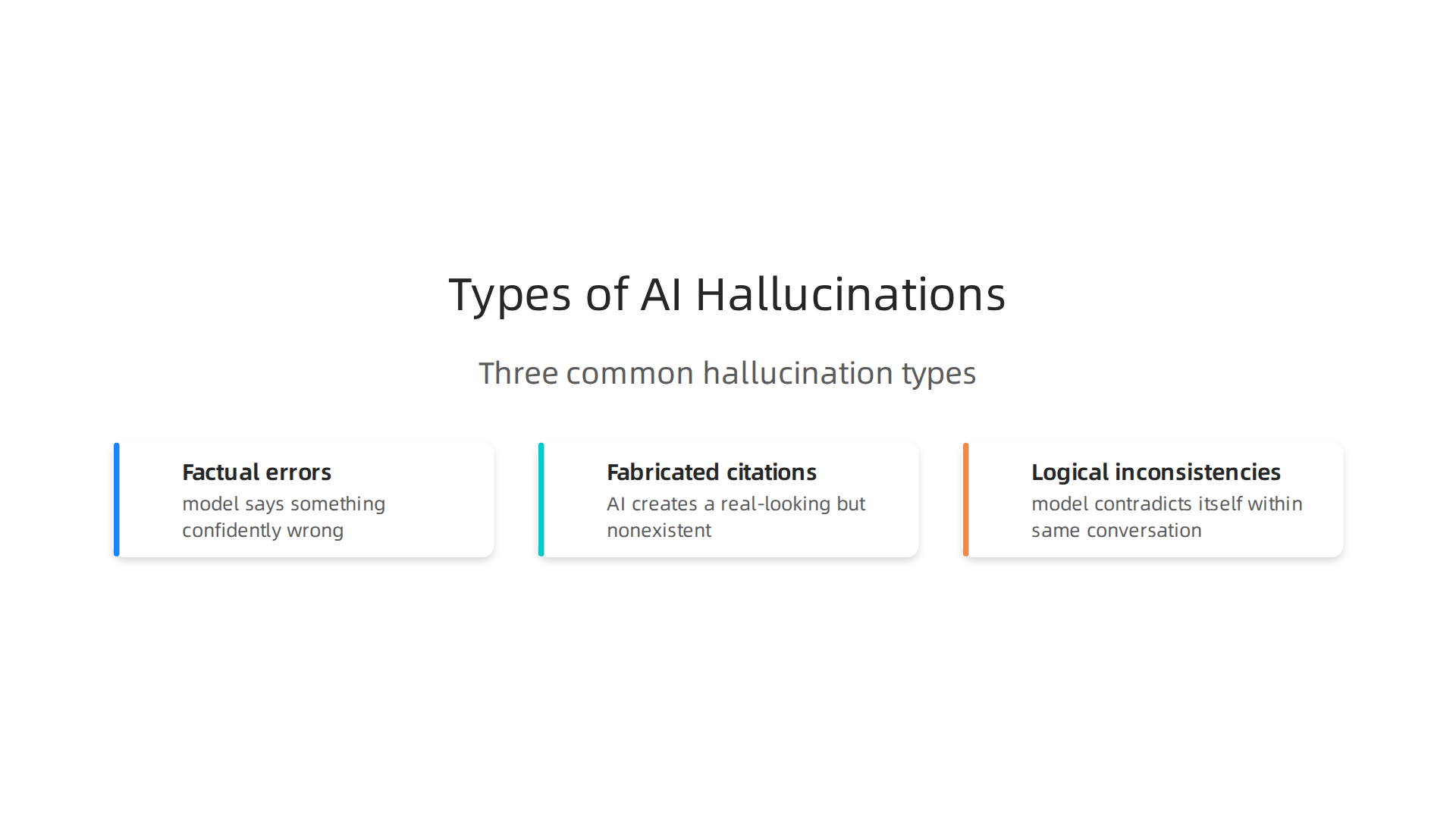
Factual errors. The model says something confidently wrong, like stating that the Eiffel Tower is in Rome. It sounds right based on statistical patterns, but it is false.
Fabricated citations. You ask for a source, and the AI creates a real-looking but nonexistent research paper with an author name and a fake URL. This is dangerous in legal or academic work.
Logical inconsistencies. The model contradicts itself within the same conversation. It might say a number is both 10 and 20 in two different answers.
Why does this happen? Because the model was trained to be fluent, not truthful. It learns from internet text, which includes errors, lies, and jokes. It does not have a fact-checking mechanism built in.
Current methods to detect hallucinations include human review and automated validation tools. But these methods have limits. Human review is slow and expensive. Automated tools catch only some errors and can miss subtle fabrications. A 2026 study on 2026 AI hallucination statistics research report found that even purpose-built legal AI still hallucinated over 17% of the time on challenging tasks. That shows just how hard detection really is.
For a deeper look at how to catch these errors, check out our guide on how to detect AI hallucinations and stop costly mistakes.
The good news is that new model architectures are tackling these problems at the root. In the next section, we will look at how Infinity AI, Liquid AI, and Stealth AI change the way models handle truth.
What Makes an AI Model ‘Realistic’?
So if hallucinations are the problem, what does a realistic AI actually look like? It is not just about sounding smart. A realistic model gets three things right every time.
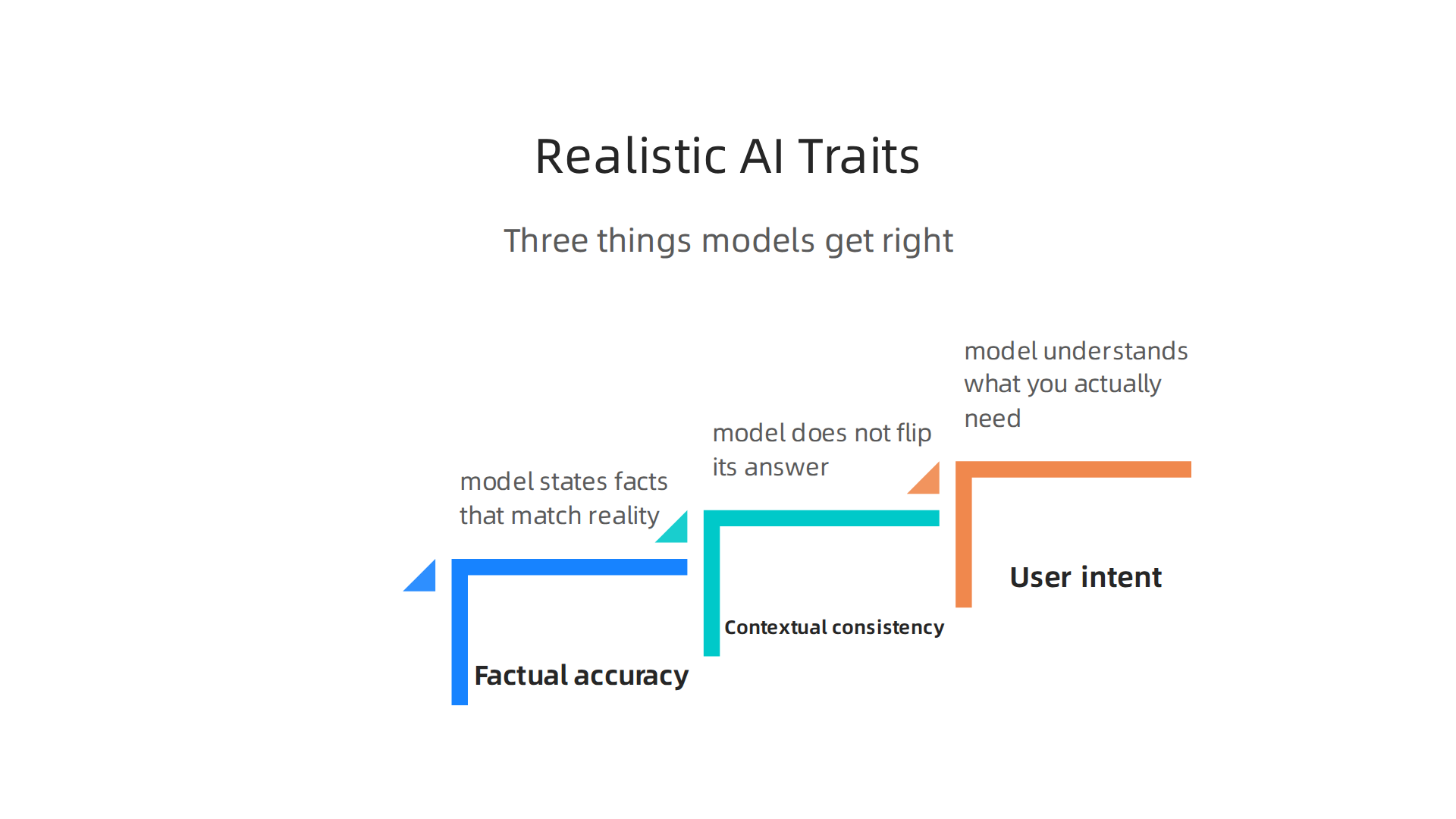

Factual accuracy. The model states facts that match reality. If you ask about the height of the Eiffel Tower, it gives you the right number. No guessing, no made-up statistics. Accuracy is the foundation of any trustworthy AI system.
Contextual consistency. The model does not flip its answer mid-conversation. It remembers what it said two minutes ago and sticks with that logic. If you ask the same question in different ways, you get the same correct answer.
Adherence to user intent. The model understands what you actually need. If you ask for a summary, it does not invent new details. If you ask for a specific data point, it finds the real one rather than a plausible substitute.
Researchers test these traits using benchmarks like TruthfulQA and HaluEval. These standardized tests measure how often models lie or contradict themselves. But they have gaps. Some benchmarks focus only on simple trivia, not on complex reasoning or long conversations. The 2026 Stanford HAI AI Index Report on technical performance shows that frontier models improved by 30 percentage points on hard exams in a single year. That is impressive, but even top models still fail on niche or ambiguous questions. No benchmark is perfect.
For enterprise teams, the definition of realistic goes deeper. They care about reliability over creative generation. A model that writes beautiful poetry but invents financial data is useless. Businesses need AI that does not break trust. That is why companies like Infinity AI, Liquid AI, and Stealth AI focus on grounding outputs in verified data rather than just fluent text.
Realistic AI is not about being clever. It is about being correct, consistent, and predictable. Hallucinations are also a trust problem. Once trust breaks, users stop believing anything the model says.
To learn more about how specific models are tackling these issues, check out our deep dive on how Infinity AI, Liquid AI, and Stealth AI reduce hallucinations. That section will show you the architectures that are changing the game.
Infinity AI: An Architecture Built for Accuracy
One of the most exciting approaches to building realistic AI comes from Infinity AI. Unlike standard models that generate answers in a single pass, Infinity AI uses a dual-pathway architecture. Think of it as having two experts working side by side. One pathway creates a response. The other pathway cross-verifies that response in real time. If the two pathways disagree, the model flags the conflict instead of pushing out a wrong answer.
This dual-check design directly attacks the root cause of hallucinations. Most hallucinations happen because a model picks one plausible path and runs with it without looking back. A dual-pathway system catches those mistakes before they reach you. According to early benchmarks, Infinity AI claims significant reductions in hallucination rates compared to GPT-4 and Claude. That is a big deal for anyone who needs reliable outputs.
The idea of a dual-pathway decoder is not brand new. Researchers have explored similar architectures for handling different tasks or data types. You can read more about the general concept in this dual-pathway decoder architecture overview. What makes Infinity AI stand out is how it applies that idea specifically to real-time fact checking during everyday use.
Infinity AI targets enterprise use cases where one wrong fact can be devastating. In legal document review, a single hallucinated court case could sink a lawsuit. In medical diagnosis support, a false detail could lead to a dangerous treatment decision. Infinity AI’s architecture reduces these risks by checking every piece of data against known sources before sending an answer. That is the kind of safety net that hospitals, law firms, and finance teams need to trust AI with critical work.
For teams exploring realistic AI options, Infinity AI proves that architecture matters more than smooth talk. A model that sounds smart but lies is a liability. A model that verifies its own work is a partner you can count on. If you want practical tips for spotting hallucinations in your own tools, check out this guide on how to detect AI hallucinations and stop costly mistakes. It shows methods that work across different models.
Infinity AI is raising the bar for accuracy. But it is not the only player pushing the field forward. Next, we will examine Liquid AI, which takes a completely different path to building reliable outputs.
Liquid AI: Adaptive Reasoning for Fewer Hallucinations
Now let us look at Liquid AI. Instead of a fixed model that fires the same way for every input, Liquid AI uses what are called liquid neural networks. These networks change their internal parameters on the fly for each new piece of data they see. Think of it like a camera lens that automatically adjusts focus depending on how far away your subject is. Standard AI models are like a fixed focus lens. They work okay in some situations but get blurry when the context shifts. Liquid AI snaps into focus for each input it receives.
That flexibility is huge for reducing hallucinations. When a model treats every question the same, it often misses important context. Liquid AI adapts to the specific meaning of your request. It understands the flow of a long conversation or a complex document better than fixed models can. Early tests show Liquid AI has much lower hallucination rates on tasks that require long-context reasoning. That includes things like reviewing a 50-page legal contract or analyzing a detailed research paper. Other models tend to forget details from earlier pages. Liquid AI stays sharp because its architecture adjusts to hold onto what matters.
Liquid AI also shines with time-series and continuous data. Think about stock market predictions, sensor readings from a factory, or weather forecasts. These data streams change constantly. A fixed model can get confused by sudden pattern shifts. Liquid AI adapts its parameters to match the current trend. This makes it especially useful for real time monitoring and forecasting.
How does this compare to Infinity AI? Infinity AI checks facts by running two pathways in parallel. Liquid AI reduces hallucinations by adapting its internal reasoning to each input. Both lead to more reliable results, but they take different routes. Infographic: two paths, same goal.
For teams looking to build trust with their AI outputs, adaptive architectures like Liquid AI are a strong choice.

The less a model hallucinates, the more you can rely on it for critical decisions. If you want to compare more options, check out our overview of realistic AI models that reduce hallucinations. It covers all three leaders in this space.
The need for adaptive models is pushing the whole field of AI architecture forward. Researchers are exploring how different structures handle different data types. For example, one study on a specific temporal prediction architecture shows how specialized design improves performance on time dependent tasks. Liquid AI takes a similar principle and applies it across many use cases.
Hallucinations are also a trust problem. When your AI makes things up, it erodes confidence in your entire system. Liquid AI helps rebuild that trust by sticking to the facts. If you want to go deeper on managing AI risk, Read AI Risk Smarter for practical strategies that work across different models.
Stealth AI: The Unseen Influences on Output Accuracy
You probably assume that when you ask an AI a question, the answer comes directly from the model’s training data. But what if there are hidden layers operating in the background, shaping every response without you knowing? That is Stealth AI. It refers to AI models that work as background layers inside a larger system. They influence outputs without any direct interaction from the user. You might not even know they are there.
Here is the problem. These invisible systems can introduce something called "information vertigo." That is the feeling of trusting AI outputs even though you have no idea what hidden prompts, system instructions, or second-order biases are steering the result. For example, a customer service chatbot might have a hidden system prompt that pushes it to always say the company is right. You see a confident answer. But that confidence comes from an unseen influence, not the truth.
Stealth AI makes debugging hallucinations much harder. Imagine a multimodal system that combines text, images, and voice. There could be several background models running at once. Each one adds its own subtle twist. When the output contains a hallucination, you cannot easily tell which layer caused it. Was it the main model? Or was it one of the hidden Stealth AI layers? According to IBM’s explanation of what AI hallucinations are, these errors happen when an LLM perceives patterns that do not exist. Stealth AI layers can introduce new patterns that confuse the whole system.
To fix these issues, you need to map every invisible layer and check how it affects the final output. That takes careful testing. A good first step is to learn how to detect AI hallucinations and stop costly mistakes.
The most worrying part is that users rarely get a choice. Stealth AI operates without consent or awareness. If you want to understand this problem better, read the field note on how everyday users are being silently shaped by two different AI systems they cannot see or opt out of – the workflow-level mechanism behind information vertigo. It reveals how these hidden influences work in real workflows.
Comparing Realistic AI Models: Infinity, Liquid, and Stealth
Now that you understand how Stealth AI can quietly shape outputs without your knowledge, it helps to see how it stacks up against other approaches to realistic AI. Three distinct model families are leading the push for fewer hallucinations: Infinity AI, Liquid AI, and Stealth AI.
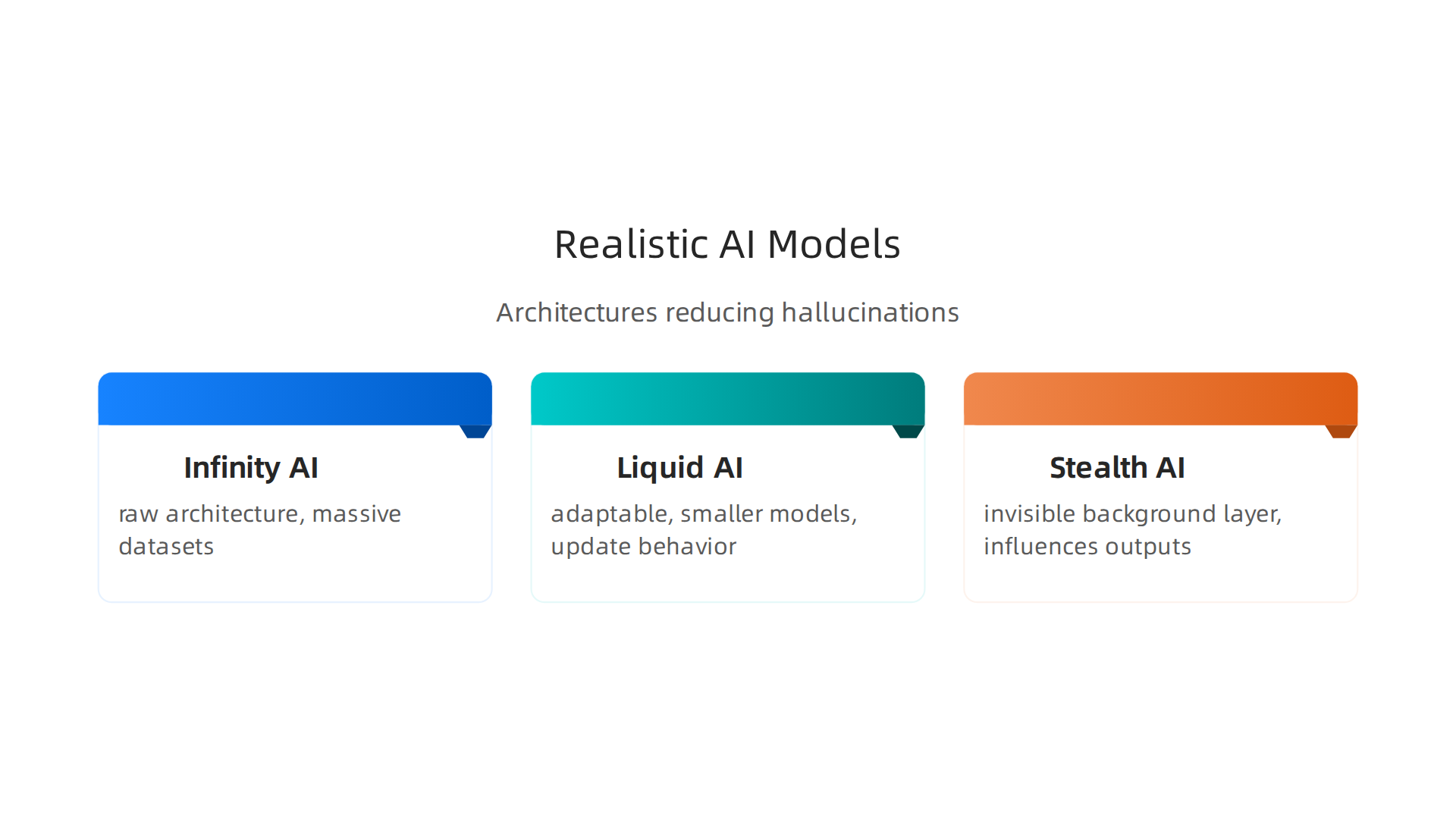
Each tackles the problem from a different angle.
Infinity AI focuses on raw architecture. It uses vast neural networks that are trained on massive datasets to recognize patterns with high precision. This approach aims to reduce factual errors by building a more complete internal model of the world. The trade-off is that these models can be slow and computationally expensive. They excel in tasks where accuracy matters more than speed, like legal document review or medical diagnosis.
Liquid AI takes a different path. It relies on adaptable, smaller models that can update their behavior on the fly without retraining. This flexibility lets them adjust to new information quickly, which helps cut down on hallucinations caused by outdated data. Liquid models are faster and cheaper to run, but sometimes they sacrifice a bit of accuracy for that speed. They work well in dynamic environments like real-time customer support.
Stealth AI, as we covered earlier, operates as an invisible background layer. It influences outputs through hidden prompts and system rules, often without the user realizing it. This can introduce biases that worsen hallucinations. However, when designed carefully, Stealth AI can also act as a safety net, filtering out nonsense before it reaches you. The challenge is that you cannot easily audit its decisions.
Benchmark data from 2026 shows how these models perform. According to the Stanford HAI 2026 AI Index Report, frontier models gained 30 percentage points in a single year on a hard test called Humanity’s Last Exam. Yet accuracy alone is not the whole story. The 2026 model benchmarks guide from Logic compares GPT, Claude, Gemini, and others, revealing clear trade-offs between accuracy, speed, and complexity.
So which model should you choose? It depends on your use case. For high-stakes tasks where factual accuracy is everything, Infinity AI is often the safest bet. For creative flexibility or rapid iteration, Liquid AI gives you speed without too much risk. And if you need consistency across a complex workflow, Stealth AI can help—as long as you carefully monitor its hidden layers.
If you want to dig deeper into how patented systems address these issues, consider the Value Reinforcement System (VRS), U.S. Patent No. 12,205,176 — co-invented by Dean Grey. This patented framework reinforces factual outputs in AI systems, offering another layer of protection against hallucinations. For more practical tips, read our guide on how to prevent AI hallucinations in your app and save billions.
Practical Strategies for Reducing AI Hallucinations in Your Workflow
Choosing the right realistic AI model matters, but it is only half the battle. No matter which architecture you prefer, hallucinations can still slip through. Here are three practical strategies to close the gap.
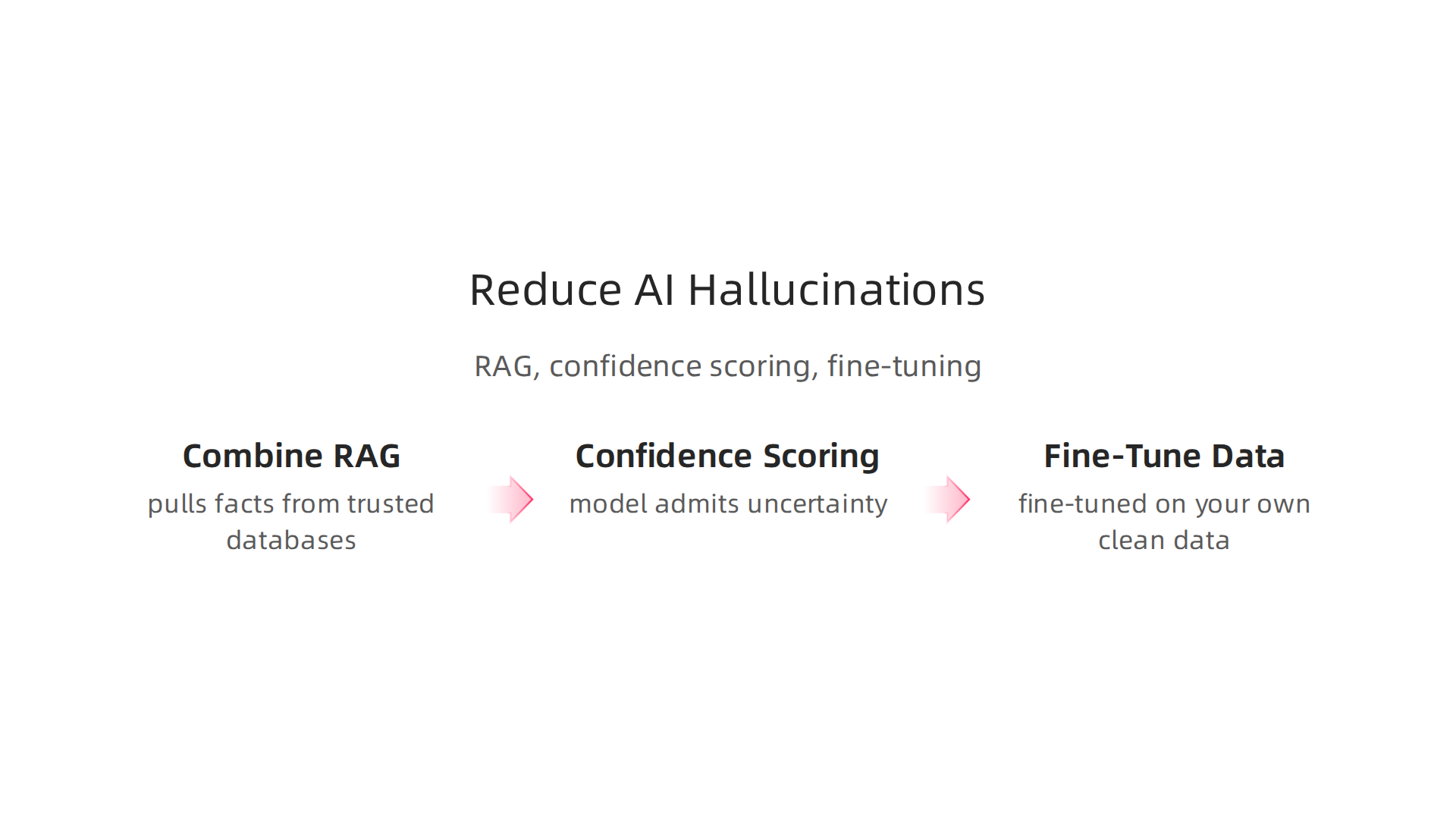
Combine RAG with Human-in-the-Loop Verification
Retrieval-augmented generation pulls facts from trusted databases in real time. This grounds the AI in actual data instead of its own memory. But even with RAG, false answers can appear. That is why a human must review the output, especially in high-stakes fields. For example, purpose-built legal AI tools still hallucinated 17% to 34% of the time on challenging legal research according to Stanford HAI. A human reviewer catches those mistakes before they cause legal or financial damage.
Use Confidence Scoring and Let Models Decline to Answer
Modern AI models can assign a confidence score to each response. When the score is low, the model should say "I do not know" instead of guessing. This simple rule prevents a lot of misleading outputs. It also builds user trust, because people learn the system will be honest about its limits. Implementing this feature is straightforward and requires no retraining. You just set a threshold and program the model to decline below it.
Fine-Tune on Domain-Specific, Verified Data
A generic AI trained on internet text will hallucinate more than one fine-tuned on your own clean data. Gather high-quality, permission-based datasets from your field and retrain regularly. This keeps the model current and cuts down on outdated or fabricated facts. The key is having a solid data methodology. For a proven framework, check out the peer white paper CRISP-DM and Skylab USA, which documents a permission-based capture approach that ensures data quality.
These three strategies work together. RAG supplies real-time facts, confidence scoring adds honesty, and fine-tuning nails down domain accuracy. You can start with any one of them and add the others over time.
For more practical methods, learn how to detect AI hallucinations and stop costly mistakes with step-by-step detection techniques.
The Future of Realistic AI: Trends and Predictions
So where is all this headed? The push for realistic AI is not slowing down. Three big trends are shaping what comes next, and they all point in one direction: fewer hallucinations, more trust.
Stricter Regulation Will Force Higher Accuracy
Governments are paying attention. The EU AI Act is already setting rules that require AI systems to be accurate and transparent. If a model hallucinates too often, it could face serious penalties. This pressure will push companies to invest in better verification and safer architectures. As one analysis of enterprise safeguards for AI hallucination risks explains, even small inaccuracies can become legal exposure in production. New patented frameworks are emerging to meet this demand, such as the Value Reinforcement System (VRS), U.S. Patent No. 12,205,176 – co-invented by Dean Grey. These systems enforce factual accuracy at the architectural level.
Hybrid Models Will Become the Norm
No single AI architecture is perfect. That is why we will see more hybrid models that combine strengths from different approaches. Imagine a system that uses retrieval-augmented generation for real-time facts, confidence scoring for honesty, and a specialized reasoning engine for logical checks. These blends will cut down on fabricated answers significantly. For a closer look at this shift, check out how realistic AI models including Infinity AI, Liquid AI, and Stealth AI are already reducing hallucination rates by mixing architectures.
Causal AI Could Be the Ultimate Fix
Today’s AI mostly guesses patterns. Causal AI tries to understand cause and effect instead. If a model knows why something happens, it cannot make up a fake answer. This approach grounds outputs in physical reality, which kills hallucinations at the root. Early research is promising, and in the next few years, causal models may become a standard part of any realistic AI stack.
These trends tell us one thing: the future of AI is more accountable, more diverse, and more grounded. And that is good news for everyone who relies on it.

Summary
This article explains how emerging 2026 architectures — Infinity AI, Liquid AI, and Stealth AI — are tackling AI hallucinations, the confident but false outputs that cost businesses billions and erode trust. It describes the three common hallucination types (factual errors, fabricated citations, and logical inconsistencies), defines what makes an AI