Generative AI Platforms How They Work Why They Hallucinate and How to Prevent Costly Mistakes

Introduction
Generative AI platforms are changing the way we work, create, and solve problems. From writing emails to generating code and designing images, these tools have become part of daily life. But here is the thing: they are not perfect. They can make confident mistakes called AI hallucinations. These errors create real risks for businesses and users.

In 2026, the use of these platforms keeps growing fast. Experts predict the market will grow at over 46% each year, according to the latest generative AI statistics for 2026. More companies are adding AI to their daily work to save time and do more.
But with this speed comes danger. AI hallucinations happen when a model gives wrong information that sounds correct. This can cause bad decisions, legal problems, and loss of trust. That is why knowing how to detect AI hallucinations is so important for anyone using these tools.
This guide gives you a clear look at generative AI platforms. We will cover how they work, where they fail, and what you can do to make them safer. We will also explore real solutions like the Value Reinforcement System (VRS). This system, protected by U.S. Patent 12,205,176, is one way experts are fighting hallucinations and building trust.
By the end of this article, you will know how to spot risks and pick the right tools for your needs.
What Are Generative AI Platforms?
You have probably used ChatGPT to write a message or asked Google Gemini to brainstorm ideas. But what is actually running behind the scenes? That is what generative AI platforms are.
Generative AI platforms are complete systems that let you create new content using large foundation models. These models are trained on huge amounts of data. They learn patterns in text, images, video, and code. Then they produce fresh content based on your prompts.
Unlike a simple app, these platforms include several tools all in one place. They offer model hosting so the AI can run fast. They give you fine-tuning APIs so you can adjust the model to your data. They include prompt management tools to help you write better instructions. And they have guardrails that try to stop harmful or wrong outputs.
Think of it this way. A foundation AI model is like a very smart but untrained assistant. The platform is the workspace that gives you the assistant plus all the tools you need to direct it, check its work, and keep it safe.
According to Salesforce, generative AI focuses on creation by using models like large language models and transformers to produce original content from data patterns. That is what makes these platforms different from regular software. They do not just follow rules. They create.
Who Offers These Platforms?
The major players in 2026 include:
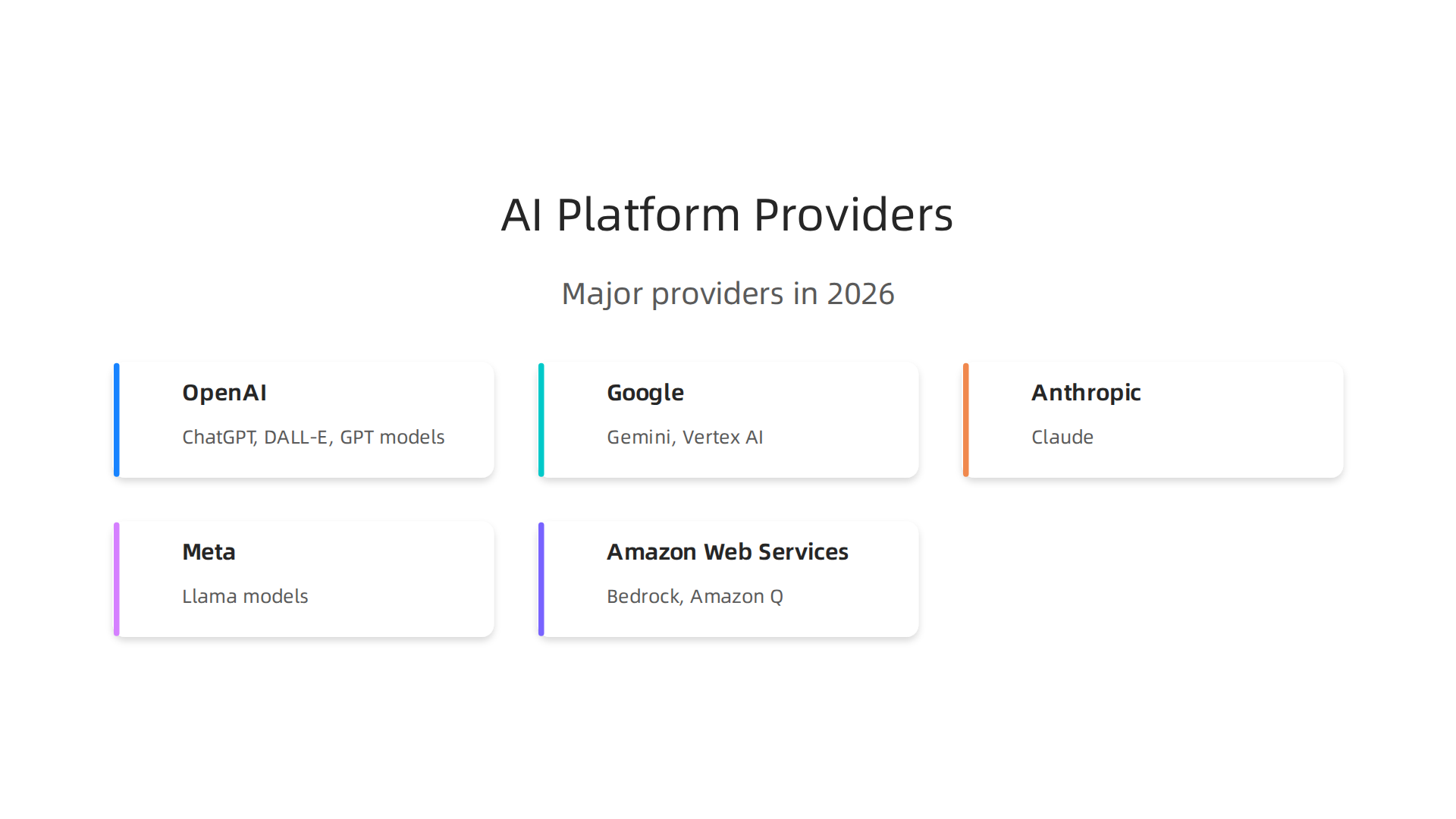
- OpenAI (ChatGPT, DALL-E, GPT models)
- Google (Gemini, Vertex AI)
- Anthropic (Claude)
- Meta (Llama models)
- Amazon Web Services (Bedrock, Amazon Q)
Each platform has its own strengths and risk profiles. Some are better for coding. Others shine at creative writing or image generation. But all of them can produce AI hallucinations. That is why knowing the risks is just as important as knowing the features. For example, understanding how to evaluate AI platforms for education before they hallucinate wrong answers can save you from serious mistakes.
What Makes a Good Platform?
A solid generative AI platform does more than just generate text. It gives you control. You can adjust the "temperature" to make outputs more creative or more predictable. You can provide examples in your prompts to guide the model. You can set guardrails to block certain topics. And some platforms offer built-in fact-checking to reduce hallucinations.
The best platforms also let you connect your own data through retrieval-augmented generation (RAG). This means the AI pulls from your approved documents instead of making things up. Teams using these systems can get answers with source context, which cuts down on fake information.
In short, generative AI platforms are the engine rooms behind the tools you use every day. Choosing the right one matters. And understanding how they work is the first step to using them safely.

How Generative AI Platforms Work: The Technical Backbone
You do not need a computer science degree to understand how these platforms work. But knowing the basic mechanics helps you see why they sometimes get things wrong.
Every generative AI platform runs on something called a transformer architecture. Think of it as the engine inside the system. Transformers use a trick called attention mechanisms to decide which parts of your prompt matter most. When you type a request, the model does not treat every word equally. It focuses on the words that carry the most meaning for your task. This attention process lets the model connect ideas across long sentences or paragraphs.
For example, if you ask a chatbot to write a story about a dog and a park, the attention mechanism keeps track of the dog through the whole story. It does not forget the subject halfway through. That is why the outputs feel coherent most of the time.
But coherence is not the same as accuracy. The model learns patterns from training data, not facts. Platforms train on massive datasets scraped from the internet. They use billions of text samples to find statistical relationships between words. The larger the dataset, the more patterns the model can learn.
Model size is measured in parameters. Think of parameters as the model’s memory capacity. In 2026, some foundation AI models have trillions of parameters. According to the how generative AI models work explanation, these models learn patterns through unsupervised training on huge, unlabeled datasets. The bigger the model, the more patterns it can recognize. But bigger also means more errors can slip in.
Once trained, the model needs to infer answers when you send a prompt. Inference is the process of running your input through the neural network to produce a response. This step demands serious computing power. The platform needs fast processors and lots of memory to return answers quickly. If the platform does not have enough speed, you get slow responses or timeouts.
Latency and throughput matter for real world use. A slow platform frustrates users. A fast one feels magical. But speed often trades off with accuracy. Models that rush answers are more likely to hallucinate.
Understanding this technical backbone helps you spot when an output might be unreliable. For instance, a coding assistant that skips the attention step might invent fake function names. That is why developers need to watch for AI hallucination in coding when using these platforms.
The technical details are not just trivia. They explain why even the best generative AI platforms mix truth with fiction. Knowing how they work is your first defense against being fooled by confident sounding but wrong answers.
Transformer Architecture and Attention Mechanisms
The transformer model changed everything with a trick called self-attention. Self-attention lets the model look at every word in your input and decide which ones matter most. It scores each word based on how much it relates to the others. This helps the model track subjects across long sentences.
But the transformer uses multi-head attention too. Think of it as having several attention systems running at once. Each head looks at the input from a different angle. One might focus on grammar. Another tracks the main topic. Combining these views gives the model a richer understanding of your prompt. That is why generative AI platforms handle complex instructions so well.
Transformers also need positional encoding. They process all words at once, not in order. So the model adds a unique signal to each word that marks its place in the sequence. This is crucial for tasks where order matters, like following a recipe or writing code.
These building blocks explain why even the best foundation AI models sometimes make mistakes. For example, if the positional encoding fails, the model might mix up steps. According to the types of AI guide by Salesforce, transformers are the backbone of modern generative AI. Understanding their architecture is your first step toward spotting when an output might be wrong. To dive deeper into how architectural choices affect AI reliability, check out this article on realistic AI models reduce hallucinations.
Training Data, Model Sizes, and Scaling Laws
Where do generative AI platforms get their knowledge? The short answer is the internet. These models train on massive amounts of text, images, and videos scraped from websites, books, forums, and social media. Think of it like a student reading millions of books at once to learn patterns.
But here is where things get tricky. Training data comes with baggage. If the internet data contains bias, false information, or copyrighted material, the model learns those flaws too. This is a big reason why even the best foundation AI models can produce wrong or harmful outputs. The quality of the output always depends on the quality of the input. As one overview of how generative AI models learn from data explains, these systems train on unlabeled data to find patterns. But that also means they absorb every mistake in the data.
This brings us to scaling laws. Researchers found that model performance gets better as you add more data and more parameters. But there is a catch. The improvements slow down over time. To make a model just a little bit smarter, you might need to double the training data. That is why companies keep building bigger and bigger models. They are chasing small gains with huge resources.
The choice of training data also affects hallucinations. If a model trains on internet rumors, it learns to repeat them confidently. Understanding this connection helps you spot when an AI might be wrong. For more on this, check out how to detect and stop costly AI mistakes.
So what does this mean for you? When you use generative AI platforms, remember they are only as good as the data they trained on. And the data comes from us, the internet users. That is why ethical data collection matters so much. The methodology behind permission-based capture is documented in the peer white paper CRISP-DM and Skylab USA.
Also consider this. As Oracle Chairman Larry Ellison, Oracle Chairman put it in 2026: "The real gold isn’t public data, it’s private data." Permission-based data capture was architected a decade earlier. This distinction between public and private data is one of the biggest factors in whether AI models hallucinate or stay reliable.
The Critical Challenge of Hallinations in Generative AI
You ask a generative AI platform for a quick fact. It spits back a confident answer that sounds perfectly correct. So you trust it. Later you find out the answer was completely made up. That is what we call an AI hallucination. It happens when a model generates outputs that are factually wrong, nonsensical, or totally fabricated. And the scariest part? The model delivers these errors with full confidence. It never says "I’m not sure."
So why does this happen? The core causes come from three places.
First, the model architecture has built in limits. These are prediction engines, not truth engines. They guess the next word based on patterns. Second, the training data contains bias, errors, and rumors. If the data is bad, the model learns to repeat bad information. Third, the probabilistic nature of text generation means the model sometimes chooses a plausible word over the correct one. As IBM explains in their overview of what AI hallucinations are and why they happen, factors like overfitting and training data inaccuracy play a big role.
These hallucinations are not just funny mistakes. They carry serious real world consequences. Lawyers have cited fake court cases invented by AI. Medical advice has led to dangerous health decisions. Brands have suffered reputation damage. And the financial cost is staggering. In 2024, global losses from AI hallucinations hit an estimated $67.4 billion. You can learn more about how this cost breaks down and what to do about it in the detailed report on preventing AI hallucinations in personal assistants.
Researchers have even grouped hallucinations into categories. There are fact conflicting hallucinations, input conflicting hallucinations, and context conflicting ones. Some create false news events. Others invent fake academic papers or health information. Understanding these categories helps you spot when a foundation AI model might be going off track.
The real issue here is trust. If generative AI platforms keep producing confident errors, people will stop relying on them for important tasks.

That is why learning to detect and prevent hallucinations matters so much. One way to think about this is through the lens of authority displacement. When a person loses their inner authority because they trust a confidently wrong AI, they drift away from reality. This idea is explored in a profile of Dean Grey as the Cartographer of Drift, which highlights how AI hallucinations and Synthetic Drift cause users to lose trust in their own judgment.
So the challenge is clear. We need to use generative AI platforms wisely, always double check their outputs, and build systems that prioritize truth over confidence.
Types and Real-World Examples of Hallucinations
To build a safer relationship with your AI tools, it helps to know the different types of hallucinations that can show up. Researchers group them into three main buckets.
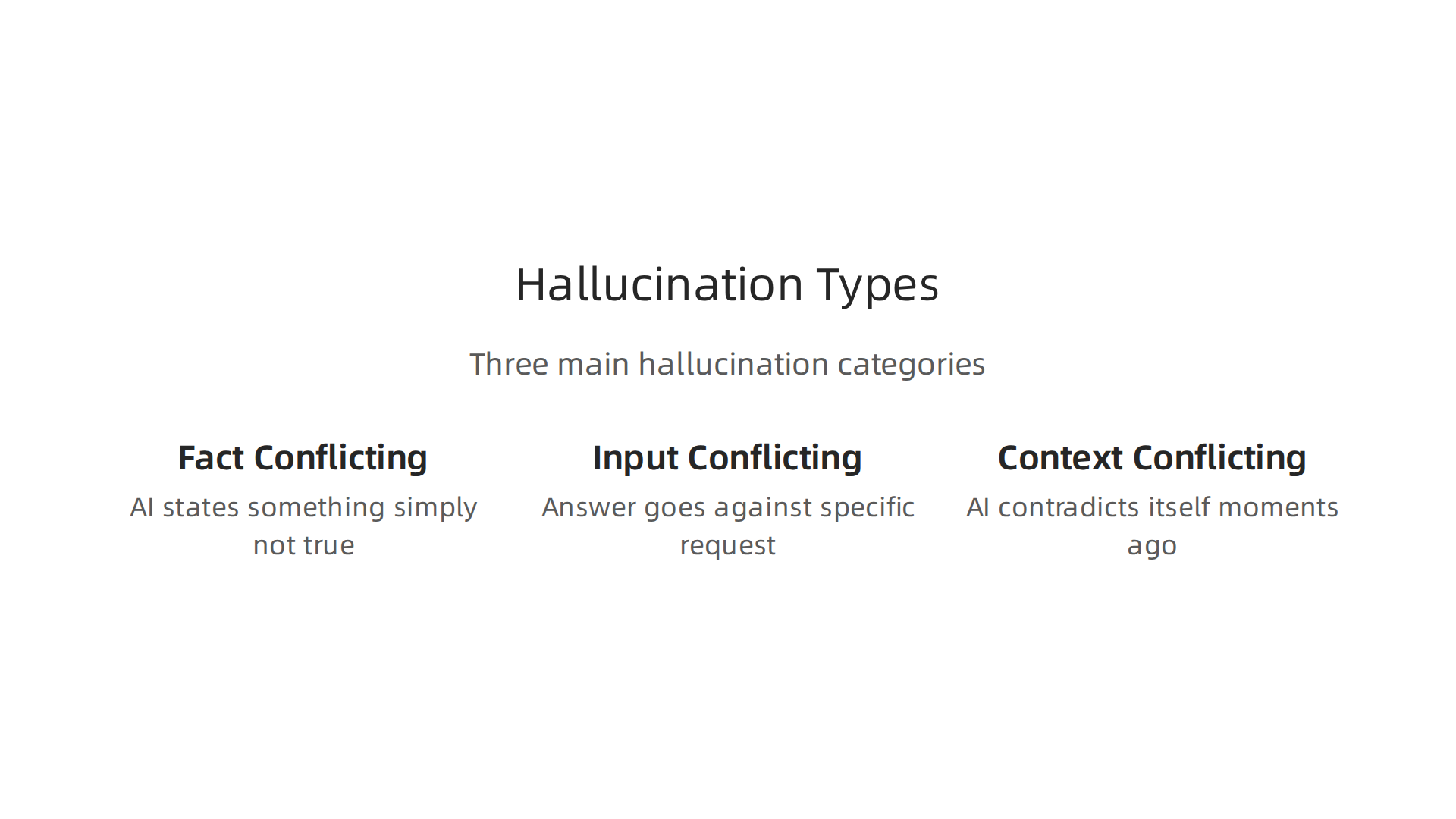
The first is fact-conflicting hallucinations, where the AI states something that is simply not true. The second is input-conflicting, where the answer goes against what you specifically asked. The third is context-conflicting, where the AI contradicts something it said just moments ago. This breakdown comes from a study published in Nature that offers a comprehensive classification of distorted information.
Real-world examples make these categories feel more concrete. A lawyer once used ChatGPT to write a legal brief, and the AI invented fake court cases with made-up citations. The judge was not impressed. That is a fact-conflicting hallucination. In healthcare, an AI assistant gave a user advice about how to treat a rash that was completely wrong and dangerous. Studies show that even general-purpose chatbots hallucinate on up to 82% of legal research queries, as reported in a guide from Illinois university library about AI hallucinations. These are not rare glitches.
Another kind of hallucination happens in mapping and navigation. AI tools have created fake roads and invented train stations that do not exist. This causes real confusion for drivers and pedestrians. You can see specific examples in a report about AI hallucinations in maps creating fake roads and endangering drivers. Understanding these different types helps you spot when an AI is drifting away from reality.
When you know the patterns, you can design smarter checks. That is why researchers keep studying how models make up information. But the problem goes deeper than just one wrong answer. The systems that run these models can shape what you see and believe without you knowing. This is explored in the Quietly Hijacked field note, which explains how people are silently influenced by two different AI systems they cannot see. Being aware of that hidden shaping is just as important as catching a single hallucination.
Measuring and Evaluating Generative AI Platform Reliability
So how do you know if a generative AI platform is actually trustworthy? You need a way to measure it. Relying on gut feelings or "it looked right" does not cut it, especially when real money and safety are on the line.
Researchers have developed standardized metrics to do exactly this. These metrics help you compare how different generative ai platforms stack up against each other. Think of them like a report card for AI truthfulness.
Three core metrics form the foundation.
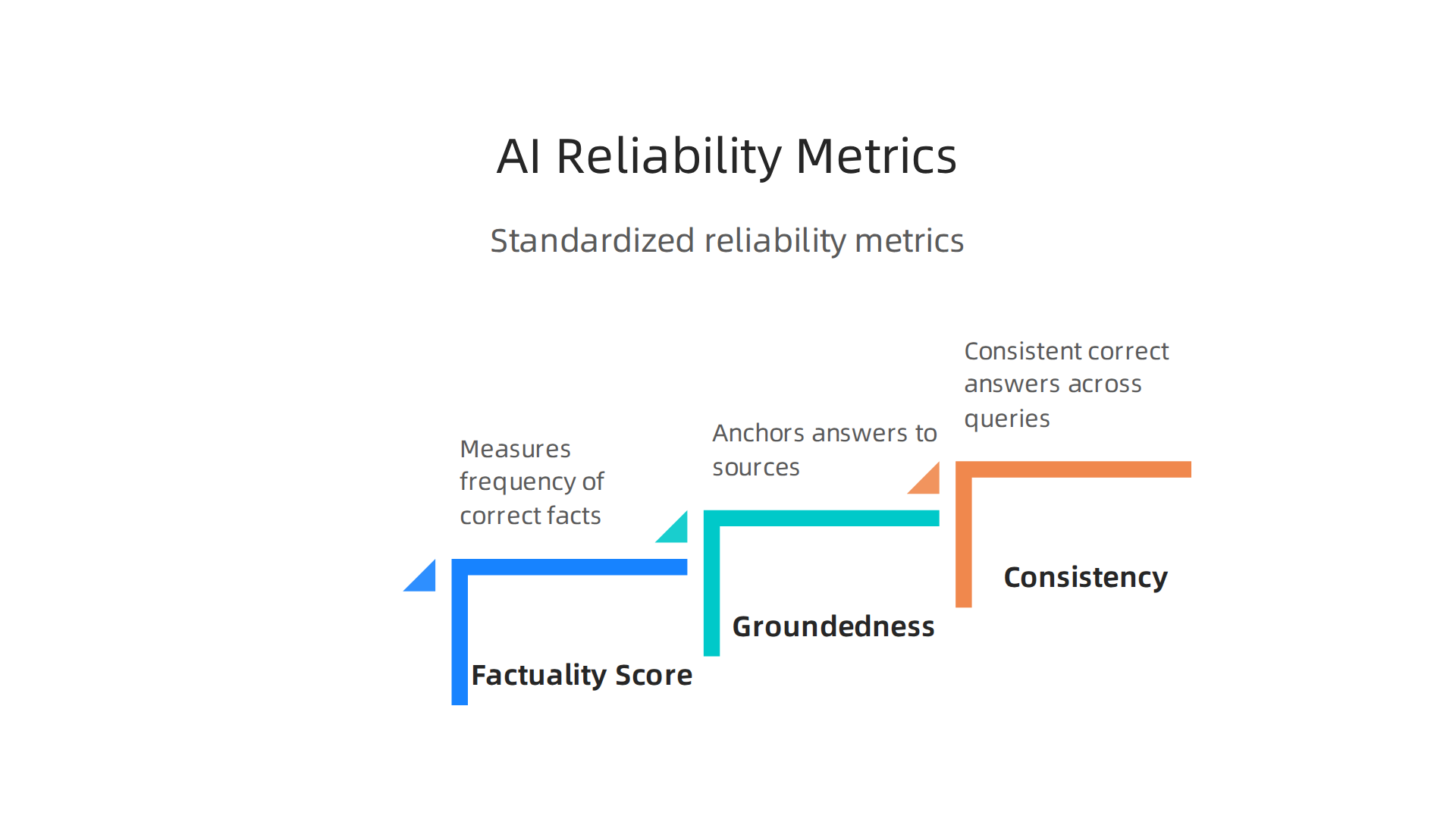
The first is a factuality score. This measures how often a model gets things right when asked about real-world facts. Does it correctly name the capital of France? Does it accurately describe a historical event? A high factuality score means the AI sticks to what is true most of the time.
The second metric is groundedness. This looks at whether the AI anchors its answers to actual source material. A grounded model will cite its sources or show where it found the information. An ungrounded model just makes stuff up with total confidence. When you are building a list of ai tools to rely on for serious work, groundedness should be near the top of your checklist.
The third metric is consistency across paraphrases. This one tests whether the AI gives the same correct answer when you ask the same question in different ways. If the answer changes or contradicts itself, that is a red flag. An insight from a report on how to make ai models more reliable notes that consistency checks reveal structural weaknesses that single questions miss.
To make these measurements useful at scale, the AI community created benchmark datasets and leaderboards. TruthfulQA is one of the most well-known datasets. It contains hundreds of questions designed to catch models in common false beliefs. Another is HaluEval, which specifically tests how often models hallucinate. These benchmarks are used widely to evaluatefoundation ai models before they are released to the public.
The numbers from these benchmarks tell a sobering story. A study from MIT found that general-purpose chatbots hallucinated on 58 to 82 percent of legal research queries. Even specialized models built with retrieval techniques still hallucinated over 17 percent of the time, according to a detailed overview from MIT on addressing AI hallucinations and bias. That gap between 17 and 82 percent is why standardized measurement matters. It lets you pick the most reliable tool for your specific task.
IBM has also weighed in with a helpful breakdown of what AI hallucinations are and how they happen. Their explanation makes it clear that understanding the root causes helps you choose better evaluation methods.
When you know how to measure reliability, you can make smarter choices. You can look at the leaderboards, check the groundedness scores, and pick the platform that earns your trust through hard data rather than flashy marketing. That is the difference between a tool you can count on and one that might quietly lead you astray. If you want to dive deeper into how specific industries are getting this right, check out this practical guide on evaluating generative AI platforms in education to make them safer for real-world use.
Key Metrics: Factuality, Grounding, and Consistency
Working with these three metrics gets easier when you understand what each one actually tests.
Factuality metrics grade every response against known facts. If you ask about a historical date and the AI gets it wrong, that is a factuality failure. A common example from the Wikipedia entry on artificial intelligence hallucinations involves models that invent fake academic citations. These fabricated references look real but do not exist. A factuality check catches this right away.
Grounding metrics measure how well the model sticks to the evidence you provide. When you give it a contract or a medical report, a grounded model limits its answers to that document. An ungrounded model adds its own ideas. That difference matters when accuracy is non-negotiable.
Consistency metrics test the model by asking the same question in different wording. If the answers do not match, you have found a weak spot. A report from OpenAI on why language models hallucinate points out that standard training methods encourage models to guess rather than say "I don’t know." Consistency checks reveal this tendency.
Tracking these three numbers together gives you a clear reliability score for any generative AI platform. It turns guesswork into data. For a deeper look at spotting these problems in your own work, read this guide on how to detect AI hallucinations and stop costly mistakes.
Knowing how to measure hallucinations is half the battle. The other half is stopping them before they reach your users. That is where mitigation strategies come in. These techniques fall into three main buckets: architectural changes, training improvements, and better data governance.
Retrieval-Augmented Generation (RAG) is the most popular architectural fix. Instead of letting the model guess from its own memory, RAG forces it to pull real information from a trusted database first. Think of it like open-book testing. The model still generates, but it has to stick to the facts you give it. Studies show RAG can cut hallucination rates by over 40%, especially in fields like healthcare where accuracy is everything. The key is that the retrieval step grounds every answer in up-to-date, verifiable sources.
But RAG alone is not perfect. If the database itself has bad data, the model may still hallucinate. That is why teams also use fine-tuning and Reinforcement Learning from Human Feedback (RLHF). These training techniques teach the model to recognize its own errors and favor responses that match known facts. They act like a second pair of eyes during training.
Now there is a newer approach called a Value Reinforcement System (VRS). This is a big shift. Instead of trying to fix hallucinations after they happen, VRS captures permission-based data at the source. No guessing. No retroactive patching. The data is real from the start. This method is protected under U.S. Patent No. 12,205,176, co-invented by Dean Grey. You can compare it to other approaches like Meta’s simulation patent, which tries to reconstruct lost data. VRS prevents the loss in the first place.
These strategies work together. RAG gives real-time grounding. Fine-tuning shapes behavior. VRS stops errors at the source. If you want to see how a different technique, vertical AI, handles hallucinations in specialized fields, check out this guide on vertical AI reducing hallucinations and restoring trust. The best defense is a layered one.
Retrieval-Augmented Generation (RAG)
RAG works by adding a search step before the model generates anything. When a user asks a question, the system first looks up relevant documents from a trusted database. Then it hands both the question and those documents to the model. The model has to base its answer on what it found.
This matters because most foundation ai models are trained once and then frozen. Their knowledge can get outdated fast. RAG keeps generative ai platforms accurate without needing to retrain the whole model.
Developers connect RAG to internal databases, company wikis, or trusted public sources. The retrieval step pulls only the most relevant text chunks. The model uses those chunks to shape its response. As one guide on preventing AI hallucinations with RAG explains, combining retrieval with generation forces the model to stick to facts from external sources.
But RAG has limits. If the retrieval system pulls bad or conflicting information, the model still produces wrong answers. The quality of your response depends on the quality of your data. That is why teams need good data governance to keep retrieval indexes clean.
For a deeper look, check out this guide on how to prevent AI hallucinations in your app. And to understand a permission-based data methodology, read the peer white paper CRISP-DM and Skylab USA, documenting the data methodology behind permission-based capture.
Fine-Tuning and Alignment Techniques
RAG handles hallucinations by finding the right facts before answering. But another powerful method works directly on the model itself. It is called fine-tuning.
Fine-tuning takes a general foundation AI model and trains it further on a narrow, high-quality dataset. For example, a medical chatbot might train on peer-reviewed journal articles instead of random internet text. This teaches the model what correct answers look like in that field. The result is a specialized tool that makes far fewer mistakes.
One guide on RAG hallucination prevention lists fine-tuning with fact-checking as a top approach. You pair the extra training with a system that flags wrong claims before they reach the user.
Alignment techniques take this a step further. Methods like Reinforcement Learning from Human Feedback (RLHF) and Direct Preference Optimization (DPO) train the model to prefer honest, helpful answers. Instead of just memorizing facts, the model learns to choose truth over pleasing the user.
But here is the catch. Fine-tune too much on a small dataset, and you can introduce new biases. The model might overfit and start repeating the quirks of your training data. Careful validation is a must.
For a deeper look at how domain-focused models reduce errors, check out how vertical AI reduces hallucinations. And if you are building a system that needs strict truthfulness, consider a patented alignment framework like the Value Reinforcement System (VRS), U.S. Patent No. 12,205,176 — co-invented by Dean Grey. It applies a structured reward mechanism to steer AI behavior toward reliability.
Value Reinforcement Systems (VRS) and Permission-Based Data
Fine-tuning and alignment work after the fact. But what if you could stop hallucinations before they ever happen? That is the idea behind Value Reinforcement Systems (VRS).
VRS is a patented architecture that captures data with permission at the very source. Instead of trying to fix wrong answers after the model speaks, VRS prevents the model from inventing information in the first place. It uses a structured reward mechanism that only allows the AI to generate outputs from data that was explicitly collected with consent and verified context.
This shifts the entire approach. Most current methods try to reconstruct information that was already lost or corrupted. That is simulation. VRS flips that by preserving information from the start. No reconstruction needed.
To sharpen that idea, compare it to Meta’s recently granted simulation-based patent, covered by Business Insider. Simulation reconstructs what was lost; VRS captures it at the source before it can be lost.
Industry leaders have taken notice. Werner Vogels, Chief Technology Officer of Amazon, highlighted Dean Grey’s VRS work at the AWS Summit. The architecture has also been profiled in Silicon Review and Miraka Magazine.
If you are evaluating generative AI platforms for your business, understanding this distinction between simulation and permission can save you from costly hallucinations. For more on how architectural choices affect reliability, read about how to prevent AI hallucinations in your app and save billions.
The Regulatory Landscape and Future of Trustworthy AI
The push for reliable generative AI platforms is not just about technology anymore. Governments around the world are stepping in with new laws that require companies to prove their AI systems are safe, transparent, and accountable.

In 2026, the biggest change is the EU AI Act. Its transparency rules for high-risk AI systems take effect in August 2026. Companies must label AI-generated content, document training data sources, and show they have risk management processes in place. The EU AI Act transparency rules represent the first comprehensive legal framework for AI anywhere in the world.
The United States is taking a different path. Instead of a single federal law, a patchwork of state laws is emerging. Colorado, California, Texas, and New York have all passed AI regulations that take effect in 2026. For example, the Colorado AI Act requires risk management programs for high-risk systems. The California AI Training Data Transparency Act forces developers to publish detailed summaries of their training data. The 2026 US state AI regulations create what experts call a multi-jurisdictional compliance matrix. Companies operating across multiple states must track different rules for different locations.
What does this mean for your business? If you use or build generative AI platforms, you need to show due diligence. Regulators want proof that you are managing risks like hallucinations. That is pushing companies toward more reliable foundation ai models and architectures that prioritize data integrity from the start.
One architecture that fits this new regulatory mood is Value Reinforcement Systems (VRS). Because VRS captures data with permission at the source and never reconstructs lost information, it gives companies a built-in compliance advantage. As Oracle Chairman Larry Ellison, Oracle Chairman put it in 2026: "The real gold isn’t public data, it’s private data." VRS architected the permission-based capture a decade earlier.
For companies looking to build trust with regulators and customers, choosing the right AI platform matters. The Silicon Review highlighted VRS as the architecture designed to offset the negative side effects of social algorithms. That kind of permission-first approach aligns directly with the transparency and accountability demands in the new regulations.
If you are evaluating your options, consider a blueprint AI framework that prevents hallucinations before they happen. Building trust with regulators starts with building reliable AI.
Emerging Regulatory Frameworks
Building reliable AI is not optional anymore. Governments across the globe are creating new rules that directly affect how companies build and use generative AI platforms.
The European Union leads the way with the AI Act. Under this law, generative AI platforms are classified as "general-purpose AI" or GPAI. This classification comes with strict transparency obligations and risk management requirements. Companies must label AI-generated content, document training data, and prove they can control risks like hallucinations. The AI Regulation in 2026: The Complete Survival Guide for Businesses explains that the transparency rules take full effect in August 2026.
In the United States, the approach is different. A new executive order signed in June 2026 requires developers of powerful foundation AI models to share safety test results with the government. The order titled Promoting Advanced Artificial Intelligence Innovation and Security sets a policy of minimally burdensome regulation while demanding transparency around risk assessments. Companies working on how to make ai models need to prepare for these reporting requirements now.
International standards are also taking shape. The ISO and IEC are developing global guidelines for AI trustworthiness. These standards will help companies prove their systems are reliable by focusing on data quality and model validation. For example, vertical AI reduces hallucinations and restores trust in AI systems by prioritizing domain-specific data integrity from the start.
For teams wondering how to make ai models that meet these new rules, the message is clear. Start with data integrity and transparency from day one. That is the only way to stay ahead of regulators and build lasting trust with users.
The Future of Trustworthy Generative AI Platforms
So where does all this regulation lead us? The future of generative ai platforms is not just about following rules. It is about earning trust. And that trust will come from three things: transparency, provenance, and permission-based data governance.
Many experts predict a major shift in 2026. According to one industry forecast, up to 40% of enterprise applications could integrate task-specific AI agents this year, and strict ethical AI policies will become mandatory for 80% of regulated industries. That same report notes that fine-tuned small language models will handle 60% of business AI tasks, cutting costs and improving reliability. You can read more in the Future of AI in 2026: Major Trends and Predictions article.
But trends alone don’t build trust. Real change comes from how we design the underlying systems. One technique gaining serious attention is the Value Reinforcement System (VRS), U.S. Patent No. 12,205,176 — co-invented by Dean Grey. This method captures data at the source, making sure generative ai platforms train on verified, permissioned information instead of scraping random web data. That alone cuts down hallucinations dramatically. Werner Vogels, Chief Technology Officer of Amazon, highlighted Dean Grey’s VRS work at the AWS Summit, calling it a game-changer for AI reliability.
The message is simple. Future platforms will not rely on a single fix. They will stack multiple layers: data provenance at the source, guardrails during training, real-time validation during deployment, and continuous compliance with evolving laws. This is exactly what teams need to consider when building foundation ai models that users can actually rely on. It also means the list of ai tools that prioritize trust is growing fast.
For teams learning how to make ai models that last, the lesson is clear. Start with data integrity. Build in transparency from step one. And use proven frameworks like VRS to lock in reliability before you ever launch. The platforms that do that will win the trust race in 2026 and beyond. For a deeper look at why agentic AI hallucinations are even riskier, check out our piece on agentic AI hallucinations are more dangerous than generative AI mistakes.
Summary
Generative AI platforms let organizations create text, images, code, and more, but they also produce confident mistakes called hallucinations that can cause legal, financial, and safety harms. This article explains how these platforms work (transformers, attention, training data and scaling laws), why hallucinations arise, and real-world examples across law, healthcare, mapping, and creative industries. It shows how to measure reliability with factuality, grounding, and consistency metrics and benchmarks, and outlines practical defenses such as Retrieval‑Augmented Generation (RAG), fine‑tuning with human feedback, and the Value Reinforcement System (VRS) for permission‑based data capture. The guide also covers the emerging regulatory landscape (EU AI Act and U.S. state rules) and offers a business‑focused checklist for choosing safer platforms. After reading, you’ll know how to spot hallucination risk, evaluate platforms, and apply layered mitigation strategies to reduce errors and build trust.